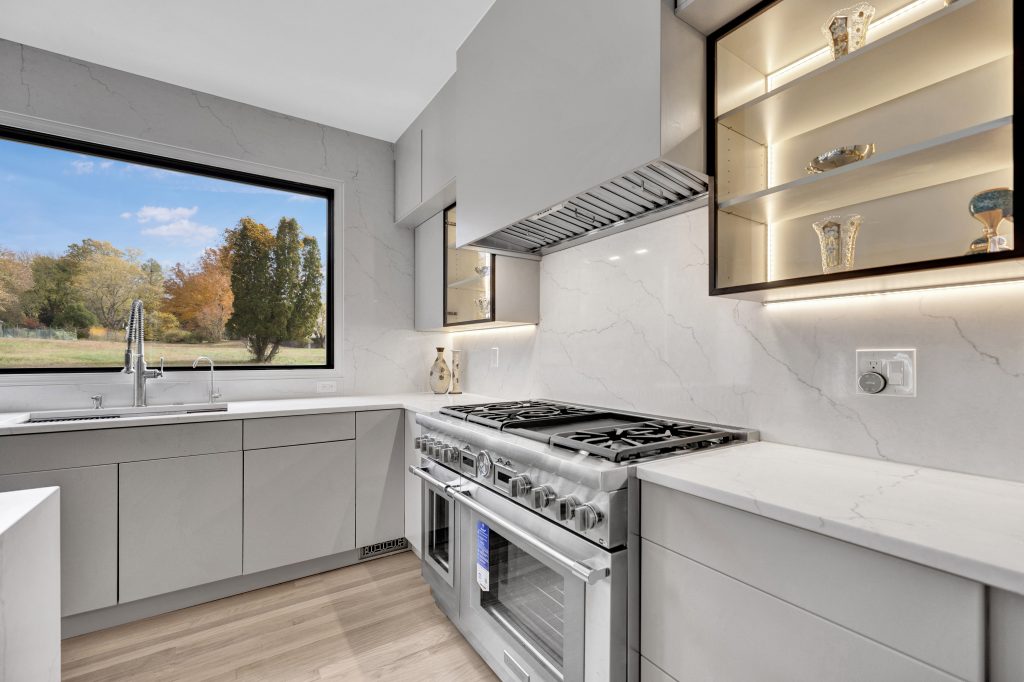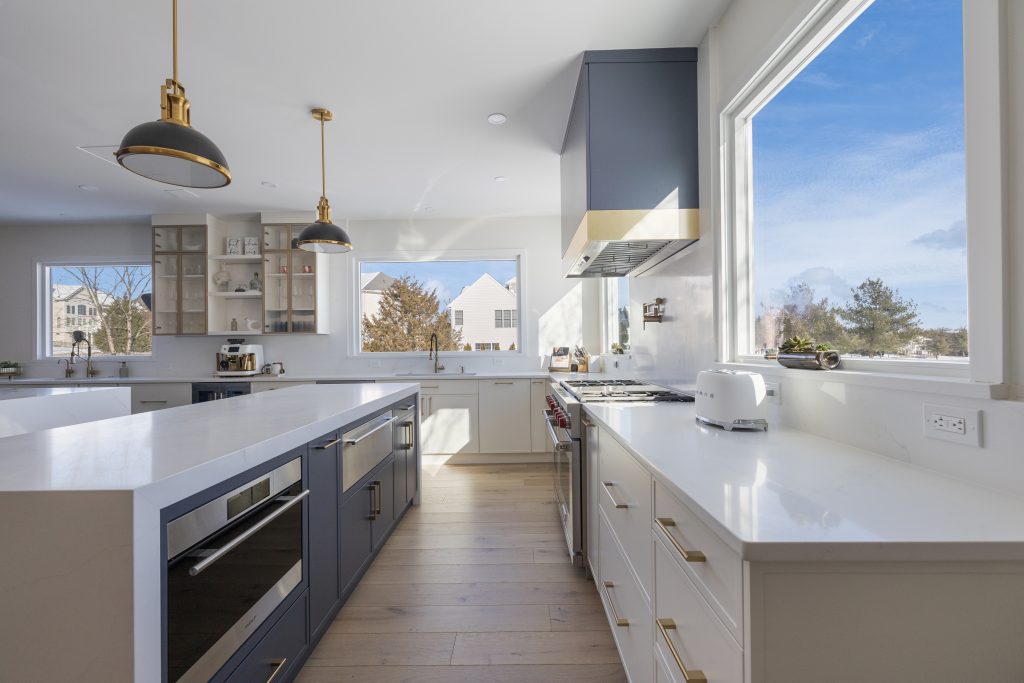

Two tone kitchen cabinets use two finishes in one kitchen: most often a light color on the walls with a darker island, dark lower cabinets under light upper cabinets, or paint beside natural wood. Done well, the second finish gives a kitchen depth and a focal point that a single color cannot, and when both finishes come from the same cabinet line it costs little or nothing more. The rules are short. One color leads, the darker one sits low, the undertones agree, and each color appears at least twice. This guide shows 24 color combinations, the four ways to divide two colors, ten rules for choosing them, what to do with the counters, the hardware and the floor, what two tone cabinets cost in Northern Virginia in 2026, and the mistakes to avoid. The photographs are kitchens EA Home Design built in Northern Virginia.
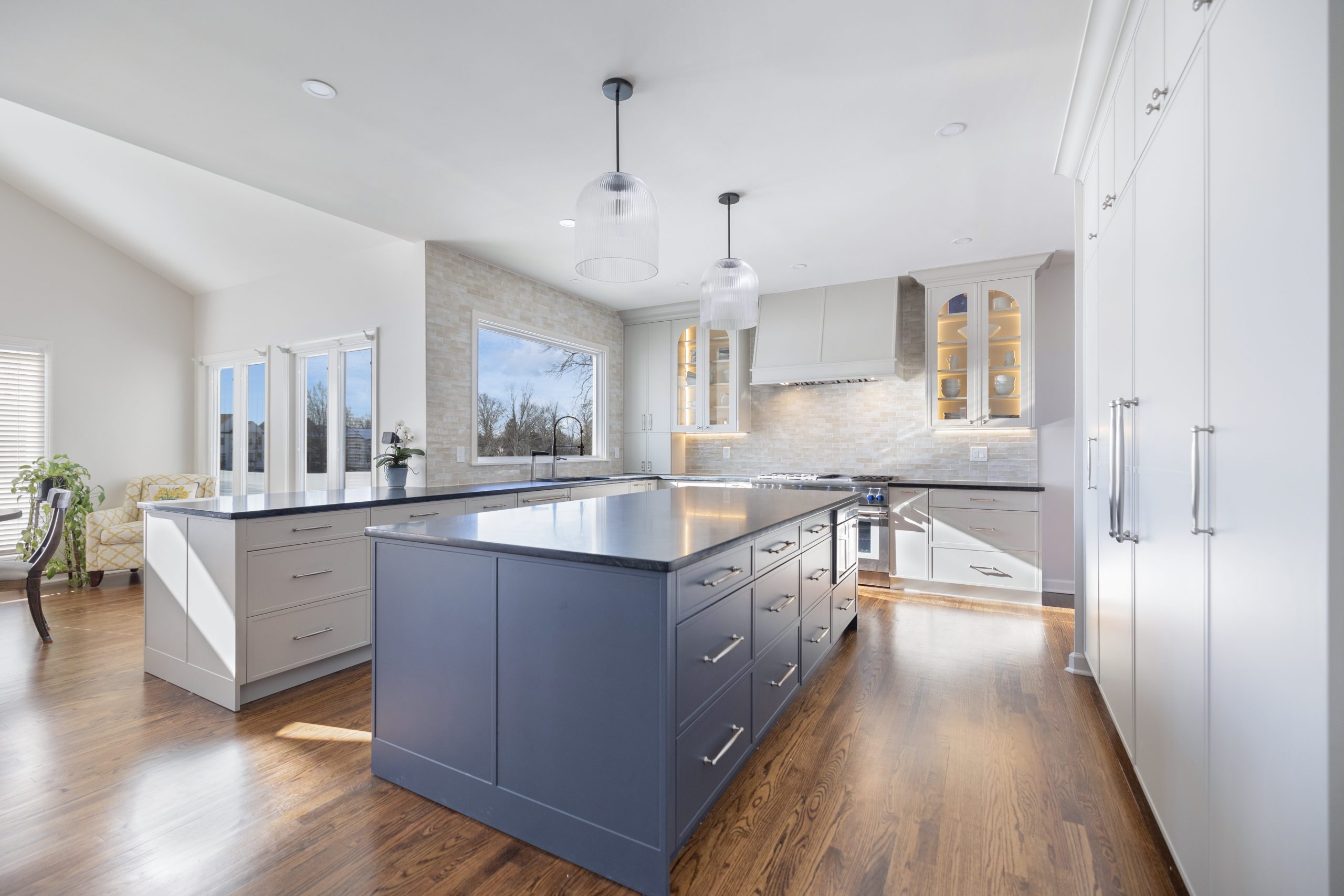
Planning a two tone kitchen?
We show both colors on your own layout in 3D before a single door is ordered. See our kitchen remodeling in Northern Virginia page.
What Are Two Tone Kitchen Cabinets?
A two tone kitchen has cabinets in two finishes, each used on a defined part of the room. The two finishes can be two paint colors, a paint and a stained wood, or two woods. What makes it two tone and not simply mixed is that each finish has a job: one covers most of the cabinets and sets the mood, and the other is given one clear block, such as the island, the base cabinets or a tall wall.
People choose two tones for practical reasons as much as for looks. An all white kitchen can feel flat, and an all dark one can feel heavy. A darker island hides the scuffs of stools and shoes. Dark base cabinets hide what white ones show at knee height. In an open plan, a second finish marks where the kitchen ends and the family room begins without a wall. And an island in a different finish reads as a piece of furniture, which is how islands began.
Two tone, two toned and two color cabinets mean the same thing. A tuxedo kitchen is the black and white version. Three finishes can work, but only when the third is a wood or a metal used in a small amount; three paint colors almost never do.
Two Tone Kitchen Cabinets at a Glance
| Question | Short answer |
|---|---|
| Most common split | Light cabinets on the walls with a darker or wood island |
| Second most common | Dark lower cabinets with light upper cabinets |
| Usual proportion | About two thirds in the leading color and one third in the second |
| Where the dark color goes | Low or in one block: the island, the base cabinets or one tall wall |
| What ties the two together | One countertop, one door style and one hardware finish |
| Extra cost in new cabinets | Little or none when both finishes are standard in the same cabinet line |
| Least expensive route | Painting the island or the lower cabinets of a sound kitchen |
| Pairings we have built most often | White with a navy or blue island, white with a wood island, white with black |
| Suits | Kitchens with an island, open plans, tall rooms, and small kitchens that need the upper cabinets to recede |
| Main risks | Three or more finishes, undertones that clash, a second color that appears only once |
The Four Ways to Divide Two Colors
Before choosing colors, choose where the line between them falls. There are four places it can go, and each gives a different kitchen.
| The split | Where the second finish goes | What it does | Best for |
|---|---|---|---|
| Island and perimeter | The island only | Makes the island the focal point; the easiest split to change later | Any kitchen with an island |
| Lowers and uppers | Every base cabinet | Grounds the room and lets the wall cabinets fade into the walls | Kitchens with no island, galley and small kitchens |
| A wall or a tall block | The refrigerator wall, a pantry wall or a bar | Frames the room and hides tall appliances in one dark mass | Large kitchens and open plans |
| Paint and wood | An island, the lowers, a hood or shelves in wood | Adds warmth and grain to a painted kitchen | White kitchens that feel cold |
A different color island
This is the split most people mean by two tone, and it is the safest. The island stands free, so the second color begins and ends on its own with no awkward joint where one color meets the other. It is also the one piece that can be repainted in a weekend ten years on. If you are unsure about color, put it on the island and nowhere else. Our kitchen island guide covers the sizes and clearances, and the kitchen island cost guide prices the island as a project.
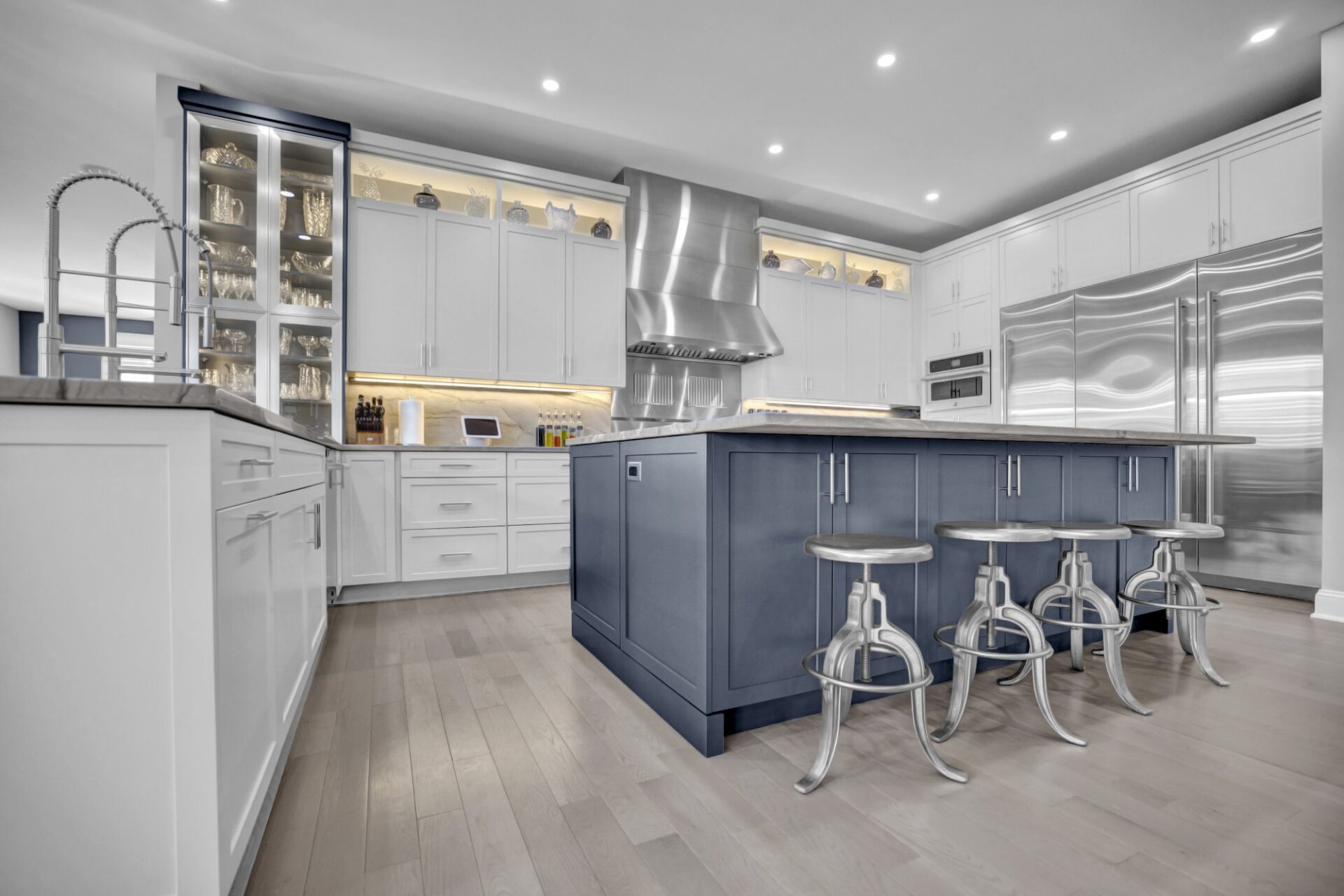
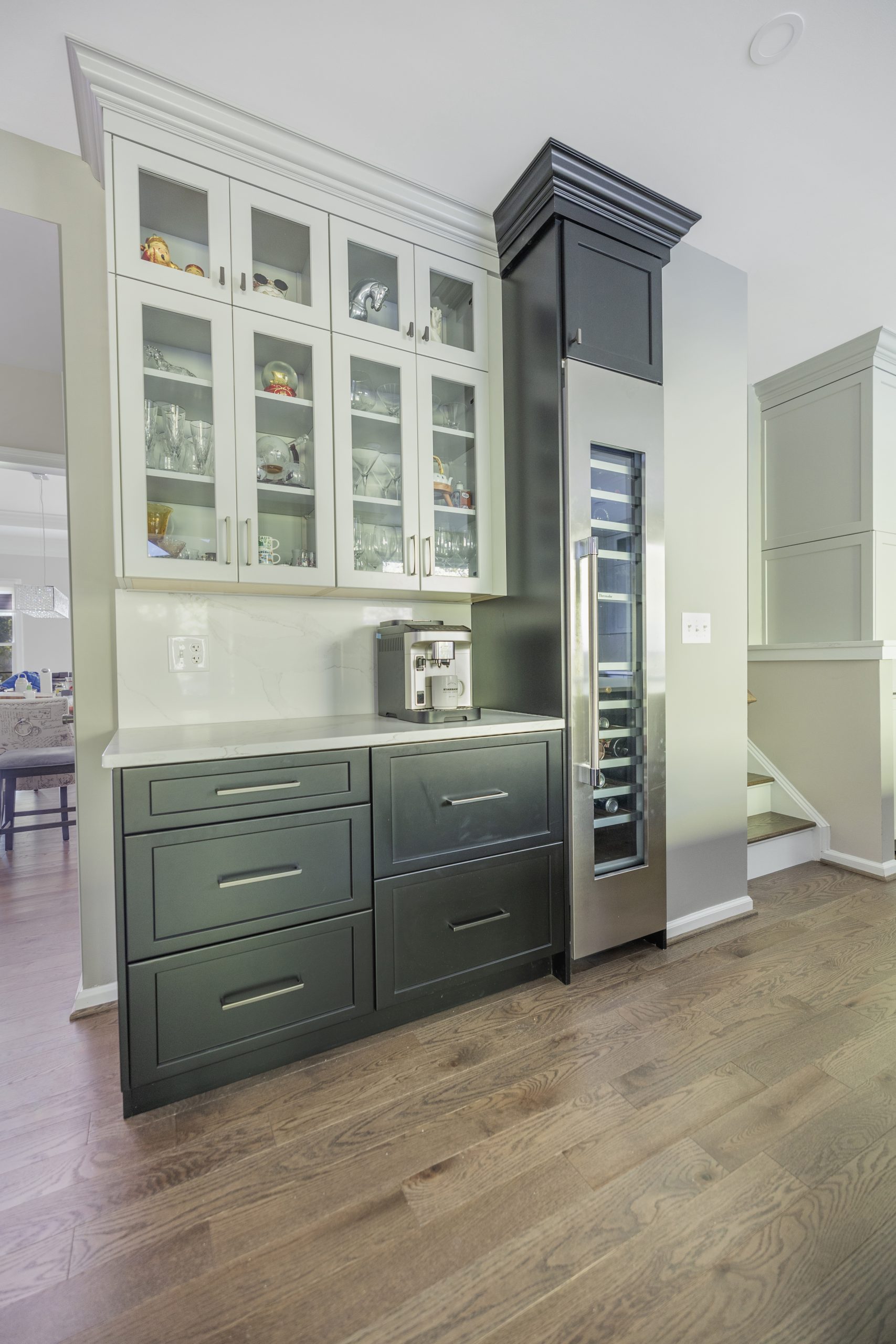
Dark lower cabinets, light upper cabinets
Here every base cabinet is the darker finish and every wall cabinet is the lighter one. The dark band at the floor grounds the room, and the light band above makes the ceiling feel higher because the wall cabinets merge with the walls. It works without an island, which makes it the two tone answer for galley and U shaped kitchens. The countertop sits between the two colors and has to suit both, so it is chosen at the same time as the paint.
One wall or one tall block in the second color
In a large kitchen the second finish can be a whole wall: the tall cabinets around the refrigerator and the ovens, a pantry wall, or a bar. The tall, dark mass hides the bulk of the appliances and gives the room an anchor, and the rest of the kitchen stays light. The color must stop at a natural break, an inside corner or the end of the run, never partway along a wall.

Paint and wood
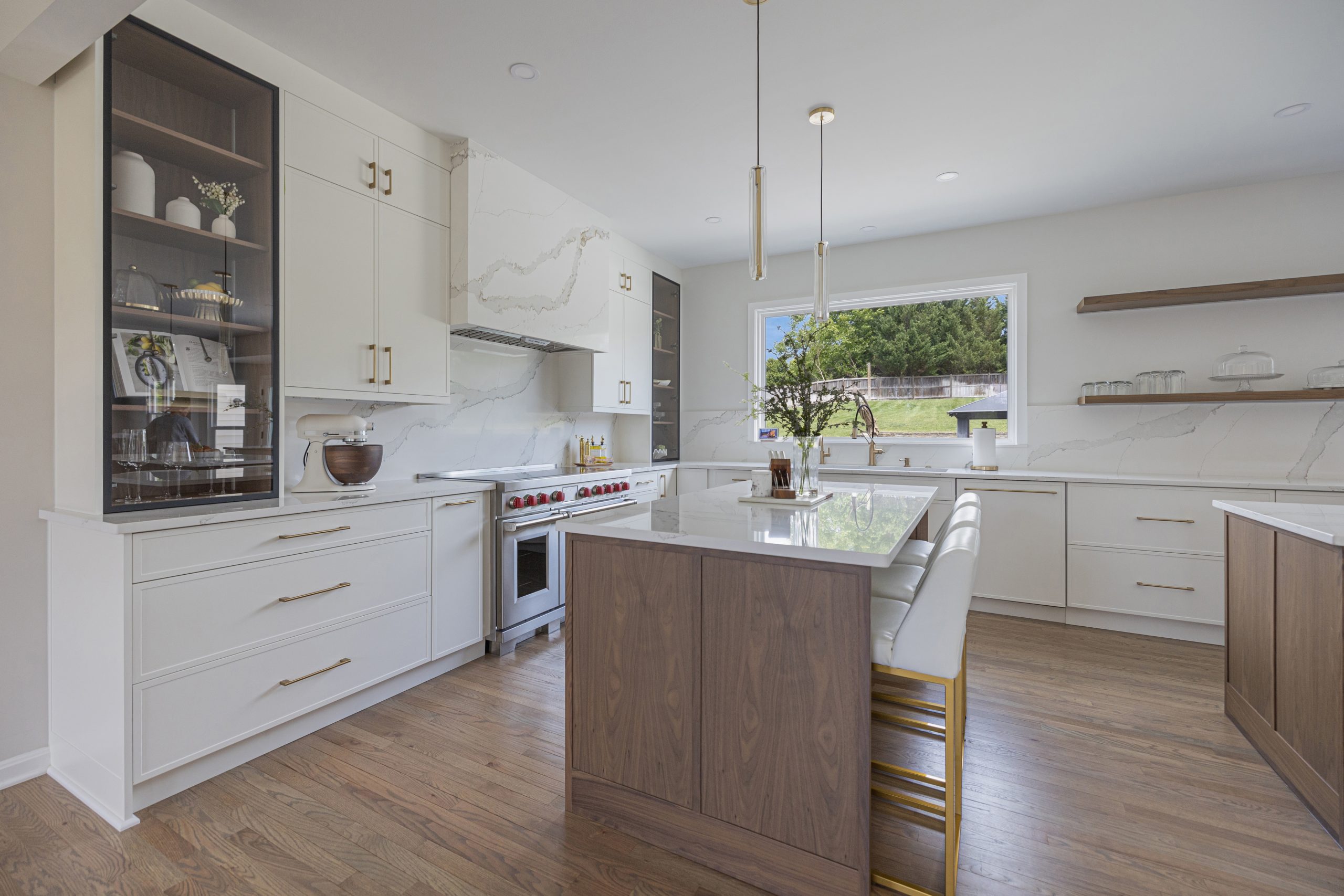
Wood is a tone. A white kitchen with a walnut or white oak island is a two tone kitchen, and it is the direction two tone kitchens have taken in 2026, because it warms a painted room without adding a color that might date. The wood can be the island, the lower cabinets, the range hood or a run of open shelves. One species is enough; two woods in one kitchen compete unless they are far apart in color.
24 Two Tone Kitchen Cabinet Color Combinations
These are the combinations that work, grouped by the leading color. Each names where the second finish goes and what it suits. Where we have built the combination, the photograph shows it.
White cabinets with a colored island
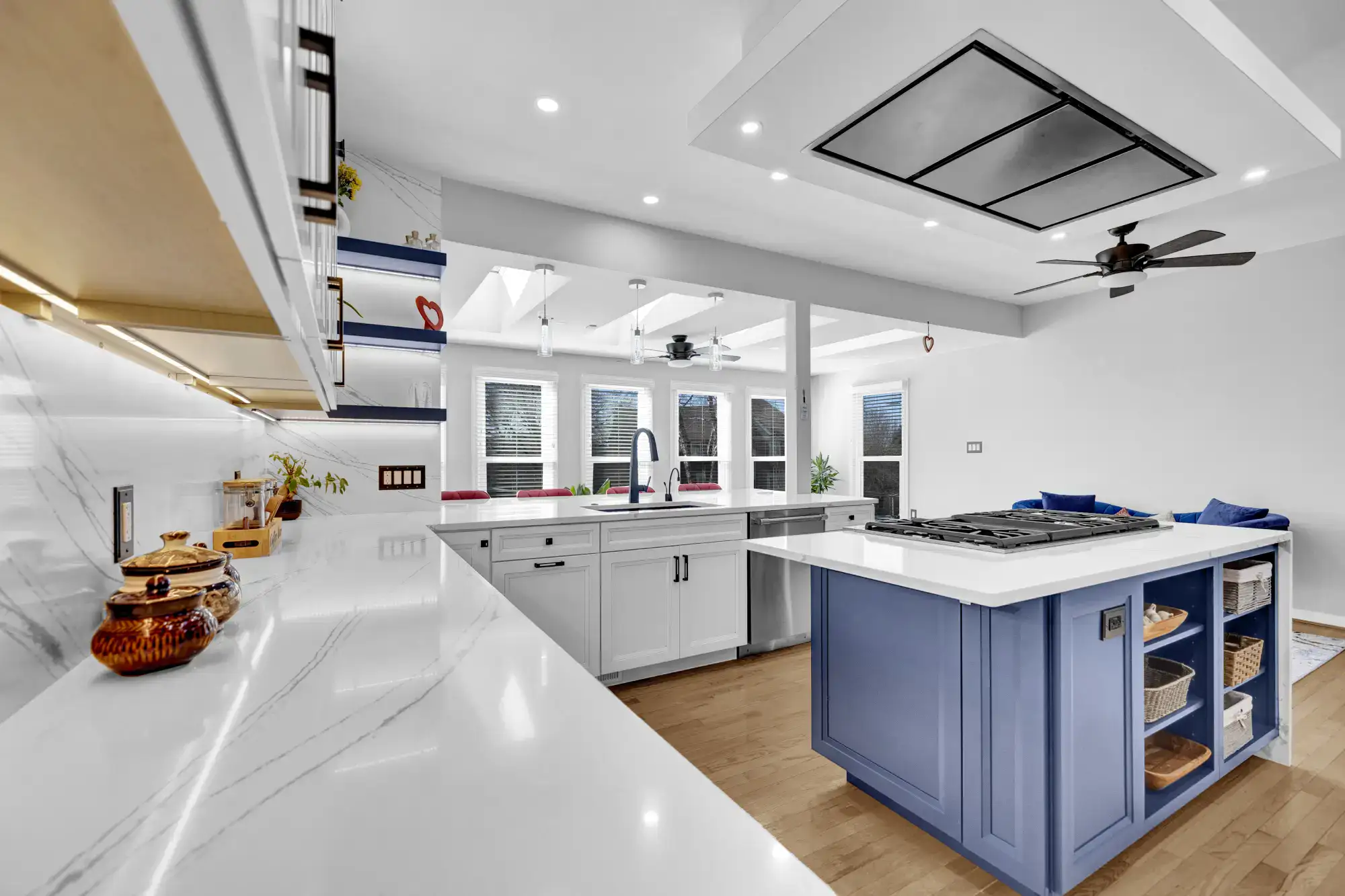
1. White with a navy blue island. The two tone kitchen we have built most often, shown at the top of this guide. Navy is dark enough to anchor the room and still reads as a color. It suits brass, nickel and black hardware alike, and it sits well beside the oak floors most houses here already have.
2. White with a slate blue island. Slate blue has gray in it, so it is calmer than navy and suits a kitchen with gray in the counters or the floor. It is a good choice when navy feels too formal.
3. White with a black island. The strongest contrast and the simplest. A black island under a white top needs something black elsewhere in the room, such as the cabinet pulls, the faucet or the window frames, or it looks dropped in.
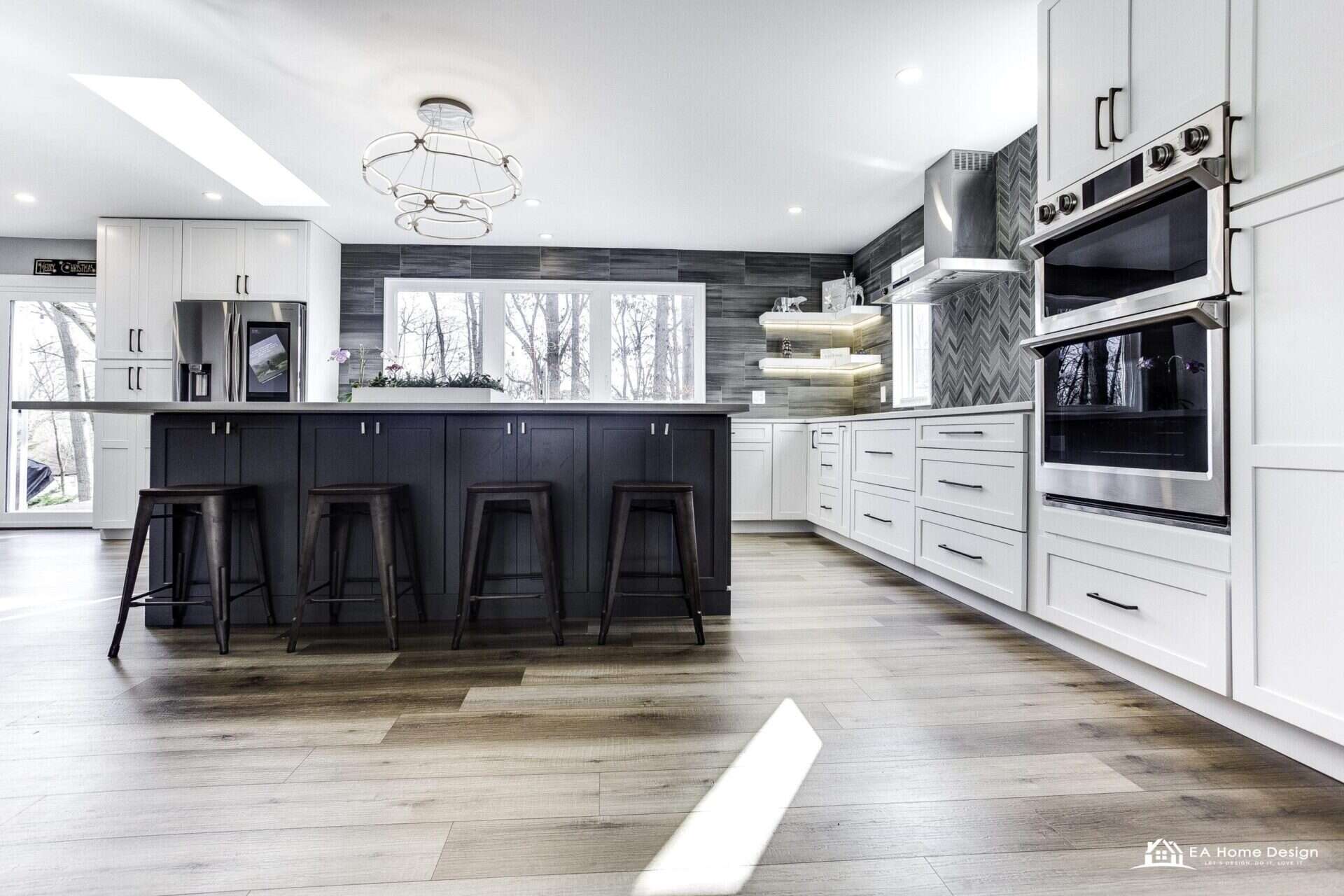
4. White with a charcoal island. Charcoal gives nearly the depth of black with less severity, and it hides dust better. It is the choice for a white kitchen with stainless appliances and a gray veined counter.
5. White with a sage green island. Sage is the soft green that has replaced gray as the gentle color of the decade. On an island it brings the garden in without committing the whole kitchen. It pairs with brass and with unlacquered or aged finishes.
6. White with a deep green island. A dark forest or pewter green is the alternative to navy for people who want something less common. It is handsome with walnut stools, marble look counters and brass.
7. White with a strong blue island. A brighter blue belongs on a small island, where it acts as an accent. The larger the island, the quieter the color should be.
White cabinets with wood
8. White with a walnut island. Walnut is the dark, warm wood. Against white cabinets and a white stone top it gives the contrast of a dark painted island with the grain and warmth of furniture. It suits brass and bronze.
9. White with a white oak island. White oak is the light, quiet wood, usually rift cut so the grain runs straight. The contrast with white is low, which makes a calm, Scandinavian kind of kitchen. Choose a warm white for the cabinets; a cold white makes oak look yellow.
10. White upper cabinets over white oak lowers. The same pairing divided the other way. The oak takes the wear below and the white keeps the wall light. It needs a plain counter, because the wood grain is already a pattern.
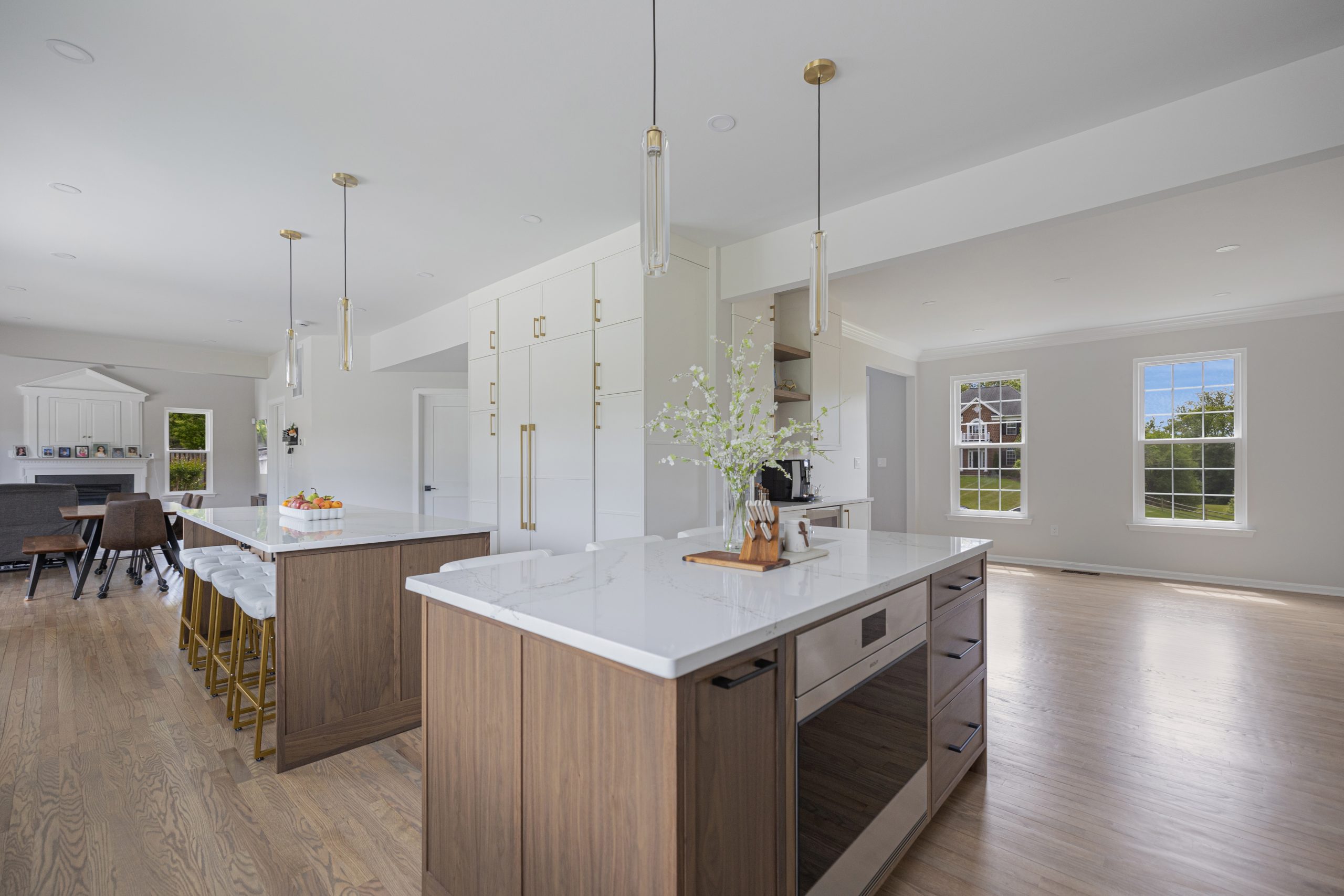
11. Two wood islands in a white kitchen. In a large open plan, a working island and a seating island in the same wood, with every wall cabinet in white.
Warm neutrals
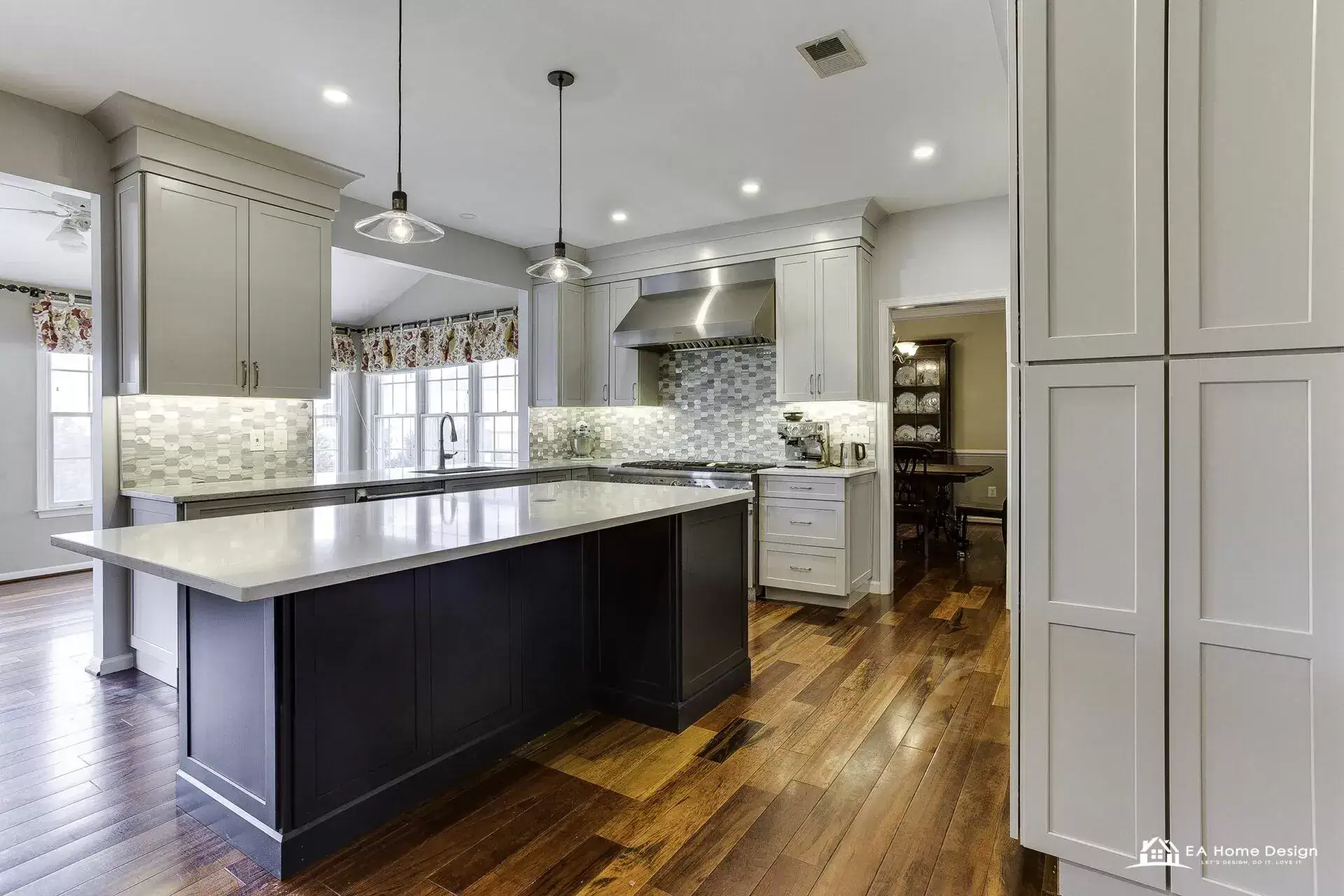
12. Greige with a charcoal island. For a kitchen that should not be white. Greige on the walls and charcoal on the island is a low contrast pairing that suits traditional houses and hardwood floors with red or brown in them.
13. Cream with a wood island. Cream cabinets have returned with warm kitchens. With a walnut or stained oak island and an aged brass faucet, the room reads as settled, not new.
14. Mushroom or taupe with warm white. Mushroom and taupe are the gray browns that replaced cool gray. Use them on the lower cabinets or the island with warm white above. They are forgiving colors: they hide dust, fingerprints and the mark of a dog.
15. Cream with sage green. Two soft colors close in value. Cream uppers and sage lowers, or a sage island in a cream kitchen, with a honed counter and unlacquered brass. This is the pairing for an older house.
Dark and light
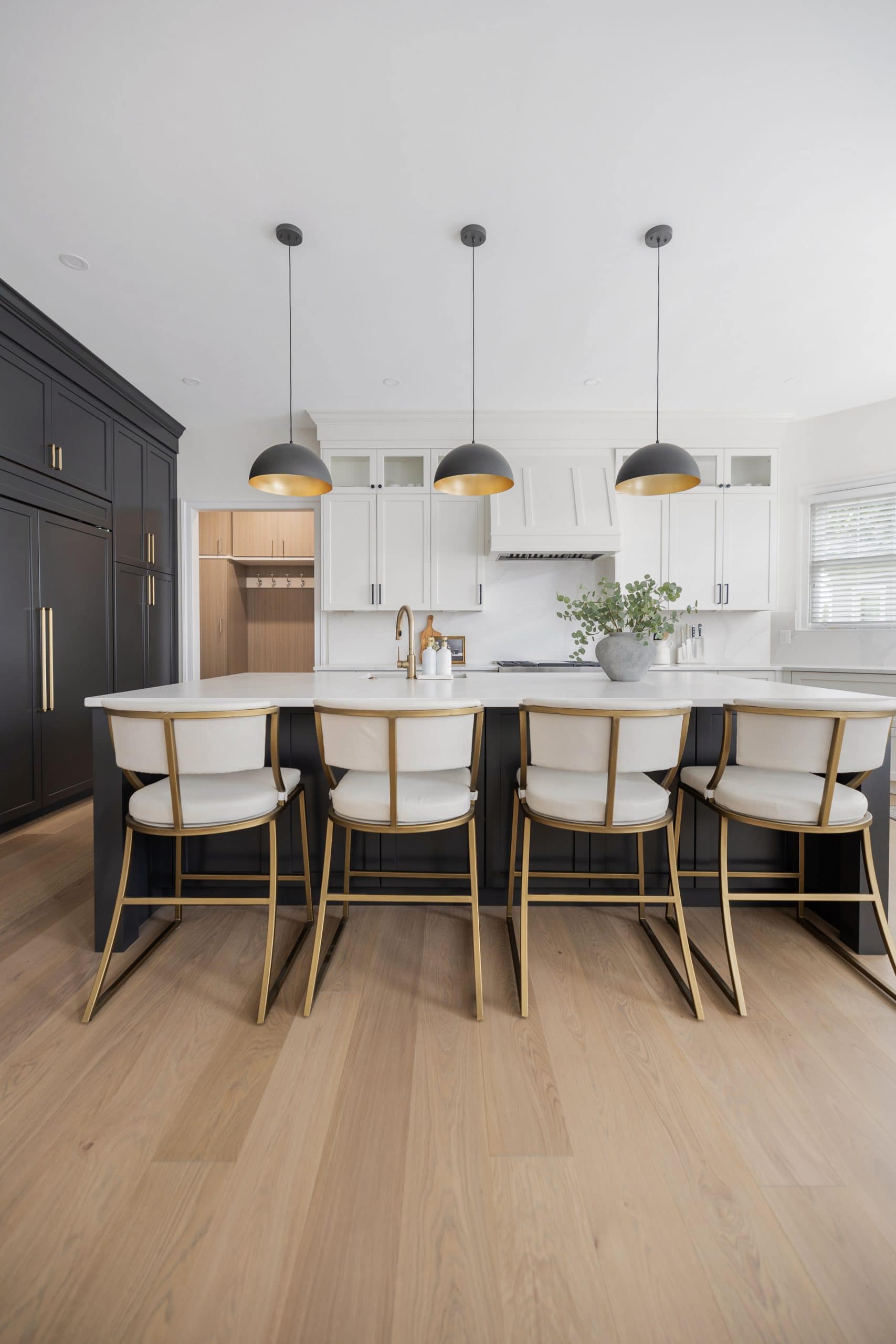
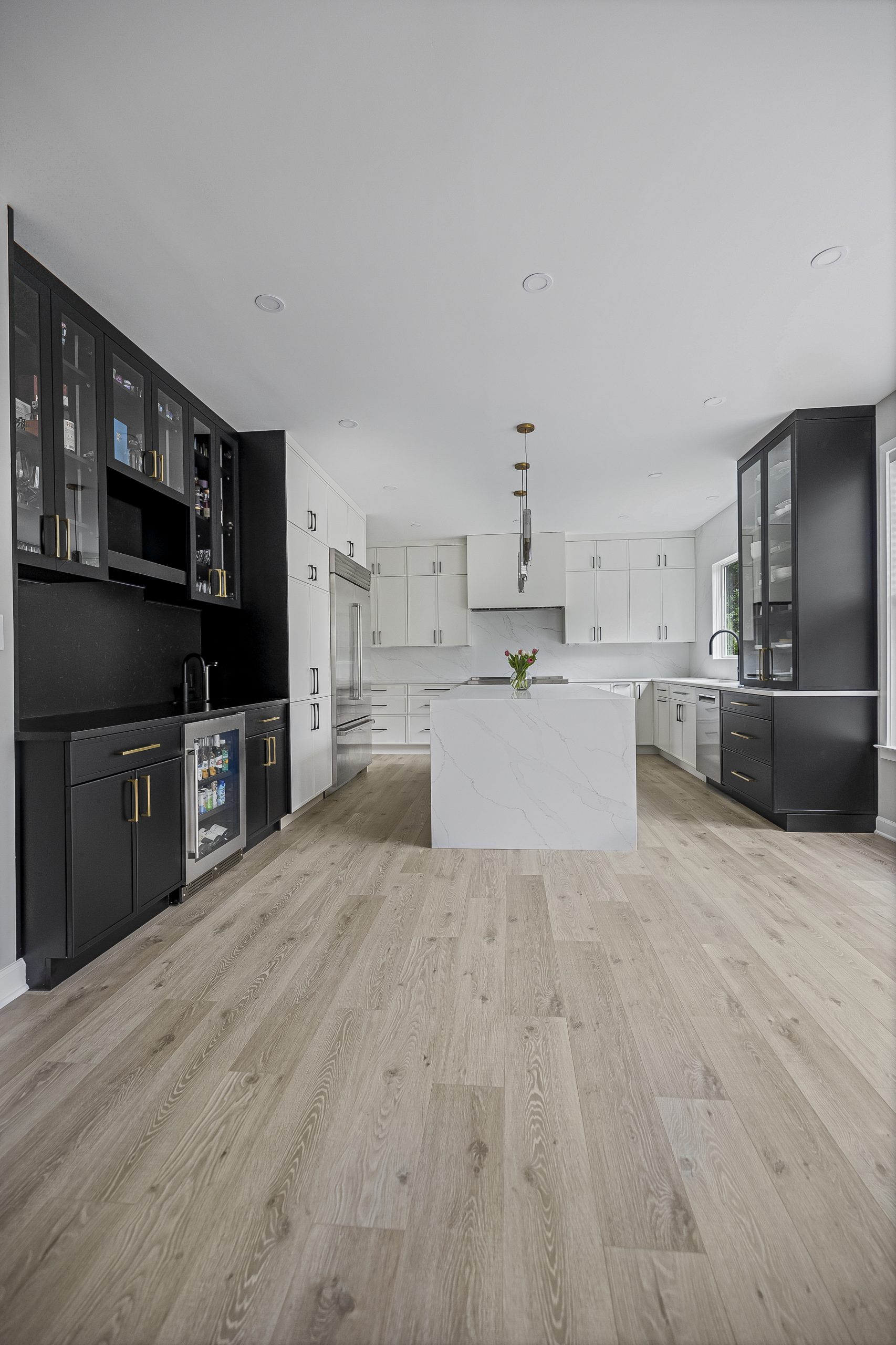
16. The tuxedo kitchen: black and white. Black lower or tall cabinets with white uppers and white counters. It is formal and graphic, and it needs warmth from somewhere: a wood floor, brass, or leather stools.
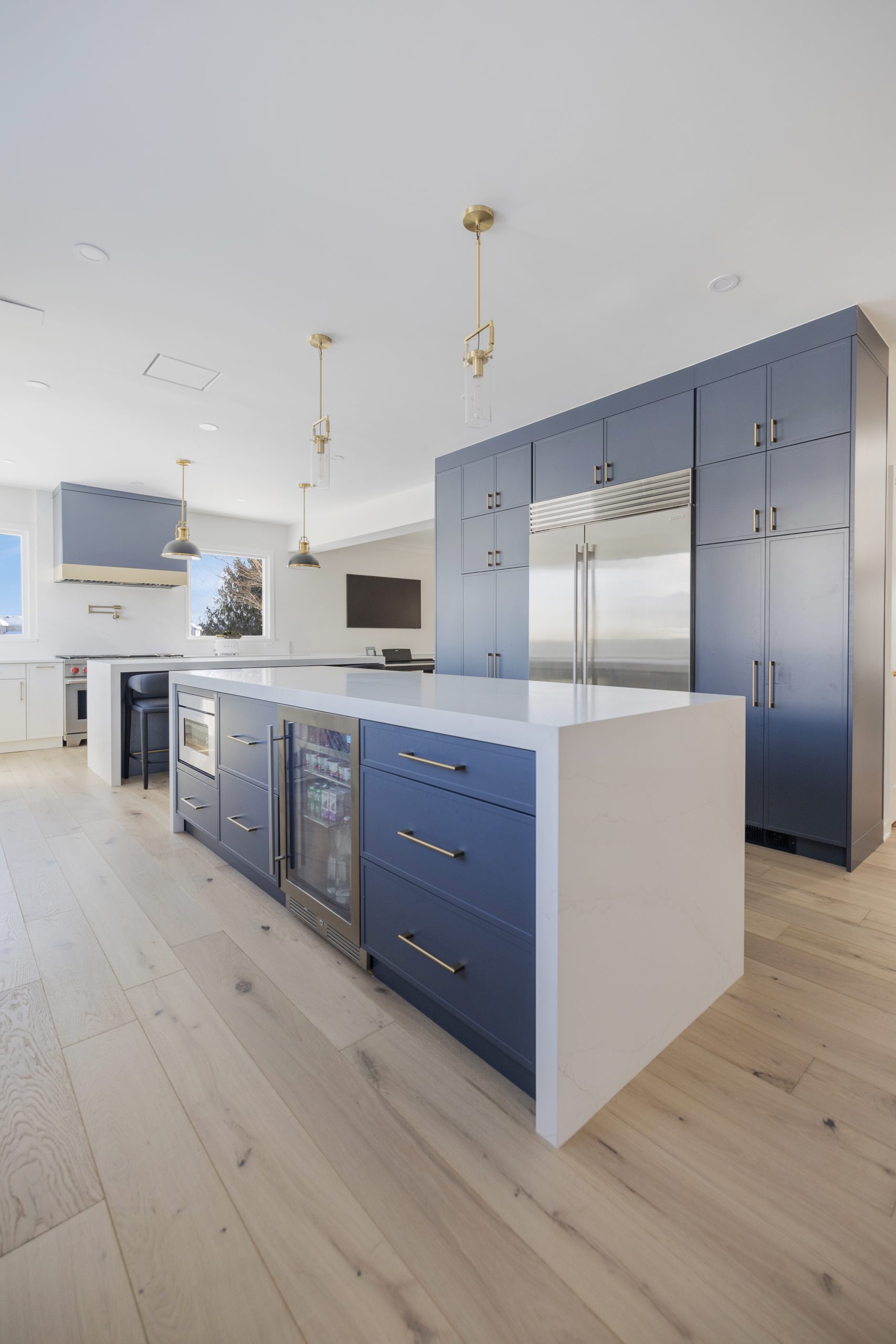
17. Navy tall cabinets with white stone. The reverse of the usual order: the dark color fills the tall wall around the refrigerator, and white is carried by the counters and the island top.
18. Navy lower cabinets with white uppers. The classic lowers and uppers split, and the most popular where there is no island. White counters and a white backsplash keep the navy from closing the room in.
19. Black with natural wood. Black tall cabinets or a black island with light oak or maple everywhere else. It is modern and warm at once, and it suits houses with black window frames.
20. Deep green with walnut. Two dark, rich finishes for a kitchen that is meant to feel like a library. It needs good light, a pale counter and a pale floor.
Color with natural wood
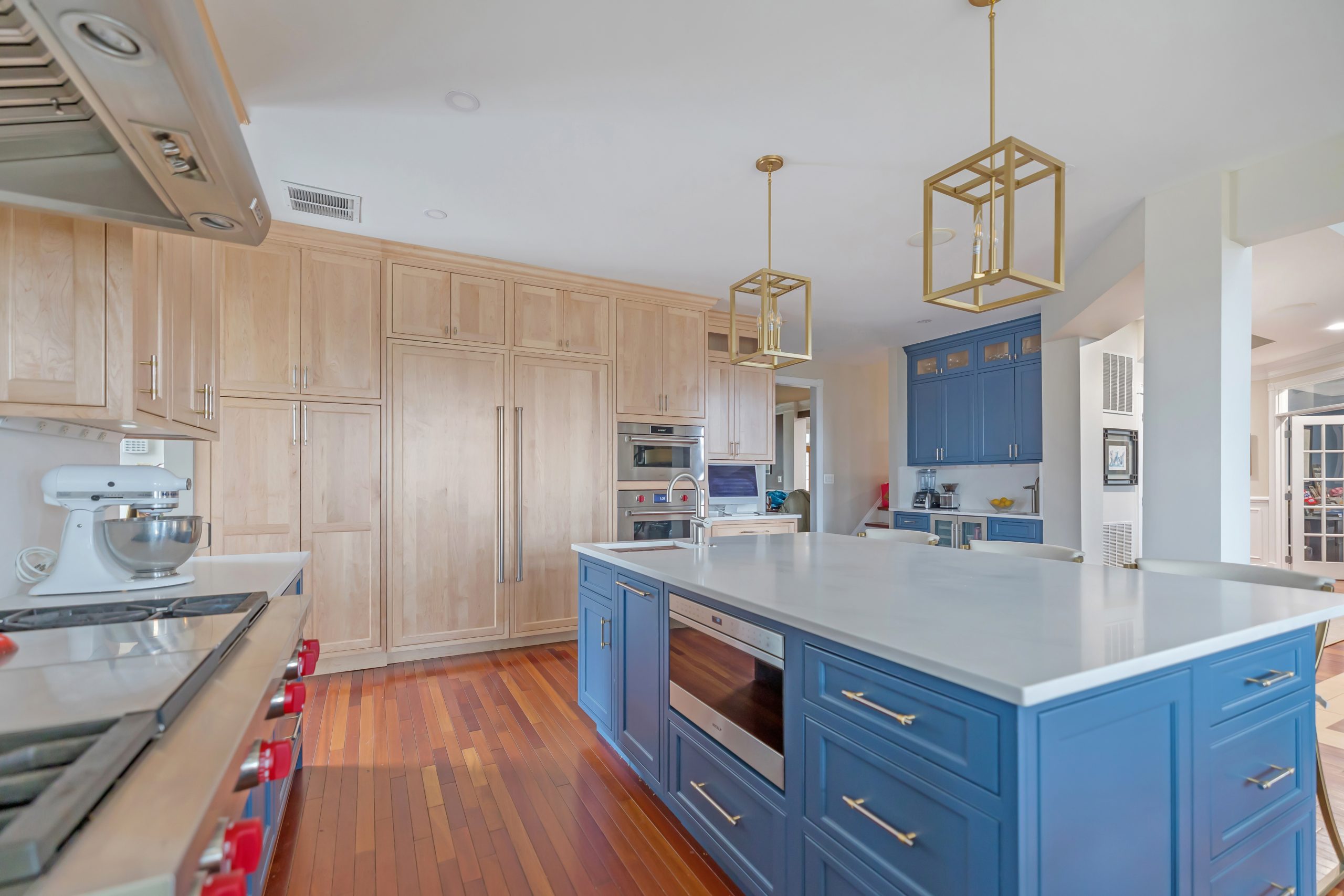
21. Natural maple with a blue island. A wall of natural maple cabinets is already warm; a blue island gives it a point of color and breaks up what would otherwise be a great deal of one wood.
22. Sage green with white oak. Sage painted cabinets on the walls and a white oak island, or the reverse. Green and oak are close to each other in nature, which is why the pairing looks easy.
A small second tone
23. A bar, a coffee station or a pantry wall in the second color. When the kitchen itself should stay one color, give the second color to a piece that stands apart: a bar at the entrance, a coffee station, a hutch. It is the least risky two tone kitchen there is.
24. A wood range hood or hutch as the second tone. One piece of wood among painted cabinets, placed where the eye lands. A wood hood, a wood hutch or wood open shelves are enough to make a kitchen two tone.

Which combination suits which kitchen
| Combination | Mood | Counter | Hardware | Suits |
|---|---|---|---|---|
| White with a navy island | Classic | White quartz or a veined white stone | Brass, nickel or black | Colonials and transitional houses |
| White with a black or charcoal island | Crisp | White or pale gray | Black or stainless | Newer houses, open plans |
| White with walnut | Warm, tailored | White stone with soft veining | Brass or bronze | Any house; the safest warm choice |
| White with white oak | Calm, light | Plain white or pale stone | Black or brushed brass | Modern and Scandinavian rooms |
| Greige with charcoal | Quiet, traditional | Pale gray or cream | Nickel or pewter | Traditional houses with brown floors |
| Cream with sage or wood | Soft, settled | Honed cream or marble look | Unlacquered brass | Older houses, farmhouse kitchens |
| Black and white | Formal, graphic | White | Brass or black | Large, bright rooms |
| Navy lowers, white uppers | Grounded | White | Brass or nickel | Kitchens with no island |
| Black with natural wood | Modern, warm | White or concrete gray | Black | Houses with black window frames |
| Deep green with walnut | Rich | Pale stone | Brass | Large rooms with strong daylight |
How to Choose the Two Colors: Ten Rules
- One color leads. Give about two thirds of the cabinets to one finish and one third to the other. Designers call the fuller version the 60, 30, 10 rule: 60 percent leading color, 30 percent second color, 10 percent accent in the metal and the stools. An even split looks undecided.
- The dark color sits low. Dark below and light above is how a room feels stable. Dark upper cabinets over light lowers make a kitchen feel top heavy, and the exceptions are rare.
- The undertones agree. Every white and every gray leans warm or cool. A warm white beside a blue gray, or a cool white beside cream, looks like a mistake. Hold the two door samples together in daylight; if one makes the other look dirty, change one.
- Contrast clearly, or stay close on purpose. White with navy is a clear contrast. Cream with sage is a deliberate closeness. The pairings that fail sit in between: two mid grays, or a white and an off white that look like a poor match.
- Each color appears at least twice. A navy island should find an echo in a navy hood, a runner, the stools or a painted pantry door. A color that appears once looks like an afterthought.
- Keep one door style. Shaker on the walls and shaker on the island. Two colors and two door styles are four ideas in one room.
- Let one counter tie the room together. The same top on the island and the perimeter is the simplest link between two cabinet colors. If the tops differ, one of them should be plain.
- Stop at two. The third finish, if there is one, is a wood or a metal in a small amount: shelves, a hood, the pulls.
- Break the color at a natural line. An inside corner, the end of a run, a change of depth or the gap between the island and the wall. Two colors should never meet side by side in the middle of a run.
- Test in your own light. Navy turns nearly black in a north room and bright in a south one. Green shifts with the trees outside the window. Look at full size door samples morning and evening, under the bulbs you will actually use, before the order is placed.
Color does more than decorate. Blues and greens calm a room, whites open it and dark colors draw it in; our guide to what room colors say explains the effect, and the 2026 design trends for Northern Virginia shows where color is going.
Paint Colors People Ask For
Cabinet makers have their own color cards, and most will match a paint color for a custom color charge. These are the paint names that come up most often when homeowners describe the two tones they want. Treat them as a starting point and judge the door sample, not the paint chip.
| Role in the kitchen | Colors people name |
|---|---|
| Warm white for the leading color | Benjamin Moore White Dove, Benjamin Moore Simply White, Sherwin Williams Alabaster |
| Navy for an island or lowers | Benjamin Moore Hale Navy, Sherwin Williams Naval |
| Black and charcoal | Sherwin Williams Tricorn Black, Sherwin Williams Iron Ore, Benjamin Moore Wrought Iron |
| Sage and deep green | Sherwin Williams Evergreen Fog, Benjamin Moore October Mist, Sherwin Williams Pewter Green |
| Greige, taupe and mushroom | Benjamin Moore Revere Pewter, Sherwin Williams Accessible Beige, Sherwin Williams Urbane Bronze for the dark version |
| Wood for an island | Walnut with a clear matte finish; rift cut white oak, natural or lightly toned |
Countertops, Backsplash, Hardware and Floors
With two cabinet finishes in the room, everything else has to do less. The rule is that the cabinets may have two tones only if the other surfaces are calm.
- Countertops. One top across the whole kitchen is the safe choice: a white quartz or a softly veined white stone suits nearly every pairing in this guide. A second top on the island works when it is clearly different in kind, such as a wood top or a dark stone on a light island, and when the perimeter top is plain. Our kitchen countertops guide compares the materials and the quartzite guide covers the natural stone most often chosen for a feature island.
- Backsplash. Keep it quiet: a plain tile in the lighter cabinet color, or the counter carried up the wall as a slab. A patterned tile beside two cabinet colors is one pattern too many. Our kitchen backsplash ideas show both.
- Hardware. One finish on both colors is the simplest and nearly always right. Brass warms navy, green and white alike; black suits white and wood. If you mix, change the metal with the cabinet color, never within it, and keep to two; the mixing metals guide has the rule.
- Appliances. Panel the dishwasher in the color of the cabinets around it. A stainless dishwasher in a navy island breaks the block of color that the island exists to make.
- The range hood. A hood is a chance to repeat the second color on the other side of the room, or to bring in the wood.
- Floors. A dark island on a dark floor disappears, and a white oak island on a white oak floor does the same. Keep a clear step in tone between the floor and the cabinets that stand on it.
- Walls and trim. Paint the walls in the lighter cabinet color or a shade of it, so the upper cabinets recede.
- Stools and lighting. These are the 10 percent. Leather, wood or a metal that repeats the hardware is enough.
Two Tone Cabinets in a Small Kitchen
Two tones can make a small kitchen look larger, if the split is the right one. In a small room the upper cabinets are at eye level and close to you, so they should be the lighter color, ideally the color of the walls. The darker finish goes on the base cabinets, where it grounds the room without crowding it.
- Use the lowers and uppers split. A small kitchen rarely has an island, so this is the split that fits. A peninsula can take the second color in place of an island.
- Keep the contrast moderate. Navy or sage below white reads as depth. Black below white in a narrow galley can read as a stripe.
- Run the light color to the ceiling. Wall cabinets that reach the ceiling in the wall color make the room feel taller.
- One counter, one backsplash, both light. The fewer lines across a small room, the larger it looks.
- Do not divide a short run. A wall of six cabinets should be one color above and one below, not a patchwork.
Our guides to small kitchen layouts, galley kitchens and U shaped kitchens show where the cabinets go before the color is chosen.
Do Two Tone Kitchen Cabinets Cost More?
Usually not, and when they do, not by much. The price of cabinets is set by how they are built, how many there are and what the doors are made of. A second standard color from the same cabinet line is, with most makers, the same price per cabinet as the first. What costs more is a premium second finish: a walnut or rift cut white oak island beside painted maple, or a color matched specially. Where a cabinet maker does charge for a second finish, the figure usually quoted in the trade is about $1,000 to $2,000 on a whole kitchen; that is a general market figure, not one of ours. These are the ways to get a two tone kitchen in Northern Virginia in 2026, from the least work to the most.
| Route | What changes | Northern Virginia cost, 2026 | Best when |
|---|---|---|---|
| Paint the island only | The island is sprayed in a second color; the rest is untouched | A share of the cost of painting the whole kitchen | The cabinets are sound and you want to try a color |
| Paint all the cabinets in two colors | Doors, drawer fronts and frames professionally sprayed, with new hardware | $3,000 to $8,000 | Boxes and doors are sound and the style is dated |
| New doors and drawer fronts in two finishes | The boxes stay; every door and drawer front is new | $6,000 to $14,000 | The doors are the problem, not the boxes |
| Refacing in two finishes | New doors and fronts, and new veneer on the frames and ends | $12,000 to $25,000 | The layout works and you want a new door style |
| A new island in a contrasting finish | A semi custom island with a quartz top, or a custom one with seating and storage | $6,000 to $12,000, or $12,000 to $25,000 for custom | The perimeter stays and the island is added or replaced |
| New semi custom cabinets in two finishes | Every cabinet replaced | $25,000 to $55,000 installed | The boxes are worn or the layout is changing |
| Custom or inset cabinetry in two finishes | Cabinets built for the room, often with a wood species island | $50,000 to $100,000 or more | A large or luxury kitchen |
New cabinets are usually part of a larger job. A full kitchen remodel in the same footprint runs $60,000 to $100,000 in Fairfax and Loudoun County, and cabinets are 25 to 35 percent of it. Our kitchen remodel cost guide has the whole budget, and the refacing against replacing guide helps decide whether the boxes are worth keeping.
What moves the price of a two tone kitchen
- Whether the second finish is standard. Two standard paints from one line: usually no difference. A custom matched color: a set charge for the match.
- Wood against paint. A walnut or rift cut white oak island costs more than the same island in painted maple, because the wood is dearer and the veneer has to be matched across the doors and panels.
- Finished ends and backs. Every block of color needs its own finished end panels, and the back of an island is a large panel in the island finish.
- One order, one maker. Both colors should come from one manufacturer in one order. Splitting the kitchen between two makers costs more and the door profiles never quite agree.
- The small parts. Toe kicks, crown, light rail and fillers have to be ordered in the right color for each run. Forgetting them is what delays a two tone kitchen.
- Painting on site. When existing cabinets are repainted in two colors, the second color means a second round of masking and spraying, which adds labor but not much.
Paint, Stain and Finish: What Lasts
- A factory finish outlasts paint applied on site. New cabinets are sprayed and cured at the factory with a catalyzed finish that is harder than any wall paint. When existing cabinets are repainted, the doors should be taken off, sprayed in a shop and cured before they come back.
- Dark colors show more. Navy, black and deep green show dust, fingerprints and chips sooner than white does. That is a reason to put the dark color on the island or the lowers in a satin sheen, and to keep a touch up kit from the cabinet maker.
- White shows grime at the handles. Which is one more argument for dark lowers in a house with children.
- Painted doors show hairline joints. Wood moves with the seasons, and a fine line appears where the rail meets the stile of a painted shaker door. It is normal. A door with a one piece or MDF center panel shows it least.
- Wood wants a clear matte finish. A matte or low sheen clear coat keeps walnut and oak looking like wood. A glossy clear coat makes them look like laminate.
- Sunlight changes wood. Walnut lightens and oak ambers over the years. Expect it, and do not match a paint to the color of new wood too exactly.
- Sheen. Satin on both colors. Two sheens in one kitchen read as two qualities of cabinet.
Our kitchen cabinet ideas guide goes further into door styles and construction, and the guide to kitchen materials for Loudoun County homes compares what holds up.
Are Two Tone Kitchen Cabinets Out of Style in 2026?
No. Two tone cabinets have been common for more than a decade, and what has changed is which two tones. The stark versions of the 2010s, cool gray with bright white, or a high gloss color against white, look dated now. The versions being built in 2026 are warmer and closer together: warm white with walnut or white oak, cream with sage, greige with charcoal, and the long lived white with navy.
Three things keep a two tone kitchen from dating. Keep the larger share of the cabinets in a neutral, so the room does not depend on the fashion for one color. Put the color where it can be changed, which means the island. And let wood do the work of the second tone where you can, because wood does not go out of style in the way a paint color does.
For resale the same logic holds. Buyers in Northern Virginia are used to a navy, green or wood island, and a neutral perimeter protects the value of the kitchen. If you expect to sell within a few years, choose the island and perimeter split with a quiet second color. Our 40 kitchen remodel ideas and transitional kitchen guide show the styles that hold their value here.
Two Tone Mistakes to Avoid
- An even split. Half and half looks undecided. One finish should clearly lead.
- Three paint colors. Two colors and a wood can work. Three colors look like leftovers.
- Undertones that fight. A cool white beside a warm cream, or a blue gray beside a brown gray.
- A color that appears once. Repeat the island color somewhere else in the room.
- Dark above, light below. It makes the room top heavy and the upper cabinets loom.
- Changing color in the middle of a run. Break at a corner or at the end of a wall.
- Two door styles as well as two colors. Keep the doors the same.
- Two busy countertops. If the cabinets carry two tones, the stone should be calm.
- A stainless dishwasher in a colored island. Panel it.
- Choosing from paint chips. Order full size door samples in the actual finish and look at them in the room.
- Ordering the two colors from two makers. The profiles, the sheen and the delivery dates will not match.
- Forgetting the floor. A dark island needs a floor it can be seen against.
How We Plan a Two Tone Kitchen
- Layout first. The cabinet plan decides where a color can begin and end, so the layout is settled before any color is discussed. In an open concept kitchen the second finish is also planned against the room it faces.
- Choose the split. Island and perimeter, lowers and uppers, a tall wall, or paint and wood.
- Render both colors in 3D. We show the kitchen in the two finishes on your own layout, and change them on screen until the proportion is right.
- Door samples in the room. Full size sample doors in both finishes are left in the house for a few days, beside the floor and the counter sample, in morning and evening light.
- Counter, backsplash and hardware together. They are chosen on the same table as the two door samples, not afterward.
- One order. Both finishes are ordered from one manufacturer, with the end panels, toe kicks, crown and fillers listed by color and by run.
- Installation. The cabinets go in, the counters are templated and set, and the touch up kit for each color stays with the house.
A full remodel in the same footprint takes six to eight weeks on site. The Vienna kitchen case study shows one from the first drawing to the last day.
Frequently Asked Questions
What are two tone kitchen cabinets? Cabinets in two finishes within one kitchen, each used on a defined part of the room. The usual versions are a light perimeter with a darker island, dark lower cabinets with light upper cabinets, and painted cabinets with a wood island.
Are two tone kitchen cabinets out of style in 2026? No. They are still being built in 2026. What has dated is cool gray with bright white. The current pairings are warmer: white with walnut or white oak, cream with sage, greige with charcoal and white with navy.
Which color goes on the bottom in a two tone kitchen? The darker one. Dark lower cabinets ground the room and hide wear, and light upper cabinets keep the walls open and make the ceiling feel higher.
Should the kitchen island be a different color than the cabinets? It is the safest way to use two tones. The island stands free, so the second color has a clear beginning and end, and it is the one piece that is easy to repaint later. Navy, charcoal, black, sage green, walnut and white oak are the usual choices.
Do two tone kitchen cabinets cost more? Usually not. Two standard finishes from the same cabinet line generally cost the same per cabinet. A wood species island or a custom matched color costs more. Painting existing cabinets in two colors runs $3,000 to $8,000 in Northern Virginia, and new semi custom cabinets $25,000 to $55,000 installed.
What are the best two tone kitchen cabinet color combinations? White with a navy island, white with a walnut or white oak island, white with black or charcoal, navy lowers with white uppers, greige with charcoal, and cream with sage green. Keep one color to about two thirds of the cabinets.
Do two tone cabinets work in a small kitchen? Yes. Use the darker finish on the base cabinets and a light color, close to the wall color, on the upper cabinets. The upper cabinets recede and the room looks larger. Keep the counter and the backsplash light.
What countertop goes with two tone cabinets? One calm countertop across the whole kitchen, such as white quartz or a softly veined white stone, suits nearly every pairing. If the island has a different top, keep the perimeter top plain.
Can I paint my existing cabinets two colors? Yes, if the doors and boxes are sound. The doors are removed, sprayed in a shop and cured. Painting only the island or only the lower cabinets is the least expensive way to get a two tone kitchen.
Should the hardware be the same on both cabinet colors? One hardware finish on both colors is the simplest choice and nearly always right. If you mix metals, change the metal where the cabinet color changes, and use no more than two.
See Both Colors Before You Order
Two finishes are twice the decision, and the easiest way to make it is to see it. EA Home Design is a Class A licensed design build firm (license 2705157182) that draws the kitchen in 3D in both finishes, brings full size door samples to the house and orders both colors from one cabinet maker, across Fairfax and Loudoun County. See our kitchen remodeling page, our case studies and our luxury remodeling guide, then book a free in home design consultation or call (703) 687-1818.