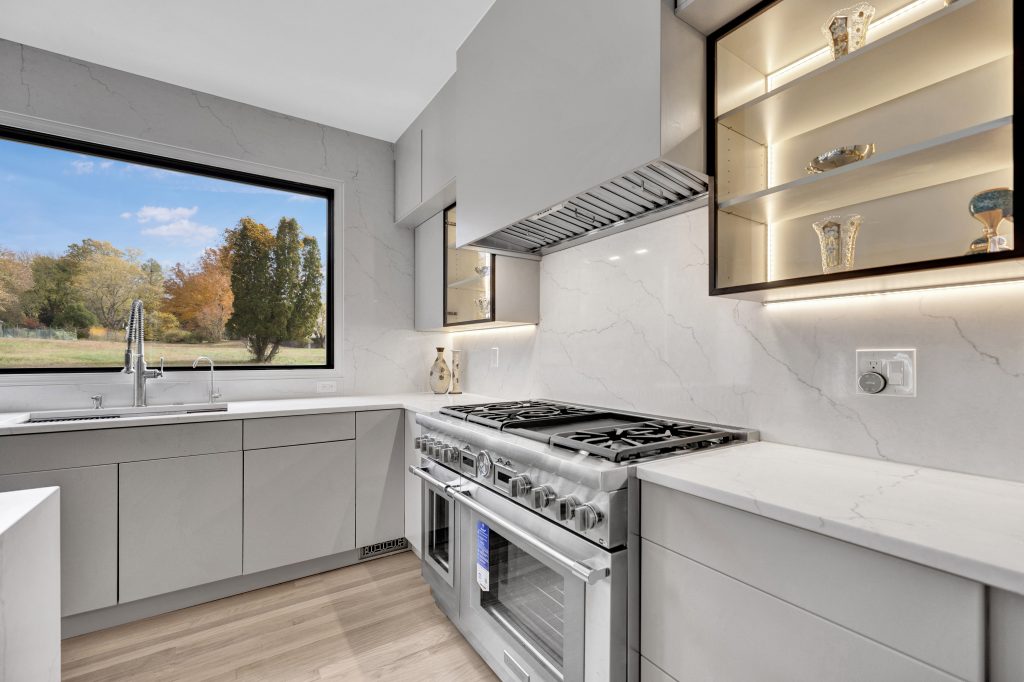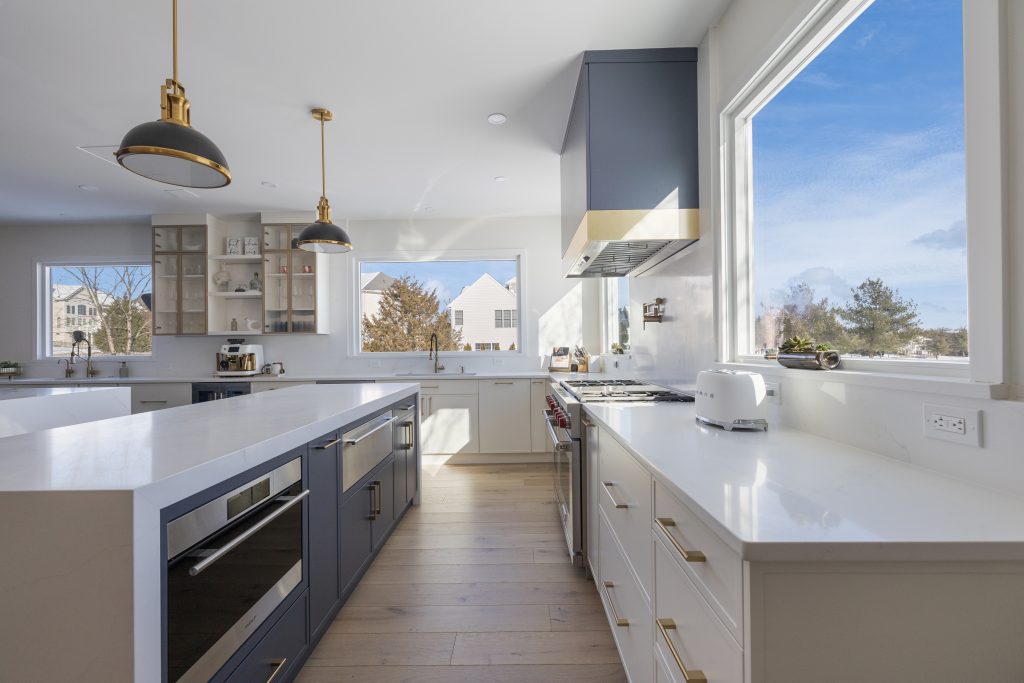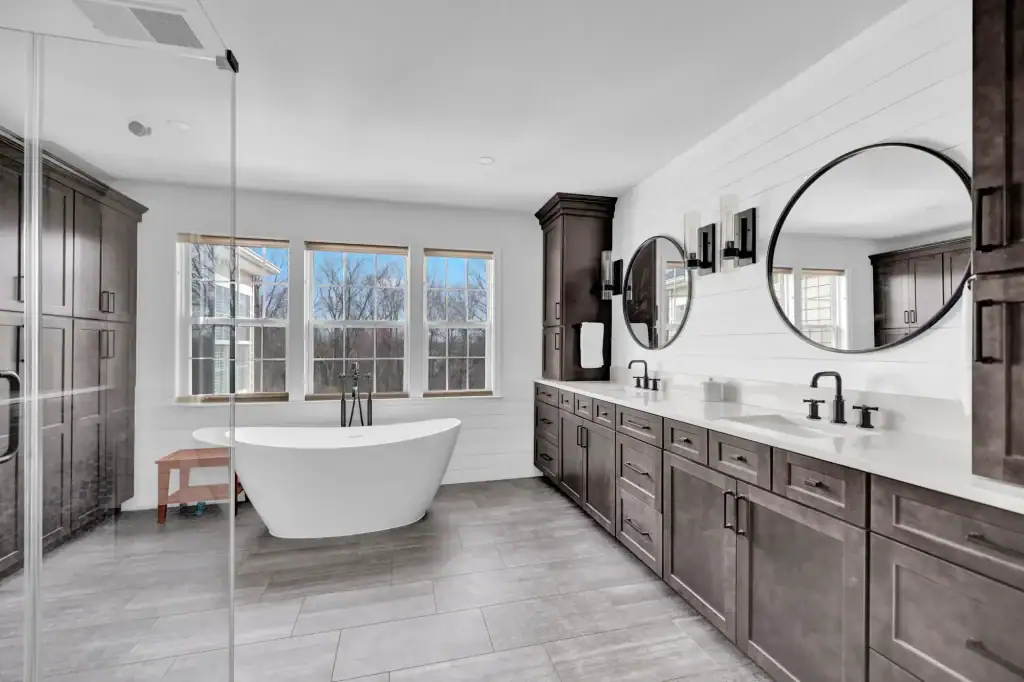

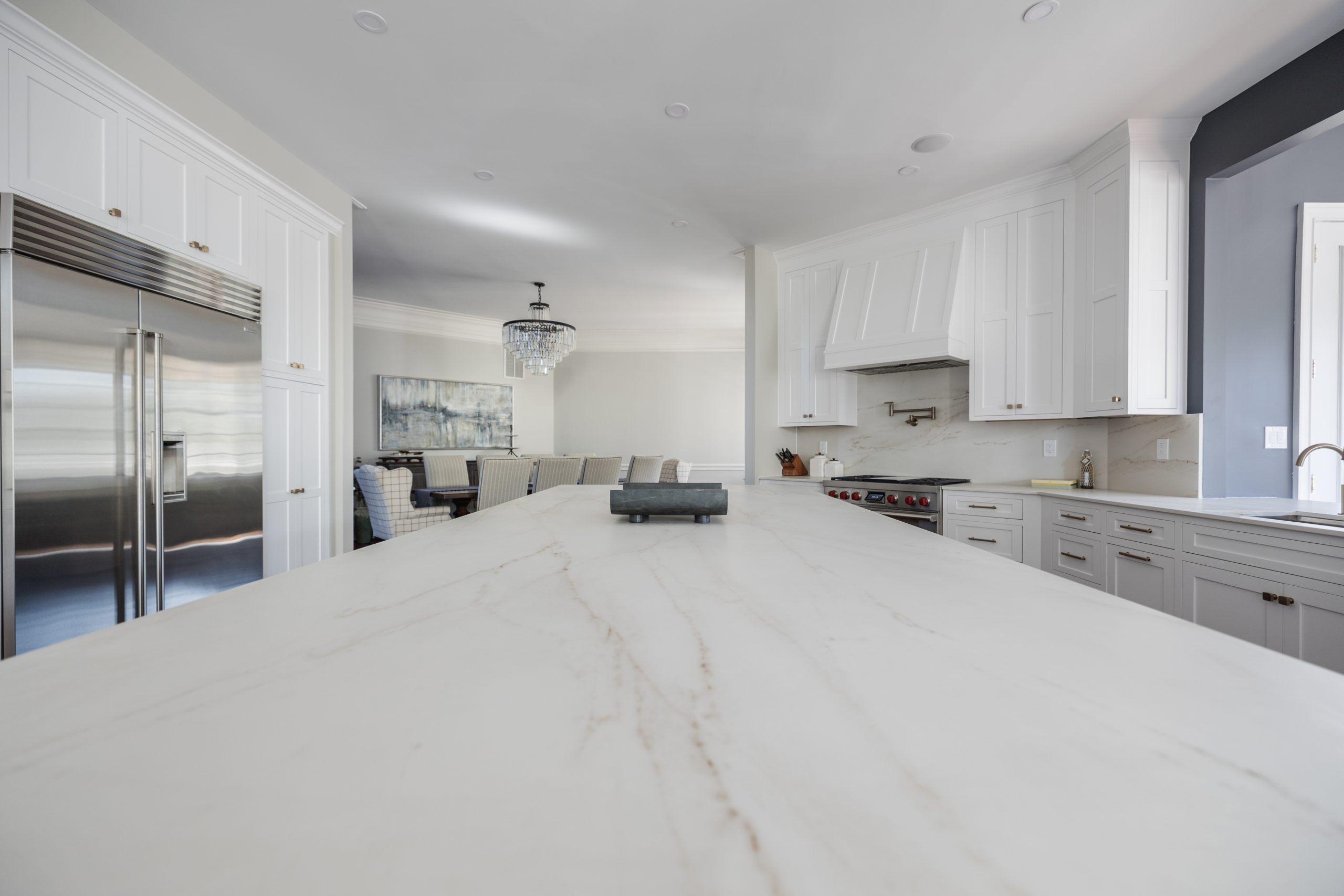
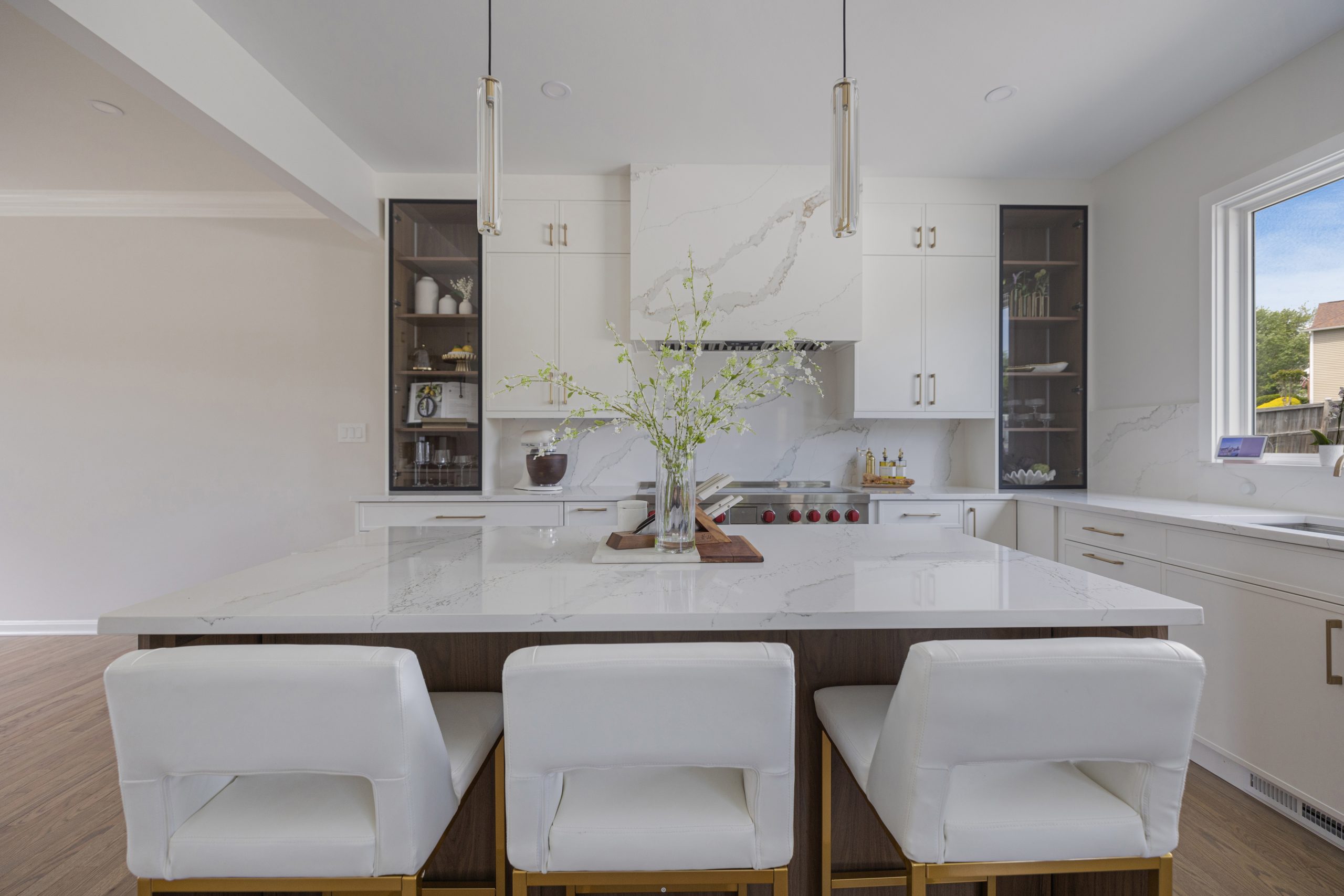
Quartzite countertops are slabs of natural stone, harder than granite and veined like marble, and in Northern Virginia in 2026 they cost $100 to $250 per square foot installed, or $5,500 to $13,750 for a typical kitchen of 55 square feet. Quartzite is not quartz. Quartz is manufactured from ground stone and resin; quartzite is quarried. It takes a hot pan, it does not etch the way marble does, and it needs sealing like granite. This guide explains what quartzite is, compares it with quartz, granite, marble and porcelain, prices it by kitchen size, describes Taj Mahal quartzite and the other colors people ask for, shows how to tell real quartzite from the marble sometimes sold under its name, and covers sealing and cleaning. The photographs are kitchens EA Home Design built in Fairfax and Loudoun County; they show the looks and the details this guide discusses, in more than one counter material.
Thinking about quartzite for your kitchen?
We take you to the slab yard and lay out the veining in 3D before anything is cut. See our kitchen remodeling in Northern Virginia page.
What Is Quartzite?
Quartzite is a natural stone. It begins as sandstone made almost entirely of quartz grains. Deep in the earth, heat and pressure fuse those grains into a single interlocking mass, and the result is one of the hardest stones used in a house: about 7 on the Mohs scale of hardness, where granite is 6 to 6.5 and marble is 3 to 4. Traces of iron and other minerals give it the veins, the gold and the gray, and in some quarries the greens and the blues.
Most of the quartzite sold for countertops is quarried in Brazil, cut into slabs of 2 or 3 centimeters, polished, and shipped to slab yards, where it is sold by the slab. No two slabs are the same, which is the reason people choose it and the reason it has to be chosen in person.
Quartzite Countertops at a Glance
| Property | Quartzite |
|---|---|
| What it is | A natural metamorphic stone, formed when sandstone rich in quartz is changed by heat and pressure |
| Hardness | About 7 on the Mohs scale; harder than granite, far harder than marble |
| Heat | Takes a hot pan; there is no resin in it to scorch |
| Acids | True quartzite does not etch from lemon, wine or vinegar |
| Stains | Resists them when sealed; some varieties absorb more than others |
| Sealing | At installation, then every one to two years, judged by a water test |
| Sun | Does not yellow or fade, so it can be used outdoors |
| Look | White, cream, gray, green and blue grounds with veining; no two slabs alike |
| Cost in Northern Virginia, 2026 | $100 to $250 per square foot installed |
| Best use | A statement island, a whole kitchen for a cook who wants natural stone, a slab backsplash |
Quartz vs Quartzite: What Is the Difference?
The names are one letter apart and the materials are opposites. Quartz is engineered: about 90 percent ground quartz bound with resin and pigment, pressed into a slab in a factory. Quartzite is cut from a mountain. Everything else follows from that.
| Quartz | Quartzite | |
|---|---|---|
| What it is | Manufactured: ground quartz, resin and pigment | Natural stone, quarried and cut into slabs |
| Pattern | Designed and repeatable; the sample is the slab | Unique; chosen slab by slab at the yard |
| Heat | Fair: the resin scorches, so trivets always | Excellent: no resin to scorch |
| Stains | Excellent: non porous | Good when sealed |
| Etching from acids | None | None on true quartzite |
| Sealing | Never | At installation, then every one to two years |
| Sun | Yellows outdoors or in a sunroom | Unaffected |
| Seams | Easy to match on a repeating pattern | Veining has to be laid out across each seam |
| Cost per square foot, installed | $60 to $150 | $100 to $250 |
| Typical kitchen, 55 square feet | $3,300 to $8,250 | $5,500 to $13,750 |
| Best for | A busy family kitchen that wants no upkeep | A kitchen that wants real stone and a slab nobody else has |
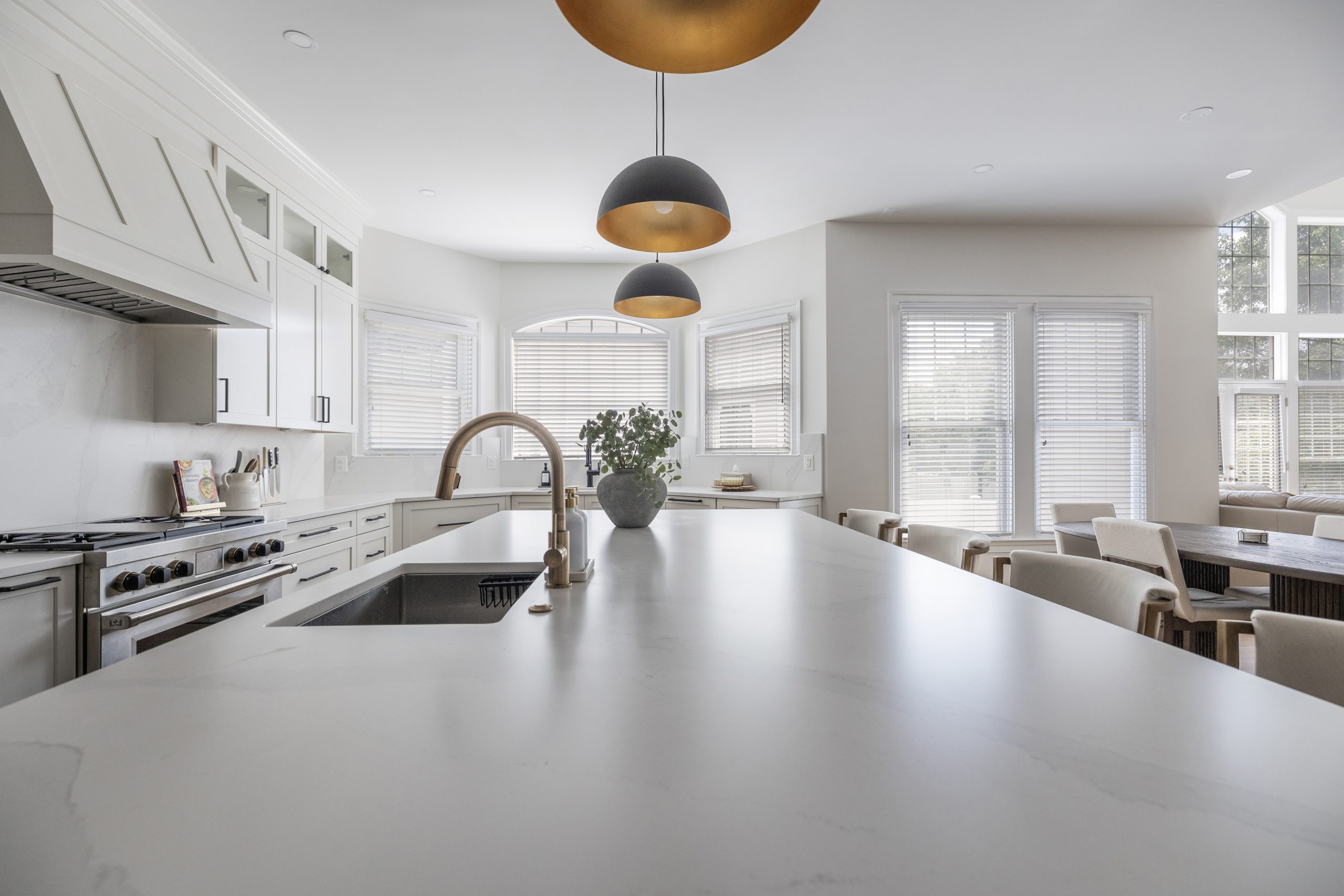
Choose quartz if the priority is a counter that asks nothing of you. Choose quartzite if you want natural veining, cook with heat, or have a sunny kitchen, and you accept a sealing day every year or two. Many of our clients use both: quartz on the perimeter, where the sink and the dishwasher are, and quartzite on the island. Our kitchen countertops guide compares ten materials, and the quartz against granite comparison goes further into the engineered side.
Quartzite vs Granite, Marble and Porcelain
| Material | Scratches | Heat | Acids and stains | Sealing | Cost per square foot, installed |
|---|---|---|---|---|---|
| Quartzite | Excellent | Excellent | No etching; stains resisted when sealed | Every one to two years | $100 to $250 |
| Granite | Excellent | Excellent | No etching; light stones absorb oil if neglected | Every one to three years | $50 to $200 |
| Marble | Fair: scratches | Good | Etches within minutes; stains | Twice a year, and it still etches | $100 to $250 |
| Porcelain slab | Excellent | Excellent | Nearly stain proof | Never | $60 to $120 |
| Quartz | Excellent | Fair | Non porous | Never | $60 to $150 |
Quartzite vs granite
The two behave almost alike: both take heat, both resist scratches, both are sealed. The difference is the look and the price. Granite reads as grain and speckle, in colors from black to gold. Quartzite reads as veining on a light ground, which is the look most kitchens now want, and it costs like premium granite and above. If you like a quartzite and a granite equally, the granite is the better value.
Quartzite vs marble
This is the comparison that sells quartzite. Marble is soft and made of calcite, so a lemon, a glass of wine or a tomato leaves a dull mark in the polish within minutes, and no sealer prevents it. Quartzite gives a similar white, veined look without the etching and with far greater hardness. Owners who love marble and cook every day usually end with quartzite on the counters and marble somewhere it is safe, such as a backsplash away from the range.
Quartzite vs dolomite and soft quartzite
Some stones sold beside the quartzites are dolomitic marble: harder and slower to etch than ordinary marble, softer than quartzite, and still marked by acids in time. Fantasy Brown and Super White are the best known. They are good stones at a lower price, as long as you know what you are buying. A slab described as soft quartzite is a warning: geologists do not recognize the term, and the stone is usually marble. The tests further down settle it in a few minutes.
Quartzite vs porcelain and soapstone
Porcelain slab is the manufactured answer to the same wish: a veined white surface that takes heat and needs no sealing, at $60 to $120 per square foot. Its pattern is printed on the surface, so an edge or a chip shows the plain body, and the veins do not run through the thickness as they do in stone. Soapstone is the opposite of quartzite in character: soft enough to scratch with a knife, never stained or etched, and dark, with a patina that owners either love or do not.
Quartzite Countertops Pros and Cons
The pros of quartzite countertops:
- Hardness. It resists scratches better than granite. Knives lose; use a board to save the knives, not the counter.
- Heat. A pan from the burner does not mark it.
- No etching. Lemon, vinegar and wine do not dull true quartzite.
- The look. The veining of marble, in whites, creams, grays, greens and blues, and every slab is the only one.
- Sunlight. It does not yellow, so it suits a kitchen with a wall of windows, a sunroom or an outdoor kitchen.
- It lasts. A quartzite counter outlives the cabinets under it, and it can be polished again decades later.
- Value in a sale. Buyers in Northern Virginia read natural stone as a finished, high level kitchen.
The cons of quartzite countertops:
- Cost. $100 to $250 per square foot installed, against $60 to $150 for quartz.
- Sealing. It is sealed at installation and again every one to two years. Unsealed, the more absorbent varieties take up oil and water.
- Mislabeled stone. Marble and dolomite are sometimes sold under the name. Test before you buy.
- Seams and matching. Because the pattern is natural, the veining has to be laid out across every seam, and that can mean buying an extra slab.
- Edges can chip. A hard, crystalline stone is brittle at a sharp corner. A slightly rounded edge solves it.
- Fabrication. It is slow to cut and hard on tooling, so not every shop does it well. The fabricator matters as much as the slab.
- You must choose in person. A sample tells you little. That is a morning at the slab yard, which most clients enjoy.
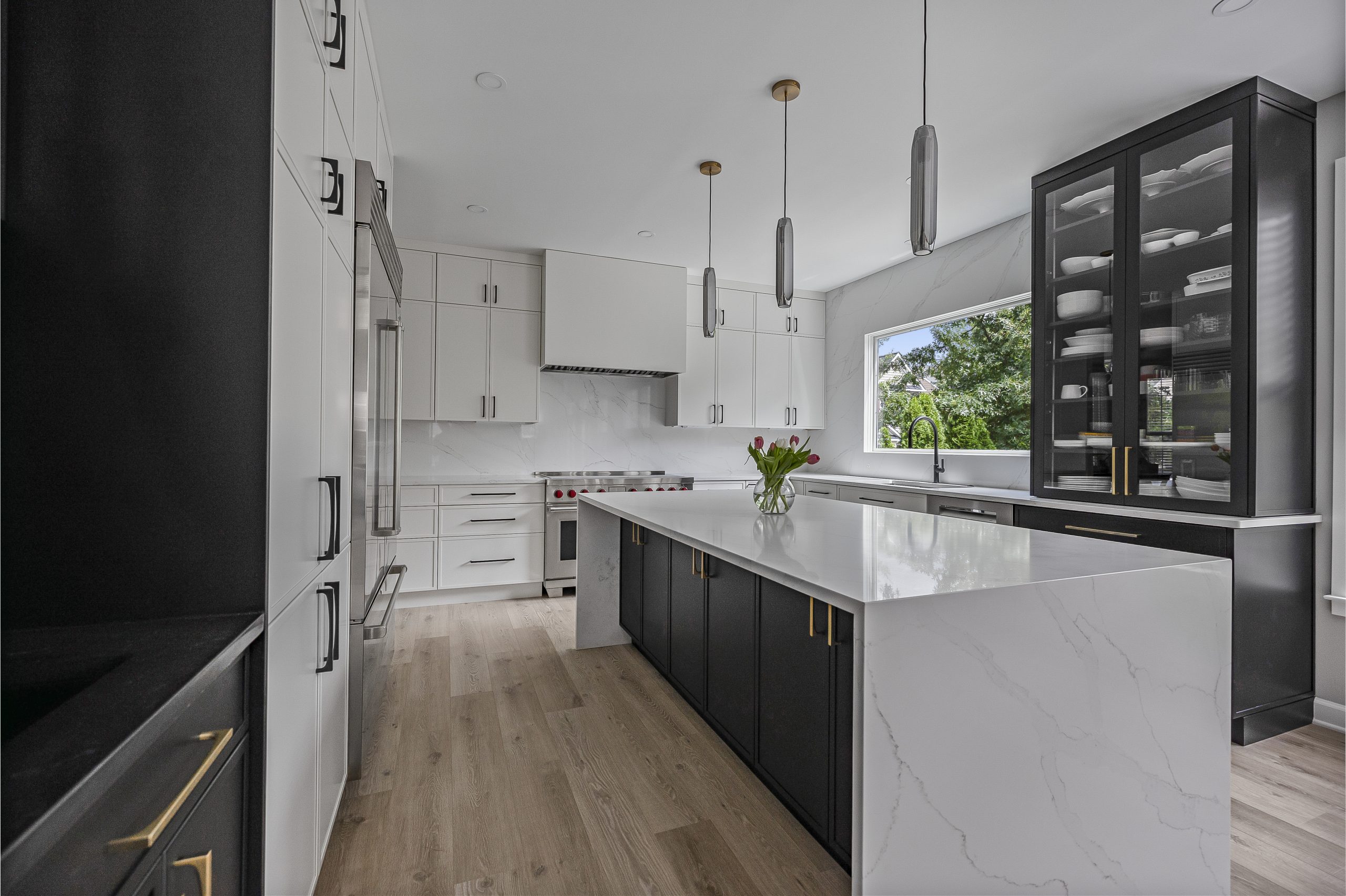
How Much Do Quartzite Countertops Cost in 2026?
In Northern Virginia in 2026, quartzite countertops cost $100 to $250 per square foot installed. That price covers the slab, the template, fabrication, the sink and cooktop cutouts, a standard edge, installation and the first sealing.
| Counter material | 10 by 10 kitchen, about 35 square feet | Typical kitchen, 55 square feet | Large kitchen with island, 90 square feet |
|---|---|---|---|
| Quartzite | $3,500 to $8,750 | $5,500 to $13,750 | $9,000 to $22,500 |
| Marble | $3,500 to $8,750 | $5,500 to $13,750 | $9,000 to $22,500 |
| Granite | $1,750 to $7,000 | $2,750 to $11,000 | $4,500 to $18,000 |
| Quartz | $2,100 to $5,250 | $3,300 to $8,250 | $5,400 to $13,500 |
| Porcelain slab | $2,100 to $4,200 | $3,300 to $6,600 | $5,400 to $10,800 |
National cost guides quote lower figures, $80 to $210 per square foot installed in one and $80 to $140 for most kitchens in another. Those are averages across the country and across the plainer stones. Labor in Fairfax and Loudoun County runs 15 to 25 percent above the national average, and the quartzites our clients choose are rarely the plainest in the yard. Our kitchen remodel cost guide shows where the counters sit in a whole budget, and the 10 by 10 kitchen cost guide prices the small kitchen.
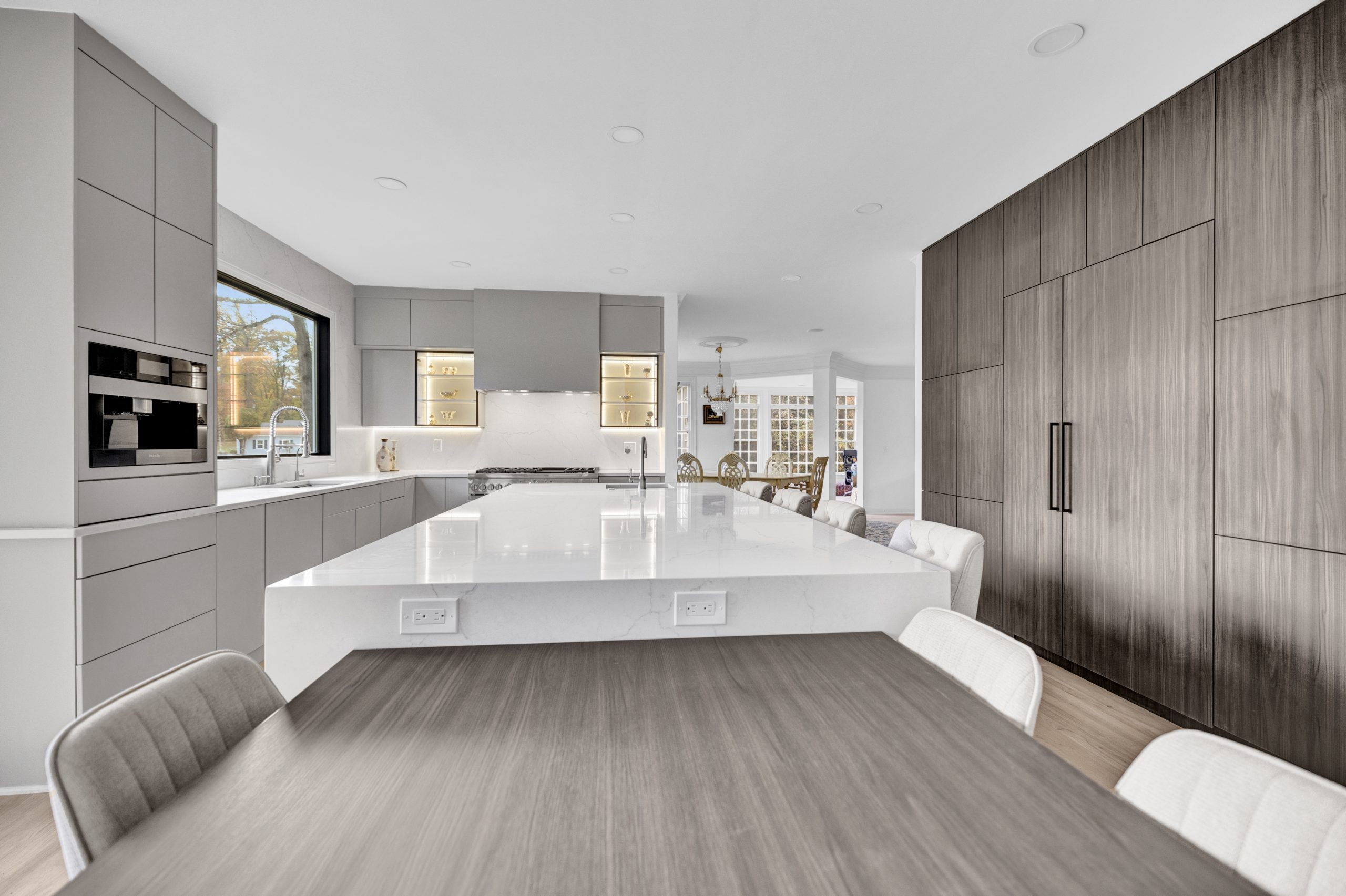
What moves the price of quartzite
- The stone itself. The whites and grays stocked in every yard sit in the lower half of the range. Taj Mahal sits in the upper half. Cristallo, Patagonia and the blues sit at the top and can pass it.
- The number of slabs. Stone is bought by the whole slab. A kitchen that needs a little more than two slabs pays for three, so the layout matters more than the square footage.
- Matching the veining. Running a vein through a seam, over a waterfall or up a backsplash uses more of each slab and sometimes one more slab.
- The edge. An eased edge is included. A mitered edge that makes the top look two or three inches thick adds labor on every exposed side.
- Waterfall ends. Each one is a mitered joint and more stone. Our kitchen island cost guide prices the island as a whole.
- A slab backsplash. Carrying the stone up the wall adds $1,500 to $4,000 to the countertop job.
- The finish. Honing or leathering a polished slab is done at the fabricator and is charged by the square foot.
- Cutouts. An undermount sink and a cooktop are standard; a second sink, a downdraft or a pop up outlet each add a cut.
Is quartzite more expensive than granite or quartz?
Usually, yes. Quartzite begins where good granite and good quartz sit and goes higher: $100 to $250 per square foot against $50 to $200 for granite and $60 to $150 for quartz. In a typical kitchen that is $2,200 to $5,500 more than quartz. At the very top of the market an exotic granite costs as much as a quartzite. The fair way to see it is as a share of the project: in a full kitchen remodel of $60,000 to $100,000, choosing quartzite over quartz moves the total by a few percent.
Taj Mahal Quartzite and the Other Colors People Ask For
| Name | Ground and veining | Notes |
|---|---|---|
| Taj Mahal | Warm white to soft beige with gold and caramel veining | The most requested quartzite; dense, with low absorption |
| Perla Venata | Cream with fine, linear veining | Close to Taj Mahal; some yards use the two names for the same stone |
| Mont Blanc | White with soft, flowing gray veining | A cooler white for painted cabinets |
| White Macaubas | White to pale gray with thin, straight gray lines | Linear and modern; more absorbent, so seal it faithfully |
| Calacatta Macaubas | White with bolder gray and gold lines | A marble look with a strong direction |
| Sea Pearl | Gray green with soft, wavy bands | Calm; good with wood cabinets |
| Cristallo | Translucent, crystalline white | Can be lit from behind; at the top of the price range |
| Dolce Vita | Cream and beige with gray and gold veining | Warm; suits traditional rooms |
| Patagonia | A patchwork of translucent crystal, black, gold and cream | The boldest; used on one island or one lit wall |
| Blue Roma | Blue gray with gold and rust veining | A feature stone for an island |
| Azul Macaubas | Pale to vivid blue bands | Rare, and priced accordingly |
| Avocatus | Deep green with lighter veining, usually leathered | The dark choice; suits walnut and brass |
| Fantasy Brown, Super White | Sold beside the quartzites | In fact marble, usually dolomitic; they can etch |
Taj Mahal quartzite
Taj Mahal is the quartzite most people have seen before they know its name. It is quarried in Brazil, and its ground is a warm white that moves toward beige, with soft veining in gold and caramel. It is popular for three reasons. The warmth suits white oak, walnut and brass, which are the materials kitchens are now built from. The pattern is quiet enough to run across a whole kitchen without tiring the eye. And it is one of the dense quartzites, so it absorbs little and is easy to live with.
Taj Mahal quartzite costs more than the common whites, in the upper half of the $100 to $250 range, and the price of a kitchen depends on how many slabs the layout needs. It is sold polished, honed and leathered; honed and leathered Taj Mahal look softer and hide fingerprints, and they want sealing a little more often. Slabs vary from nearly plain to strongly veined, so tag the actual slabs, from one lot, on the same visit.
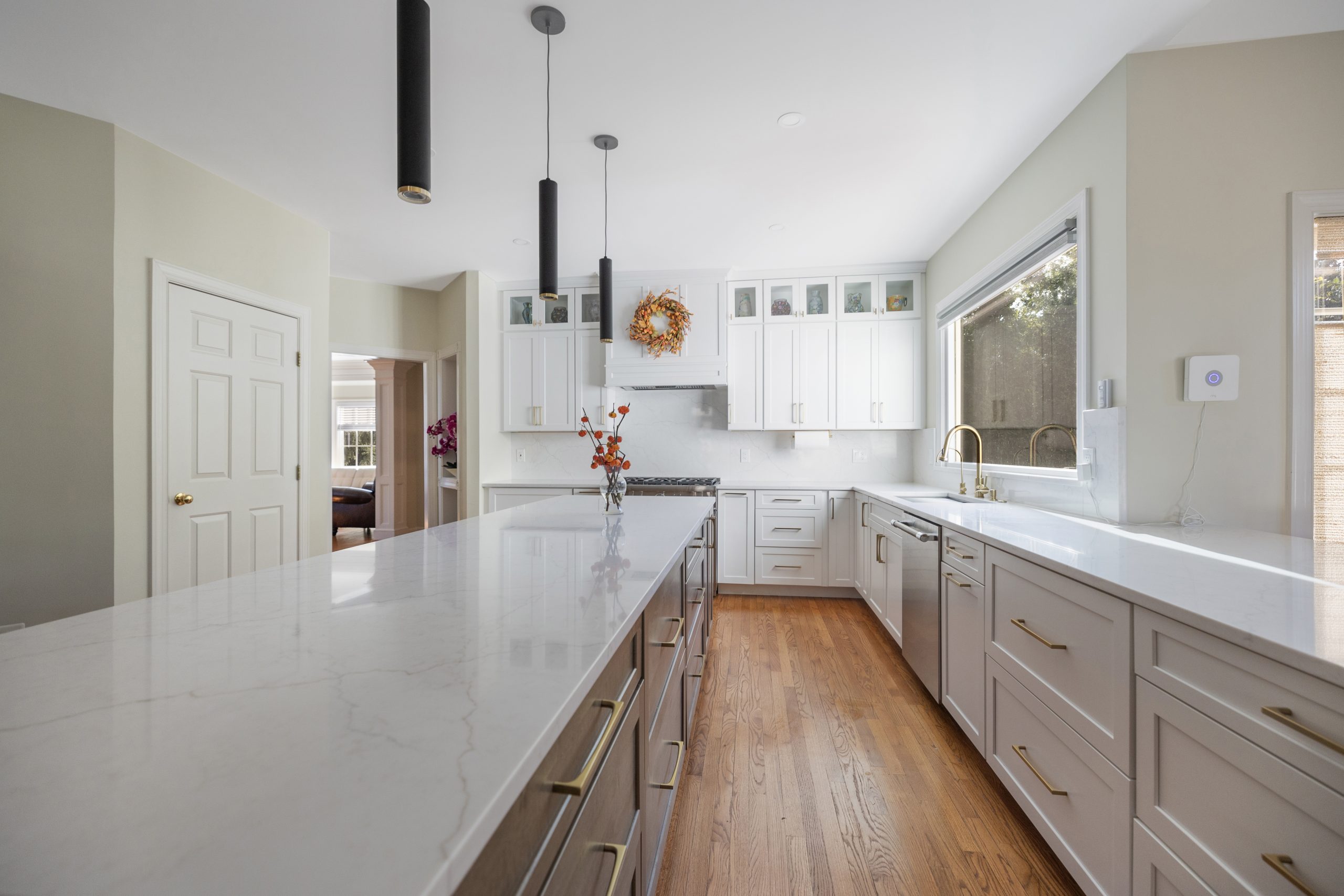
White quartzite countertops
White quartzite is the natural alternative to marble and to marble look quartz. Mont Blanc, White Macaubas and the paler Taj Mahal slabs are the usual choices. The whiter and more sugary a quartzite looks, the more it tends to absorb, so ask the yard how each one behaves and seal it on schedule. A white quartzite is never a flat white: there is always gray, cream or a little gold in it, and that is its value against white cabinets.
Gray, green, blue and black quartzite
Sea Pearl is the calm gray green that works with almost any wood. Avocatus is a deep green that reads nearly black in the evening and is usually leathered. Blue Roma and Azul Macaubas are feature stones, best on a single island with quiet counters around them. The darkest quartzites are usually sold honed or leathered, because a polished dark stone shows every fingerprint.
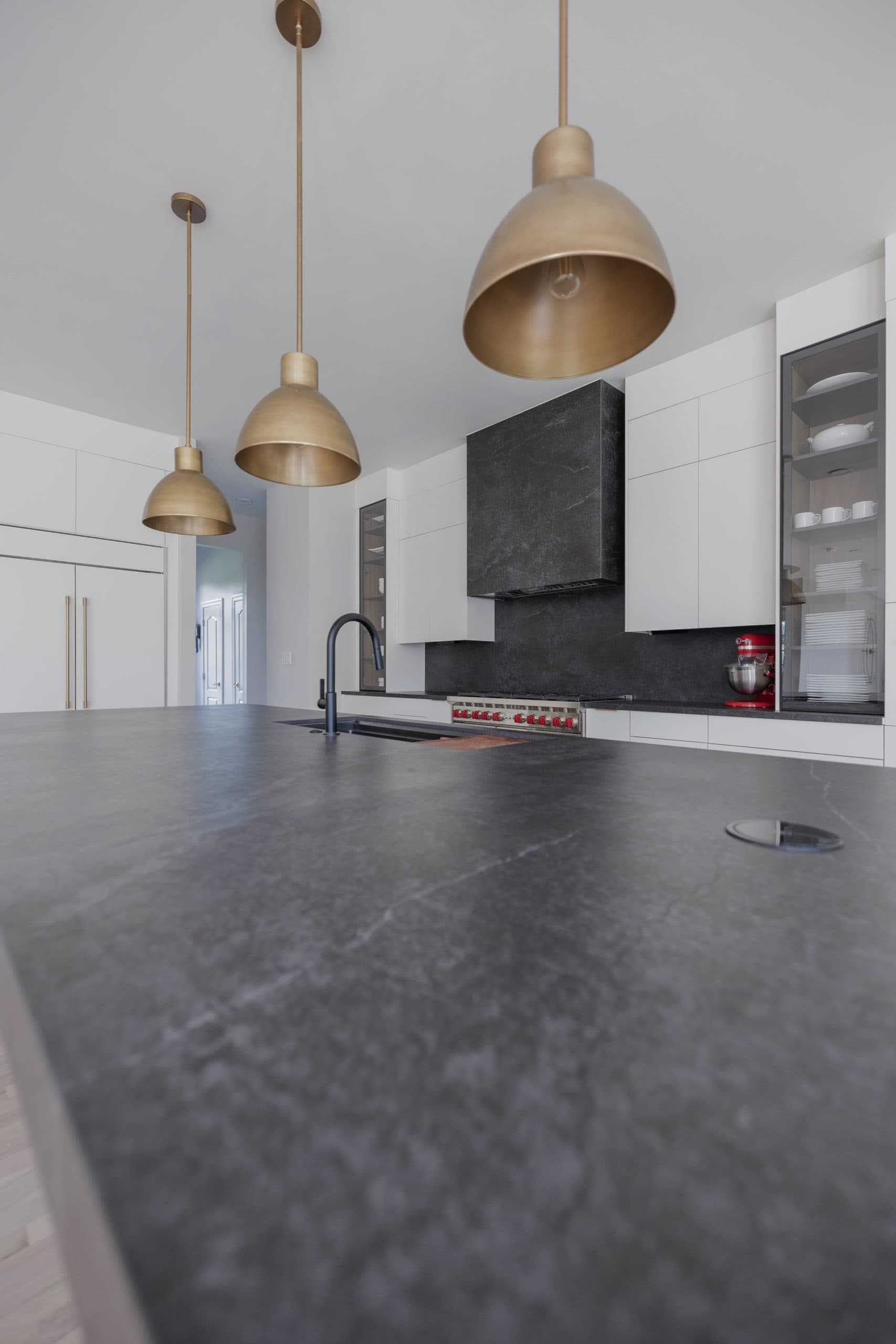
Cristallo and Patagonia
Cristallo is nearly pure crystal and lets light through, so it can be lit from behind on a bar, an island front or a vanity. Patagonia is a dramatic mix of translucent crystal and dark stone, sold as quartzite and often lit the same way. Both are priced at the top of the market, both are used in small, deliberate amounts, and both need a fabricator who has worked with them before.
Is It Real Quartzite? Three Tests at the Slab Yard
Because marble and dolomite are sometimes sold as quartzite, test the stone before you pay for it. Ask the yard for an offcut of the slab you are tagging, or test on the rough edge of the slab itself.
- The glass test. Draw a rough edge of the stone firmly across a glass tile. Real quartzite is harder than glass and cuts a scratch you can feel with a fingernail. Marble slides, and leaves a powder line that wipes away.
- The knife test. Press the tip of a steel knife into the stone and drag it. On quartzite the steel leaves a gray streak of metal that rubs off, and no groove. On marble or dolomite it cuts a groove.
- The acid test. Put a few drops of lemon juice or vinegar on the polished face and leave them for fifteen minutes. Wipe, and look across the surface against the light. A dull spot means the stone contains calcite or dolomite and will etch in your kitchen. Dolomite reacts slowly, so do not hurry this one.
A good yard will hand you the offcut and the lemon. If a slab fails, it may still be a fine stone for a bathroom or a bar at a lower price, but it is not what the label says and it should not go beside your range.
Does Quartzite Stain, Etch or Scratch?
- Does quartzite stain? A sealed quartzite resists stains well. Unsealed, it can take up cooking oil, and the more absorbent varieties darken where water stands. Wipe oil and wine when you see them and keep the seal up.
- Does quartzite etch? True quartzite does not. If a counter sold as quartzite shows dull rings from lemon or vinegar, the stone is marble or dolomite.
- Does quartzite scratch? Hardly. It is harder than a steel knife. Grit under a heavy pot can mark a polished face over the years, and a stone shop can polish that out.
- Can you put hot pans on quartzite? Yes. There is no resin to scorch, which is its advantage over quartz. A trivet is still a good habit: it protects the sealer, and it spares a cold slab a sudden shock near a cutout.
- Does quartzite chip? At a sharp edge by the sink or the dishwasher, it can. An eased or slightly rounded edge prevents most chips, and a chip can be filled.

Sealing Quartzite Countertops
Quartzite is sealed with a penetrating sealer, which soaks into the stone and leaves nothing on the surface. The fabricator applies it at installation. After that, the stone tells you when it wants more.
- The water test. Pour a spoonful of water on the counter near the sink and leave it for ten to fifteen minutes. If it still stands in a bead, the seal is good. If the stone has darkened under it, it is time to reseal.
- How often. Most kitchens need it every one to two years. Dense stones such as Taj Mahal can go longer; the whiter, more absorbent ones want it yearly. Honed and leathered finishes take sealer more often than polished.
- How to seal quartzite. Clean the counter and let it dry overnight. Wipe on a penetrating stone sealer, let it stand for the time on the label, and wipe every trace off the surface before it dries. Let it cure for a day before the counter gets wet.
- What sealing does not do. It slows absorption; it does not make stone stain proof, and it does nothing about etching on a stone that is really marble.
How to Clean Quartzite Countertops
Quartzite needs less care than its price suggests. The rule is mild soap, a soft cloth, and nothing acidic or abrasive, because harsh cleaners strip the sealer even when they do not harm the stone.
| When | What to use | How |
|---|---|---|
| Every day | Warm water, a drop of dish soap and a soft cloth | Wipe, rinse with a clean damp cloth and dry, so soap does not build into a film |
| Every week | A pH neutral cleaner made for natural stone | Spray, wipe and dry; this lifts the film that soap leaves |
| Oil and grease marks | A paste of baking soda and water | Spread it over the mark, cover with plastic wrap, leave for a day, wipe away and repeat if needed |
| Coffee, tea and wine on light stone | A paste of baking soda and hydrogen peroxide | Test in a corner first; cover, leave for a day and wipe away |
| Dried food | A plastic scraper | Lift it off dry, then wipe; do not scour |
| Hard water marks at the faucet | A stone safe cleaner for soap film and minerals | Never vinegar or a lime remover |
| Once a year | The water test | Reseal if the stone darkens under standing water |
Do not use vinegar, lemon based cleaners, bleach, ammonia, glass cleaner, abrasive powders or scouring pads. If a mark will not lift, a stone restoration company can hone and polish the surface, which is one of the advantages of a counter that is stone all the way through.
Finishes, Edges, Thickness and Seams
- Polished. Glossy and reflective; it shows the veining at its strongest and absorbs the least.
- Honed. Matte and smooth. Softer to the eye, and it shows oil marks sooner, so it is sealed more often.
- Leathered. Matte with a slight texture you can feel. It hides fingerprints and water spots and suits dark stones and warm whites.
- Edges. An eased edge, square with the corner softened, is the standard and the safest against chips. A mitered edge makes the top look thick and suits an island.
- Thickness. 3 centimeters, about an inch and a quarter, is the Northern Virginia standard and sits on the cabinets without a sub top.
- Seams. Natural slabs run roughly 110 to 130 inches long and 65 to 75 inches wide. An island longer than the slab, or an L shaped run, takes a seam; it is placed away from the sink and the cooktop and the veining is matched across it.
- Overhangs. About 10 inches of seating overhang without support, as with granite; beyond that, steel brackets are let into the cabinet tops.
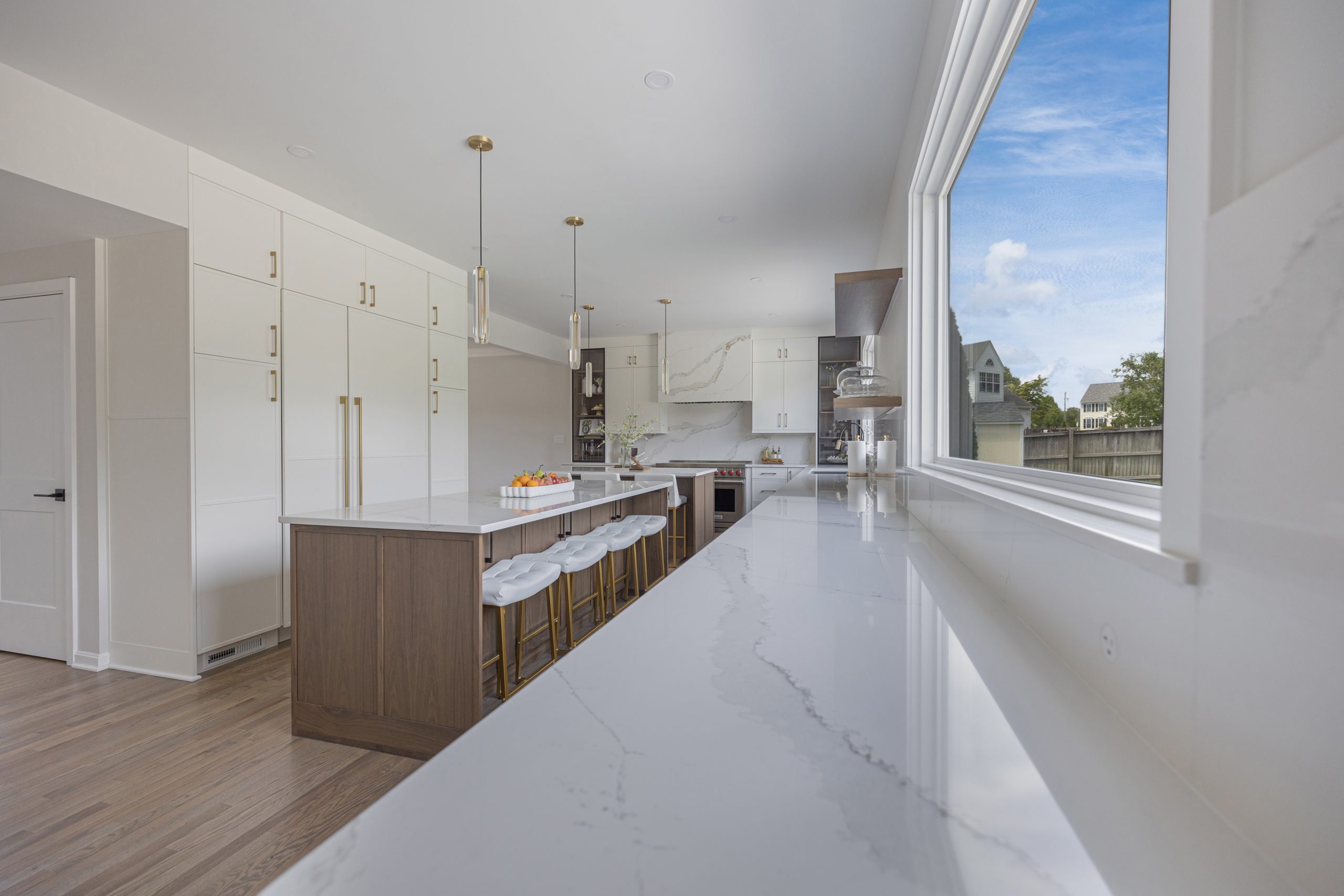
Where Quartzite Works Best
A quartzite island
The island is where a statement stone earns its cost: it is the surface everyone faces, and it is one piece. The perimeter can then be a quiet quartz at the sink and the range. One of the two surfaces should be calm; two veined stones in one room compete. Our kitchen island guide covers sizes and seating.

A waterfall end
On a waterfall the top turns down the end of the island to the floor. With a veined stone, both pieces are cut from one slab so the lines continue over the mitered corner. It is the detail that shows the stone best and the one that most needs a careful fabricator.

A quartzite backsplash
Carrying the same slab up the wall behind the range gives a surface with no grout and no resin, at $1,500 to $4,000 added to the countertop job. The slabs for the counter and the wall are tagged together so the color agrees. Our kitchen backsplash ideas compare a slab with tile.

Quartzite bathroom countertops
A vanity top is small, so a remnant from the yard often does it, and that is the least expensive way to own a rare stone. Quartzite does not etch from toothpaste or cleaners as marble does, and a sealed top handles water. It also suits a shower bench, a niche shelf and a tub deck. Our bathroom remodeling page and timeless bathroom guide show the rooms.
Outdoor kitchens and sunny rooms
Quartz yellows in strong sun; quartzite does not. For an outdoor kitchen, a sunroom or a counter under a south window, natural stone is the right choice, in a honed or leathered finish that does not glare.
From the Slab Yard to the Kitchen: How It Is Chosen and Installed
- Set the budget and the layout first. The drawing tells us how many slabs the kitchen needs, which is most of the price.
- Visit the slab yard. For most of Northern Virginia that means a trip up the Route 28 corridor. Look at whole slabs standing up, in daylight if the yard allows it, not at samples.
- Tag the slabs. Choose the actual slabs, from one lot, and have them held in your name. Photograph the lot numbers.
- Test an offcut with glass, a knife and lemon, as above.
- Approve the layout. The fabricator photographs the slabs and places the counter pieces on them on screen, so you see where each vein and each seam will fall before anything is cut.
- Template. Once the cabinets are set and level, the fabricator measures them, with the sink, the cooktop and the faucet on site.
- Fabrication. Seven to fourteen days. The stone is cut wet, the cutouts are made and the edges are profiled and polished.
- Installation. One day. The pieces are set, the seams are filled with color matched epoxy, the sink is fixed underneath and the stone is sealed.
- Plumbing and backsplash. The sink and faucet are connected the next day, and a tile backsplash follows the counter.
In a full remodel the counters go in around week six; our kitchen remodel timeline shows what happens in the gap between cabinets and stone. One note on health: quartzite, like engineered quartz, is nearly all silica, and its dust is a hazard to the people who cut it. Choose a fabricator who cuts wet with ventilation, and do not allow stone to be cut dry in the house.
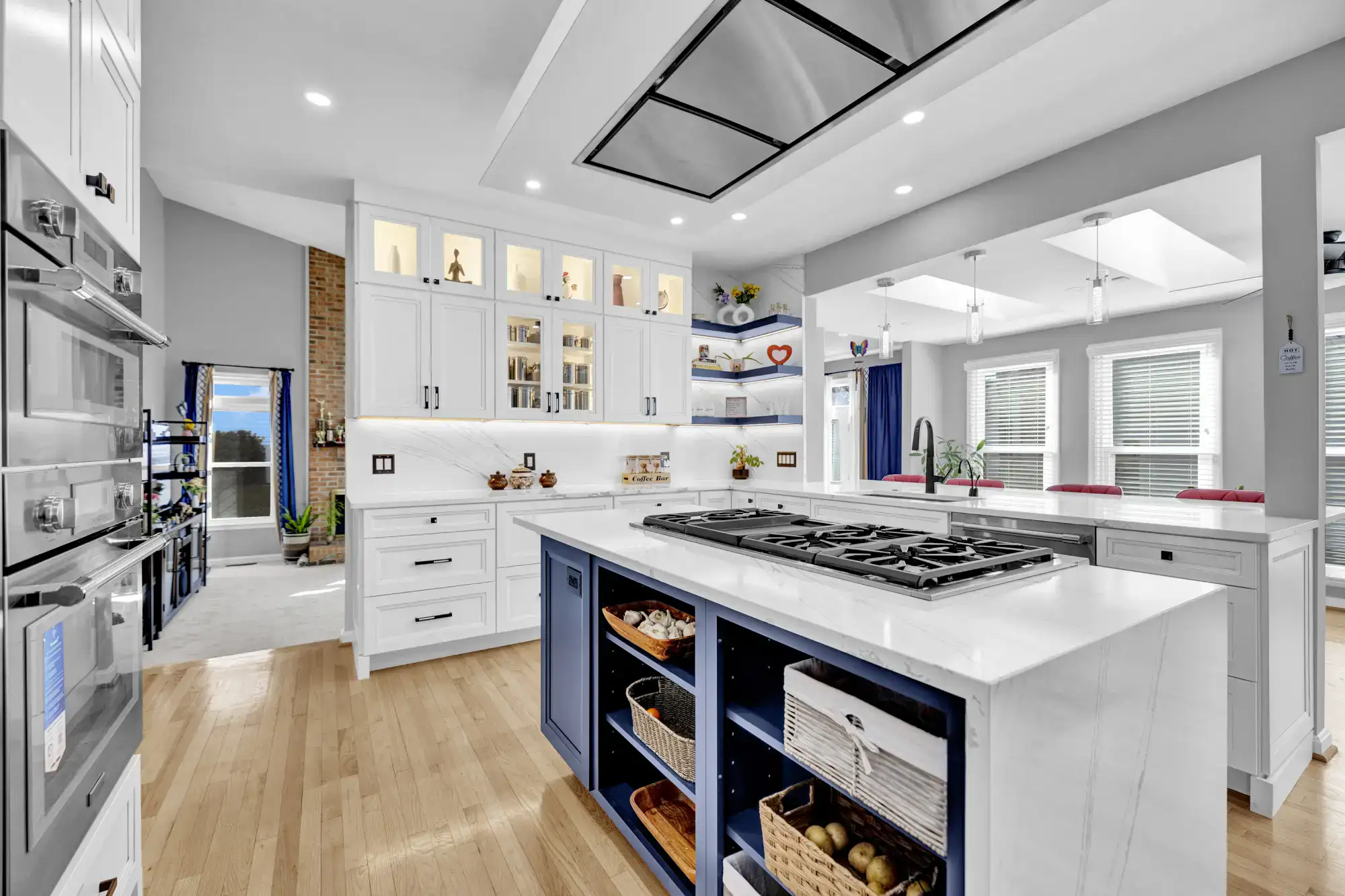
What to Pair With Quartzite
- Cabinets. Warm whites such as Taj Mahal suit white oak, walnut and cream or greige paint. Cool whites such as Mont Blanc suit white, gray and navy. Green and blue stones want plain wood or a quiet paint. Our kitchen cabinet ideas guide covers the cabinet side.
- Backsplash. The same slab, or a plain tile in a color taken from the stone. A patterned tile beside a veined counter is one pattern too many.
- Metals. Brass and bronze with the warm stones, nickel and stainless with the cool ones, and no more than two in a room; our mixing metals guide has the rule.
- Sink and faucet. An undermount sink shows the polished edge of the stone; our kitchen sink guide compares them.
- Light. Under cabinet lighting and a pendant over the island show the depth in the stone at night.
- Style. Quartzite suits the transitional kitchens most Northern Virginia houses are built for; see our transitional kitchen guide, the 40 kitchen remodel ideas and, for the materials that age well, the natural elements guide.
Quartzite Mistakes to Avoid
- Choosing from a sample. A hand sized piece cannot show a slab ten feet long. Choose the slab.
- Skipping the tests. Five minutes with glass and lemon prevents the most expensive mistake.
- Buying slabs from different lots, so the island and the perimeter are not the same white.
- Not approving the layout, and finding the best vein cut out for the sink.
- A sharp square edge at the sink and the dishwasher, where pots strike it.
- Two statement stones in one room. One leads, the other stays quiet.
- Choosing the fabricator on price alone. Quartzite is hard to cut; ask to see a kitchen the shop has done in it.
- Forgetting to reseal, then blaming the stone for an oil mark.
- Cleaning with vinegar or bleach, which strips the sealer.
- Deciding the counters last. The slab count, the seams and the appliance cutouts all depend on a finished layout.
Frequently Asked Questions
Is quartzite the same as quartz? No. Quartz is a manufactured slab of ground quartz and resin. Quartzite is a natural stone, quarried and cut into slabs. Quartzite takes heat and sunlight that quartz does not, and it needs sealing, which quartz never does.
How much do quartzite countertops cost? In Northern Virginia in 2026, $100 to $250 per square foot installed: $3,500 to $8,750 for a 10 by 10 kitchen, $5,500 to $13,750 for a typical kitchen of 55 square feet and $9,000 to $22,500 for a large kitchen with an island. National guides quote $80 to $210 per square foot.
Is quartzite more expensive than granite or quartz? Usually. Quartzite runs $100 to $250 per square foot installed, against $50 to $200 for granite and $60 to $150 for quartz. Only the exotic granites cost as much.
Is quartzite good for kitchen countertops? Yes. It is harder than granite, takes a hot pan, does not etch from lemon or wine and does not yellow in the sun. The costs are the price and a sealing day every year or two.
Does quartzite stain? A sealed quartzite resists stains well. Left unsealed, it can absorb cooking oil, and the more absorbent varieties darken under standing water. Wipe spills and keep the seal up.
Does quartzite need to be sealed? Yes. It is sealed at installation and again every one to two years. Pour a little water on the counter: if the stone darkens under it within fifteen minutes, reseal.
Can you put hot pans on quartzite? Yes. Quartzite contains no resin, so a hot pan does not scorch it. A trivet is still a good habit, because it protects the sealer.
How do you clean quartzite countertops? With warm water, a drop of dish soap and a soft cloth every day, and a pH neutral stone cleaner once a week. Lift oil marks with a paste of baking soda and water. Do not use vinegar, bleach, ammonia or abrasive pads.
What is Taj Mahal quartzite? A Brazilian quartzite with a warm white to soft beige ground and gold and caramel veining. It is the most requested quartzite because it is dense, quiet in pattern and suits white oak and brass. It is priced in the upper half of the quartzite range.
How can I tell if my quartzite is real? Draw a rough edge of the stone across glass: real quartzite scratches it. Then leave lemon juice on the polished face for fifteen minutes: real quartzite shows no dull spot. A stone that fails either test is marble or dolomite.
See the Slab Before It Is Your Kitchen
Quartzite is chosen once and lived with for decades, so it is worth choosing well. EA Home Design is a Class A licensed design build firm (license 2705157182) that designs the kitchen in 3D, takes clients to the slab yard, tests the stone and approves the veining layout with them before anything is cut, across Fairfax and Loudoun County. See our kitchen remodeling page, the Vienna kitchen case study, our other case studies and our luxury remodeling guide, then book a free in home design consultation or call (703) 687-1818.