Quartz is the better countertop for most kitchens: it never needs sealing, it shrugs off wine, oil and tomato sauce, the slab looks like the sample, and the marble looks that most homeowners want now are only available in quartz at a price most budgets can carry. Granite is the better countertop if you want a natural stone that no one else has, if you set hot pans down without thinking, or if the counter is going outdoors. The prices overlap more than people expect. In Northern Virginia in 2026, quartz runs $60 to $150 per square foot installed and granite $50 to $200, so a typical 50 to 60 square foot kitchen lands at $5,000 to $8,000 in quartz and $4,000 to $9,000 in granite depending on the level of stone. We are a Class A licensed design build remodeler (VA #2705157182) that installs both every month in Fairfax and Loudoun County, and this guide compares them on what actually decides the choice: cost, heat, stains, scratches, sealing, seams, looks, resale, health and what happens at the fabricator.
Quartz vs Granite Countertops at a Glance
| Quartz | Granite | |
|---|---|---|
| What it is | Engineered stone: about 90 percent ground natural quartz bound in polymer resin with pigments | Natural igneous rock, quarried in slabs and polished |
| Installed cost, Northern Virginia 2026 | $60 to $150 per square foot; most kitchens $70 to $120 | $50 to $200 per square foot; most kitchens $55 to $110 |
| A 55 square foot kitchen | $5,000 to $8,000 | $4,000 to $9,000 |
| Sealing | Never | Every one to three years for most stones; some dense granites almost never |
| Stains | Non porous; resists nearly everything in a kitchen | Resists when sealed; oil and wine mark an unsealed light stone |
| Heat | Resin can scorch or discolor above roughly 300 degrees Fahrenheit; always use a trivet | Takes a hot pan; sudden extreme heat can still crack a stone at a weak point |
| Scratches | Very hard; knives dull before it marks, but it can be scratched | Very hard; similar, and a scratch in a busy pattern disappears |
| Chips | Chips at edges and cutouts; repairs are visible in light solid colors | Chips at edges and cutouts; color matched epoxy repairs nearly disappear |
| Seams | Tight and color matched; easy to hide in a consistent pattern | Visible in a pattern with movement; a good fabricator plans them where the eye does not go |
| Outdoors and sunlight | No; resin yellows and warranties exclude it | Yes; UV stable |
| Consistency | The slab matches the sample; two islands match each other | Every slab is different; you choose the slab, not the sample |
| Looks available | Solid colors, fine patterns, and the marble looks with soft or dramatic veining | Speckles, flecks and movement in blacks, grays, browns, whites, greens and blues; leathered and honed finishes |
| Lifespan | 25 years and more | Longer than the kitchen around it |
| Resale in Northern Virginia | The surface buyers recognize as current | Premium and leathered granites read as luxury; speckled 2000s granite reads as dated |
| Best for | Busy family kitchens, white and marble look designs, anyone who does not want to seal | Cooks who use heat, outdoor kitchens, dark honed looks, anyone who wants a one of a kind stone |
Everything below is the detail behind those rows. If you want the whole field, including quartzite, porcelain, marble and wood, our kitchen countertops guide compares ten materials; this page stays on the two that most Northern Virginia kitchens actually choose between.
What Quartz and Granite Countertops Actually Are
Quartz: Engineered Stone
A quartz countertop is a manufactured slab, not a slice of rock. Crushed natural quartz, one of the hardest common minerals, is mixed with polymer resins and pigments, pressed under vacuum and vibration, cured and polished. The quartz content is around 90 percent by weight, the resin binds it and fills every pore, and the pigments and veining are printed or poured in during manufacture. That process is the source of every quartz advantage: no pores, so no sealing and no stains; a controlled pattern, so the sample in the showroom is the slab in your kitchen; and the ability to imitate Calacatta and Carrara marble, which is why white quartz with soft gray veining is the most specified countertop in the country. It is also the source of every quartz limit. The resin is what scorches under a hot pan, yellows in sunlight and dissolves under the wrong chemical. Quartz comes in standard slabs of about 120 by 55 inches and jumbo slabs of about 130 by 65 inches, the jumbo size being the reason a long island can be done in one piece, and in 2 centimeter and 3 centimeter thicknesses, 3 centimeter being the standard in Northern Virginia. Do not confuse it with quartzite, a natural stone covered later.
Granite: Natural Stone
Granite is igneous rock, cooled slowly from magma into interlocking crystals of quartz, feldspar and mica, quarried in blocks, sawn into slabs and polished, honed or leathered. Most of what is sold in Northern Virginia comes from Brazil and India, some from Italy, Spain, Norway and China, and a little from Virginia itself: the dark gray Virginia Mist quarried near Culpeper is a countertop stone as well as the building stone described in our exterior stone guide. Granite is sold in levels, one through five and beyond, and the level is a price group set by rarity and yield, not a grade of quality; a level one Uba Tuba is as durable as a level five blue Bahia, it is simply common. Every slab is unique, which means you choose the actual slab at the yard, the fabricator lays out your pieces on that slab so the veins run where you want them, and no sample tells you what the whole stone looks like. Granite is porous to a degree that varies by stone: dense black and dark gray granites barely absorb anything, light and open grained stones drink oil and need their sealer. Slabs run around 110 by 65 inches, smaller than jumbo quartz, which is why a long granite island often carries a seam.
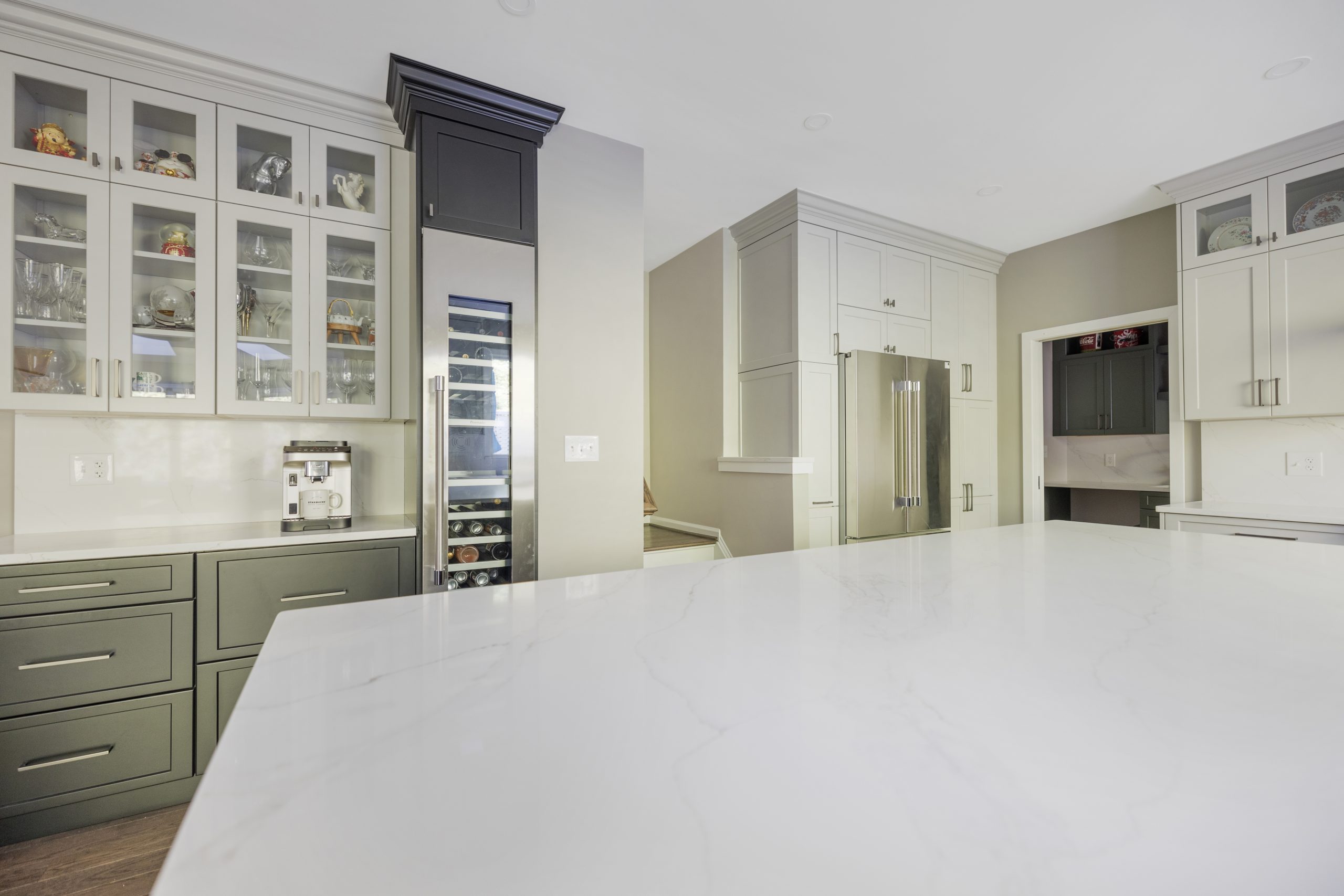
Cost: Quartz vs Granite Countertops in 2026
These are the installed ranges we see on our own kitchens in Fairfax and Loudoun County, consistent with our kitchen remodel cost guide. Installed means the slab, fabrication, edges, cutouts, delivery and installation on finished cabinets; removal of the old tops, plumbing reconnection and a backsplash are separate.
| Tier | Installed cost per square foot | What you get |
|---|---|---|
| Granite, level 1 and 2 | $50 to $75 | Common stones in stock at every yard: Uba Tuba, Santa Cecilia, New Venetian Gold, Baltic Brown, Black Pearl; the builder granite of the 2000s and still the cheapest stone counter |
| Granite, level 3 and 4 | $75 to $120 | More movement, lighter and whiter stones, honed and leathered finishes, Virginia Mist, Alaska White, Steel Gray leathered |
| Granite, exotic and premium | $120 to $200 | Blues, deep greens, dramatic whites with quartz veins, bookmatched slabs, stones with low yield |
| Quartz, entry | $60 to $85 | Solid colors and fine speckled patterns from the value lines; the counter in most builder and flip kitchens |
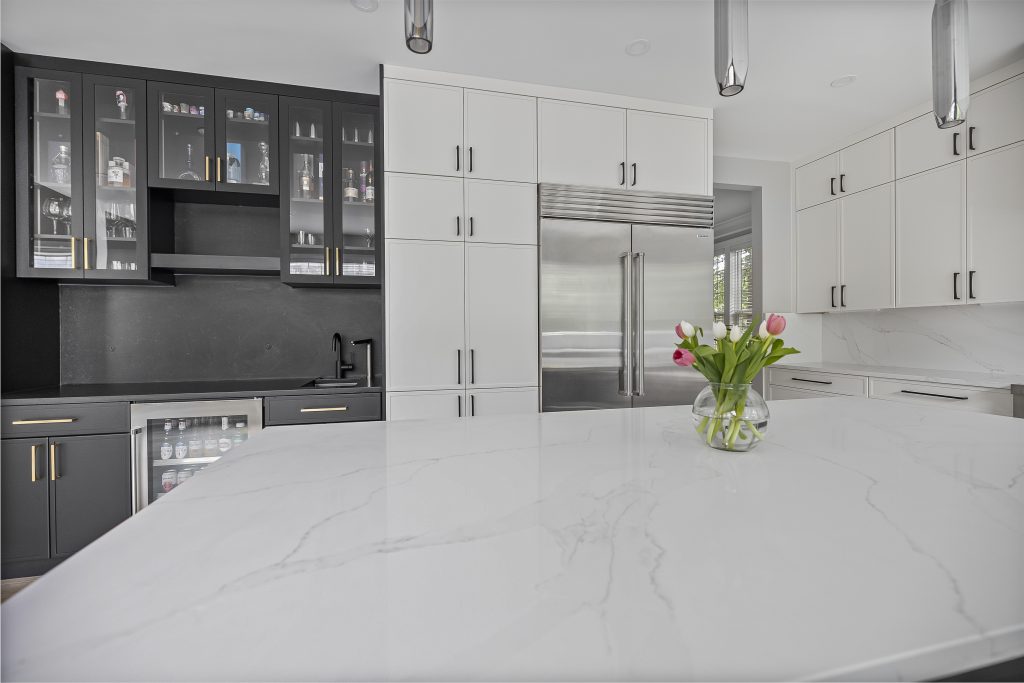
| Quartz, mid range | $85 to $120 | The marble looks, Calacatta and Carrara patterns, warm whites and grays from the established brands; where most of our kitchens land |
| Quartz, premium | $120 to $150 | Heavy veining, jumbo slabs, bookmatched islands, honed and textured finishes, thicker mitered edges |
Three things move a countertop bill more than the choice between the two materials. Slab yield: a kitchen that fits on two slabs costs less than one that needs a third for a single piece, and an island that fits inside a jumbo quartz slab avoids a seam that granite would need. Edges and details: a standard eased or beveled edge is included, an ogee or a thick mitered edge is an upcharge per linear foot, and a waterfall end adds $2,500 to $6,000 per side in quartz and more in granite, as our kitchen island cost guide explains, because each side is a separate mitered, pattern matched piece. Cutouts and backsplash: an undermount sink cutout, a cooktop cutout and a full height slab backsplash each add to the count. The big box package prices that advertise stone at half these numbers are usually 2 centimeter material in a short list of colors with the sink cutout, the edge and the removal priced as extras; compare the installed total, not the per foot figure.
The honest summary: at the bottom of the market granite is cheaper than quartz, in the middle they cost about the same, and at the top exotic granite and quartzite cost more than any quartz. Over the life of the counter, granite adds a bottle of sealer every year or two and an occasional professional reseal, which is small money; quartz adds nothing.
Durability: Heat, Scratches, Stains and Chips
Heat
Granite wins, and it is the one place the gap is wide. Granite formed at temperatures no kitchen can produce, and a pan off the burner set directly on it does no harm; the risks are a sudden extreme temperature change cracking a stone at a thin point, such as beside a cooktop cutout, and heat damaging the sealer rather than the stone. Quartz is limited by its resin, which begins to discolor, scorch or craze somewhere above roughly 300 degrees Fahrenheit, and a hot cast iron pan, a slow cooker base or a toaster oven left running against the surface will leave a permanent mark that no warranty covers. The rule in a quartz kitchen is a trivet for anything that comes off a burner or out of the oven, without exception. Households that will not keep that rule should choose granite or accept a mark near the range within the first year.
Scratches
Both are among the hardest surfaces a kitchen can have. Granite sits at 6 to 7 on the Mohs scale and quartz mineral at 7, so an ordinary knife dulls itself before it marks either one, and a cutting board is for the knife, not the counter. Quartz can be scratched by something harder than the resin holding the mineral, an unglazed ceramic bottom or a dropped piece of hardware, and a scratch shows most on a dark, uniform quartz. A scratch in a busy granite pattern is simply invisible. Honed and leathered finishes hide use on both; a polished black surface of either kind shows everything, from scratches to water spots.
Stains
Quartz wins clearly. It has no pores, so wine, coffee, oil, turmeric and beet juice wipe up whether they sat for a minute or overnight; the exceptions are dyes and solvents, permanent marker, hair dye and some nail polish removers, which attack the resin rather than soaking in. Granite resists stains when its sealer is intact and absorbs them when it is not, and the difference between stones is large. A dense dark granite may never take a stain in twenty years; a light, open grained stone will show an oil ring under a bottle within a season if it goes unsealed. The test is a few drops of water left on the counter for ten minutes: if they bead, the sealer is working, and if the stone darkens, it is time to reseal.
Chips and Cracks
Both chip in the same places, the edge at the sink where pots land and the corner of a cooktop cutout, and neither cracks in normal use once it is properly supported. Granite chips are repaired with color matched epoxy and, in a stone with pattern, disappear; quartz chips are repaired the same way but a repair in a light solid quartz is usually visible if you know where to look. Granite has natural fissures and pits that are part of the stone and not defects, and a buyer who wants none of that wants quartz. Overhangs for seating are where support matters: most fabricators allow a 3 centimeter quartz top to overhang about 12 to 14 inches without brackets and a 3 centimeter granite top about 10 inches, and anything beyond that gets steel brackets or corbels in either material.
Sunlight and Outdoors
Granite goes outdoors; quartz does not. UV light yellows and fades quartz resin, and every major quartz warranty excludes exterior use and often a counter under a large south facing window. For an outdoor kitchen in Northern Virginia the choice is granite, porcelain slab or concrete.
Chemicals
Quartz is damaged by strong alkalis and solvents: oven cleaner, bleach left to sit, paint stripper, drain cleaner and some degreasers, all of which cloud or pit the resin. Granite is damaged by acids and harsh cleaners that strip the sealer: vinegar, lemon, and bathroom cleaners built for tile. In both kitchens the daily cleaner is dish soap and warm water, and the specialty products are a stone cleaner for granite and nothing at all for quartz.
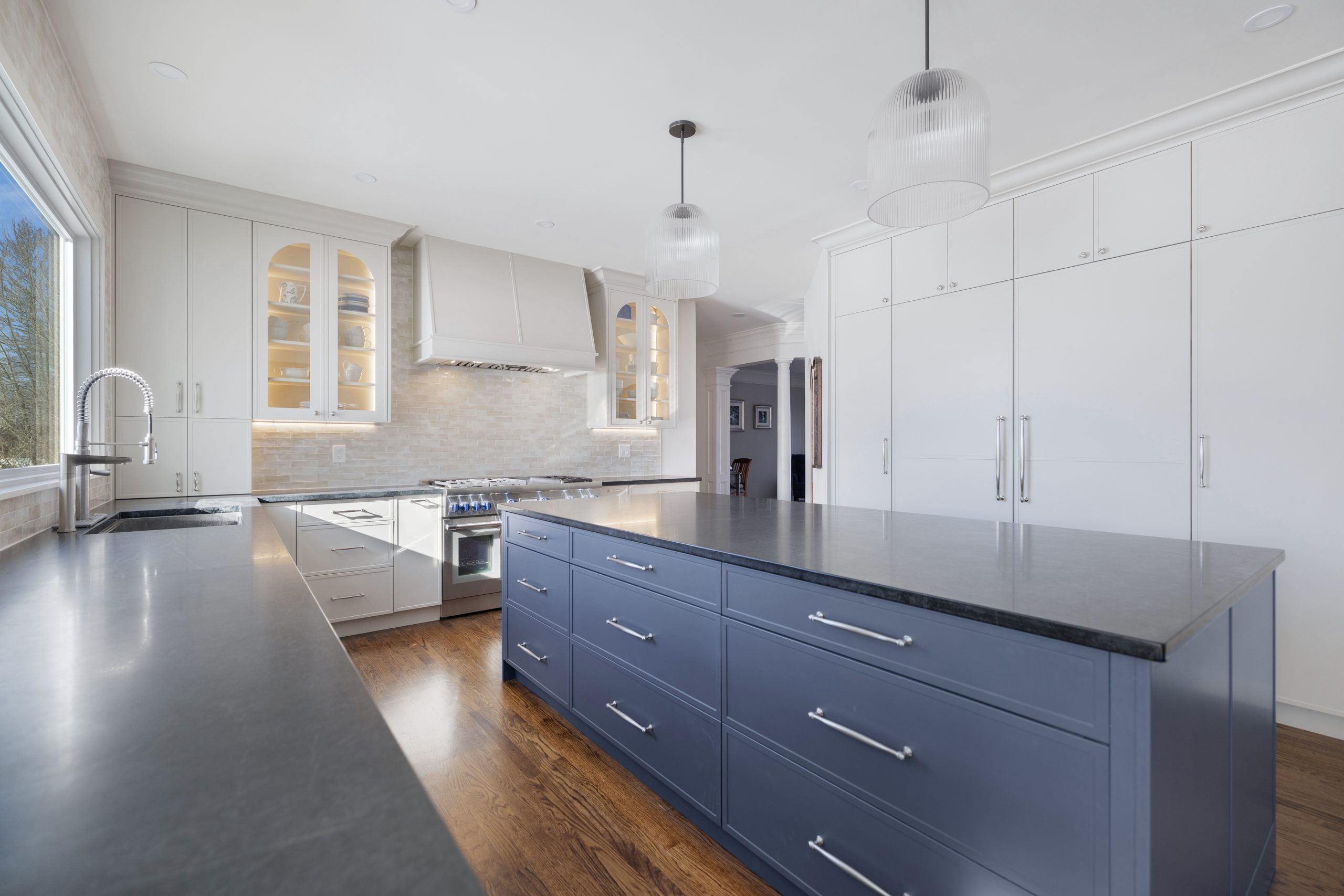
Maintenance: Sealing and Daily Care
Quartz maintenance is a sponge, dish soap and warm water, a plastic scraper for anything dried on, and a trivet. That is the whole list, and it is the reason quartz has taken most of the market. Granite adds one job: sealing. A penetrating sealer is wiped on, left for the time on the bottle, and buffed off, a twenty minute task with a $20 to $40 bottle that most homeowners do themselves every one to three years, or every five or more on a dense dark stone; some fabricators apply a fifteen year sealer at installation and the water test tells you when it has given up. Daily cleaning for granite is the same soap and water or a pH neutral stone cleaner, never vinegar or an acidic spray. Two habits serve both materials: do not leave standing water at a seam, where it eventually loosens the adhesive, and wipe the area around the sink faucet, because Northern Virginia’s moderately hard water leaves mineral spots on any dark polished surface, quartz or granite alike, and honed finishes show them less.
Looks: Consistency Against Character
Quartz offers control. The sample is the slab, the two ends of a long island match, the veins can be run the length of the island and mitered down a waterfall end so the pattern turns the corner, and the marble looks are convincing enough that most visitors will not know. The trade is that a quartz pattern repeats, a printed vein has a certain regularity to it, and a room full of quartz can feel flat next to real stone. Granite offers character. Movement, depth, crystals that catch light, and a slab nobody else has, chosen by you at the yard and laid out so the vein you liked lands on the island rather than under the toaster. The trade is that you have to see the slab, the seams show more, and the granite most people picture, the speckled Uba Tuba and Santa Cecilia of the early 2000s, now dates a kitchen faster than almost any other finish. Current granite looks nothing like that: honed and leathered Virginia Mist and Steel Gray, white and cream stones with gray veining, and deep dramatic slabs used as a single statement. Both materials come polished, honed and leathered; honed quartz shows fingerprints and marks more than polished, while leathered granite hides almost everything. Our transitional kitchen guide covers how counters, cabinets and backsplash are chosen together, and the Loudoun kitchen materials guide has the local buyer’s view of both.
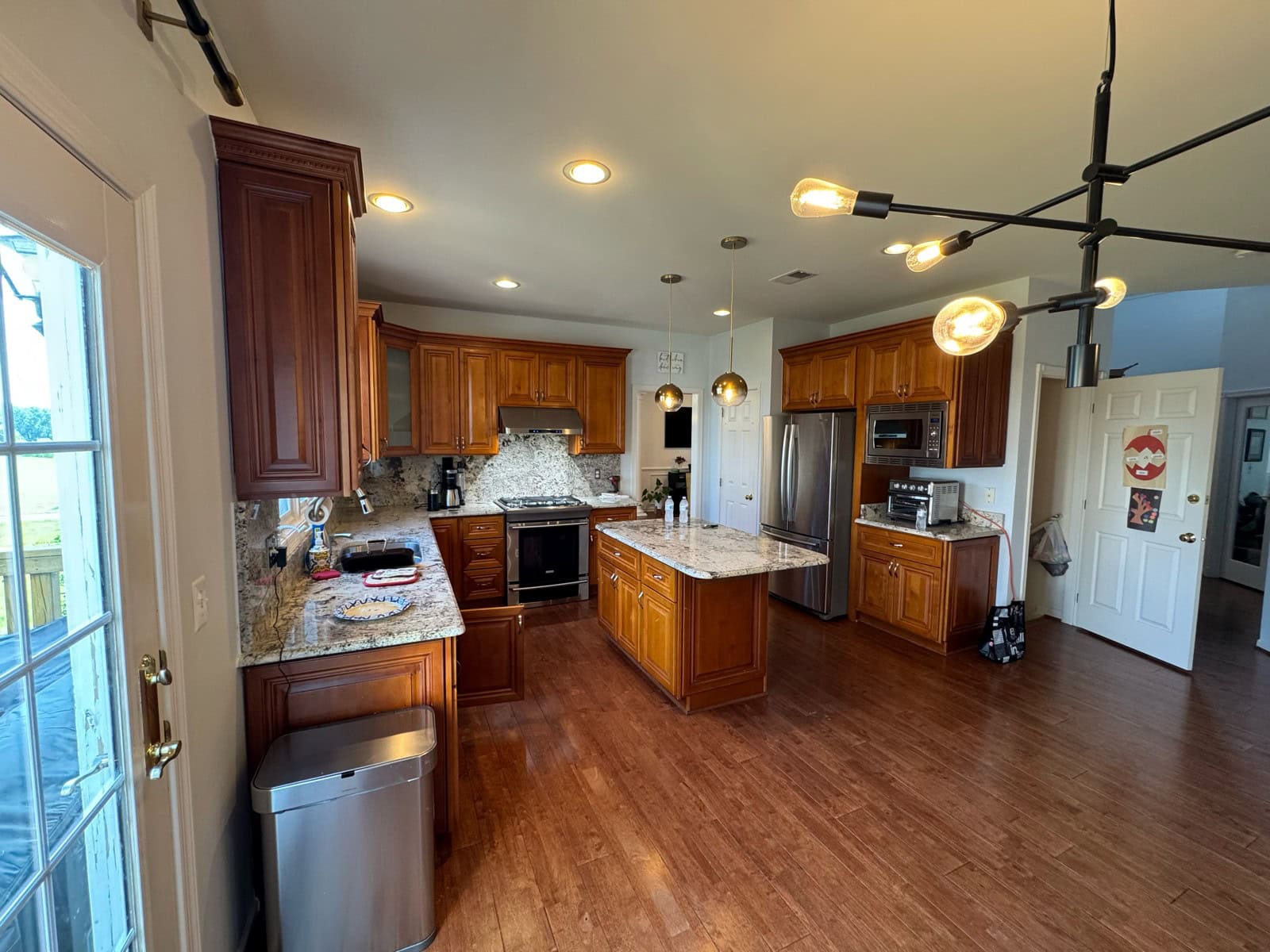
Resale: What Northern Virginia Buyers Prefer
Twenty years ago granite countertops were the line in the listing. Today the line is quartz, and in Fairfax and Loudoun County the white or lightly veined quartz counter is the surface buyers recognize as current and photograph well online, which is where a house is sold first. That does not make granite a liability. A leathered black or a dramatic light granite in a designed kitchen reads as luxury to the same buyers; what reads as dated is the specific speckled, polished, brown and gold granite of the tract homes built between 1998 and 2008, which is exactly the stone most Northern Virginia sellers are replacing. Neither material changes an appraisal, both outlast the sale, and the honest resale rule is that the counter should match the rest of the kitchen: quartz on painted shaker cabinets, a considered granite in a kitchen that is otherwise natural wood and stone. If the kitchen is being refreshed to sell within three years, quartz in a white or soft gray is the low risk answer.
Health and Safety: Radon, Silica and Food Prep
Three questions come up, and two of them are asked about the wrong material. Radon from granite: granite contains trace uranium and some slabs emit measurable radon, but the Environmental Protection Agency’s position has long been that the contribution of a granite countertop to indoor radon is very small compared with the radon that enters a home from the soil beneath it. If radon concerns you, test the house, not the counter; in the Northern Virginia counties that sit on radon prone geology, that test is worth doing regardless of what the kitchen is made of. Food safety: quartz is non porous and certified for food contact by NSF, so it harbors nothing; sealed granite is also safe for food preparation, and the sealer is what keeps it that way. Silica: this is the real issue, and it belongs to the people who cut the stone rather than the people who cook on it. Engineered quartz is more than 90 percent crystalline silica, granite typically 10 to 45 percent, and cutting, grinding or polishing either without water and ventilation releases the fine silica dust that causes silicosis. A wave of severe silicosis among young countertop fabrication workers led Australia to ban engineered stone in 2024 and led regulators here to tighten enforcement of the OSHA silica standard. An installed quartz or granite counter poses no silica risk in a home. The practical response is to ask any fabricator how they cut, insist on wet cutting and dust capture, and never allow dry cutting of either material in your house or driveway on installation day.
Fabrication and Installation: What Happens After You Choose
The process is identical for both materials, and the kitchen remodel timeline guide shows where it falls in the project. Once the cabinets are installed and level, the fabricator templates the exact shape, usually with a laser, and you approve the layout: where the seams fall, which part of the slab goes on the island, how the veins run. For granite that approval happens on your actual slab; for quartz it is a drawing. Fabrication takes one to two weeks, installation takes a day, and the sink and cooktop are reconnected after it. Undermount sinks work with both, clipped and epoxied to the underside of the stone; our kitchen sink guide covers the choices. Dishwashers mount to the cabinets or to a bracket rather than into the stone. Seams are set with color matched epoxy and should be tight, flat and placed away from the sink and the cooktop; a seam through a cutout is a crack waiting for a reason. None of this needs a permit in Fairfax or Loudoun County when the counters go on existing cabinets with the sink in the same place, as the kitchen permit guide explains; a sink that moves or a cooktop that needs a new circuit brings its own trade permit.
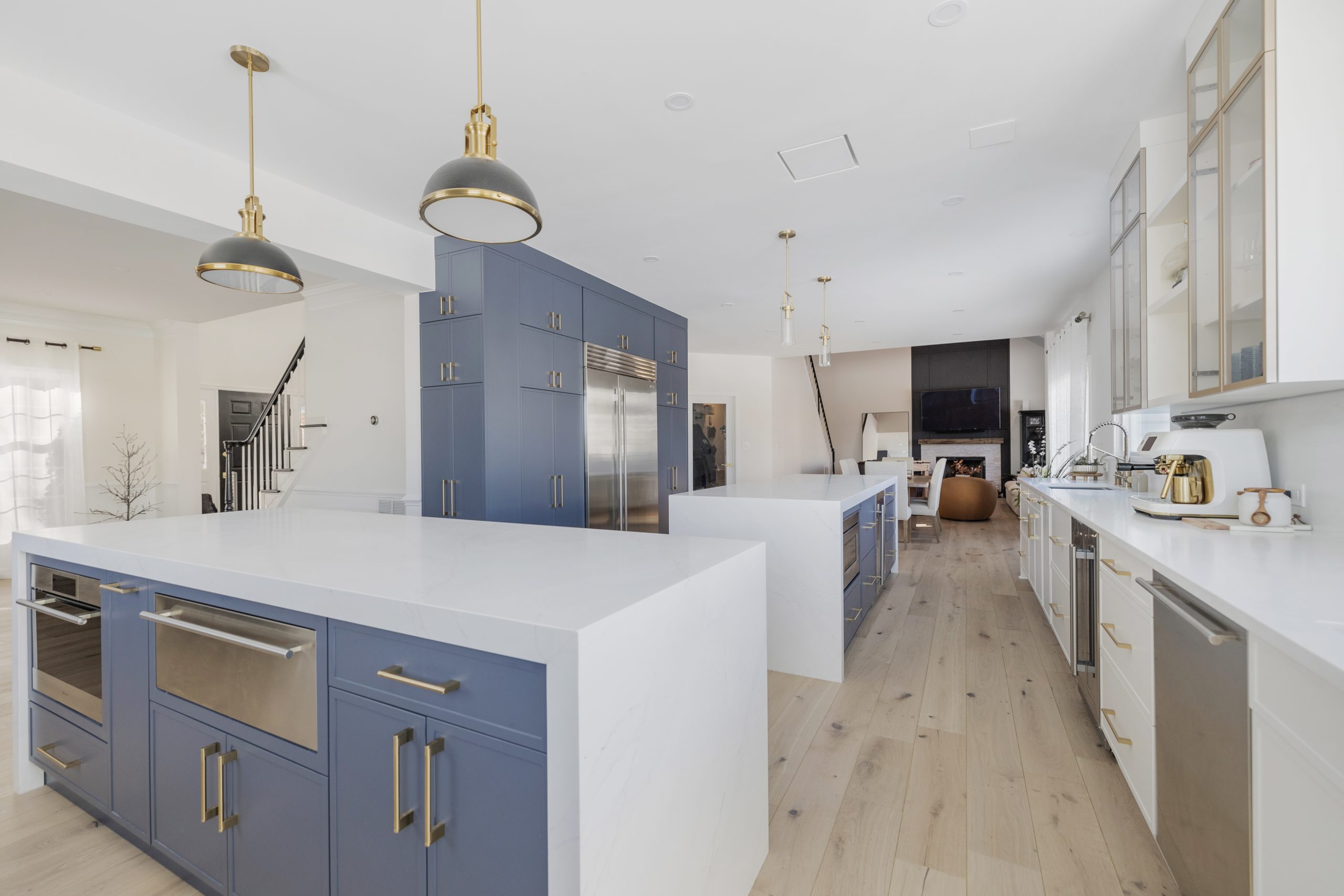
Which Should You Choose? A Decision Guide
| Your kitchen | Choose | Why |
|---|---|---|
| A busy family kitchen, kids, spills, no time for upkeep | Quartz | No sealing, no stains, no maintenance calendar |
| You want white counters or a marble look | Quartz | Real marble stains and etches; white granite is rare and expensive; quartz gives the look without the care |
| You cook seriously and set hot pans down | Granite | The one clear durability gap; quartz will scar near the range within the year |
| An outdoor kitchen or a counter in strong sun | Granite | Quartz resin yellows and its warranty excludes it |
| A dark, honed or leathered look | Either; granite is often cheaper here | Leathered Virginia Mist or Steel Gray at level 3 costs less than a premium dark quartz and hides more |
| You want a stone nobody else has | Granite, or quartzite | Every slab is unique; quartz patterns repeat |
| A long island with no seam | Quartz | Jumbo slabs at 130 by 65 inches; granite slabs are smaller |
| Selling within three years | Quartz in white or soft gray | The surface buyers and listing photos reward now |
| A tight budget for a large kitchen | Level 1 or 2 granite | $50 to $75 installed beats entry quartz and is the same stone it always was |
| A traditional or historic house | Honed granite, or soapstone | A polished engineered slab can look wrong against old wood and plaster |
Quartzite, Porcelain and Marble: The Alternatives Worth a Look
Quartzite is the natural stone people confuse with quartz, and it is closer to granite: a metamorphosed sandstone, harder than granite, heat proof, with the white and gray veining of marble, and priced like premium granite and above. It needs sealing like granite and it has to be real quartzite, because some soft marbles are sold under the name; a glass tile or a knife blade should not scratch it. Porcelain slab is fired ceramic, thin, heat proof, UV stable and nearly stain proof, the right answer for an outdoor kitchen or a full height backsplash, with the caveats that the pattern is printed on the surface so a chipped edge shows the body and that fabrication takes a specialist. Marble is the most beautiful and the least forgiving: it etches under lemon and wine, stains, and scratches, and belongs in the kitchen of someone who will love the patina. All three, with butcher block, concrete, stainless and laminate, are compared in our best kitchen countertops guide.
The Northern Virginia Specifics
Most of the region’s slab yards sit along the Route 28 and Route 50 corridors between Sterling, Chantilly and Manassas, close enough to Fairfax and Loudoun County that choosing a granite slab in person is an afternoon rather than a project, and we walk clients through them with the cabinet door and the backsplash tile in hand. The housing stock sets the job: the colonials and town homes built across Loudoun and western Fairfax between the late 1990s and 2008 carry the speckled polished granite of that era on cherry or maple cabinets, and the most common countertop project we do is replacing exactly that with a white veined quartz on painted or new cabinets, as in our Vienna kitchen case study. Virginia Mist, quarried near Culpeper, is the local stone worth asking for when the design wants a dark honed or leathered counter. Counters replaced on existing cabinets need no permit in either county; a moved sink or a new cooktop circuit does. And the region’s water is moderately hard, which argues for honed finishes and against polished black surfaces of either material around the sink. Our kitchen remodeling service page shows the finished kitchens, and our design build process shows where the countertop decision falls in a project.
Frequently Asked Questions
Is quartz or granite better for kitchen countertops?
Quartz is better for most kitchens because it never needs sealing, does not stain, and looks exactly like its sample, and it is the only way to get a marble look without marble’s care. Granite is better if you set hot pans directly on the counter, want a natural stone that is unique to your kitchen, or need a counter outdoors. Both last decades.
Which is cheaper, quartz or granite?
At the low end granite is cheaper: level 1 and 2 granite runs $50 to $75 per square foot installed in Northern Virginia against $60 to $85 for entry quartz. In the middle they cost about the same, $75 to $120 for either. At the top, exotic granite at $120 to $200 costs more than premium quartz at $120 to $150. A typical 55 square foot kitchen is $5,000 to $8,000 in quartz and $4,000 to $9,000 in granite.
Can you put hot pans on quartz countertops?
No. The resin that binds quartz begins to discolor or scorch above roughly 300 degrees Fahrenheit, and a hot pan, a slow cooker or a toaster oven against the surface leaves a permanent mark that warranties exclude. Use a trivet for everything that comes off a burner or out of the oven. Granite takes a hot pan without harm.
Does granite need to be sealed?
Most granite should be sealed every one to three years, and dense dark granites far less often. It is a twenty minute job with a wipe on penetrating sealer. Test it by leaving a few drops of water on the surface for ten minutes: if the stone darkens, reseal; if the water beads, the sealer is working. Quartz is never sealed.
Which is more durable, quartz or granite?
They are close, and each wins one category. Granite wins on heat and on hiding chips and scratches in its pattern. Quartz wins on stains and on consistency. Both are harder than kitchen knives, both chip at sink edges and cutouts if abused, and both outlast the cabinets under them.
Which countertop is better for resale?
In Northern Virginia, white or lightly veined quartz is the surface buyers currently recognize as an upgrade and the one that photographs best for a listing. A premium or leathered granite in a designed kitchen also reads as luxury. The countertop that hurts a sale is the speckled polished granite of the early 2000s, which dates the whole kitchen.
Do granite countertops give off radon?
Some granite emits trace radon, but the Environmental Protection Agency’s position is that a countertop’s contribution to indoor radon is very small compared with radon entering from the soil under the house. Test the home, not the counter, especially in the parts of Northern Virginia with radon prone geology.
Is quartz countertop dust dangerous?
Only when the stone is cut. Engineered quartz is more than 90 percent crystalline silica, and dry cutting or grinding it releases dust that causes silicosis in fabrication workers, which is why Australia banned the material in 2024 and OSHA enforces a silica standard here. An installed counter is inert and safe. Ask your fabricator to wet cut with dust capture, and never allow dry cutting at your house.
Can quartz countertops go outside?
No. Sunlight yellows and fades the resin, and quartz warranties exclude exterior use. For an outdoor kitchen choose granite, porcelain slab or concrete.
What is the difference between quartz and quartzite?
Quartz is an engineered slab of crushed mineral in resin; quartzite is a natural metamorphic stone, harder than granite, heat proof, with marble like veining, that needs sealing like granite and is priced like premium granite and above. The names cause real confusion at the slab yard, so ask which one you are looking at.
How thick should quartz or granite countertops be?
Three centimeters, about 1 1/4 inches, is the standard in Northern Virginia for both materials and needs no plywood underlayment. Two centimeter material is cheaper, common in package pricing, and needs support and a laminated edge to look as thick. Mitered edges can make either read as 2 or 3 inches thick.
How long do quartz and granite countertops last?
Both last 25 years or more with ordinary care, and granite effectively lasts as long as the house. In practice a countertop is replaced when the kitchen is redesigned, not when it wears out, which is why the dated granite of 2003 is coming out of Northern Virginia kitchens in perfect condition.
The short version: quartz for the family kitchen, the white kitchen and the marble look; granite for the cook, the outdoor kitchen, the dark honed look and the one of a kind slab; and in either case a 3 centimeter slab, a fabricator who wet cuts, seams away from the cutouts and a finish chosen for how the room is used. If you are planning a kitchen in Fairfax or Loudoun County, we design the counters with the cabinets and the backsplash in our 3D design studio and take you to the slab yard before anything is ordered.
Related guides: the best kitchen countertops comparison, kitchen remodel costs in Northern Virginia, the kitchen island cost guide, kitchen materials for Loudoun County homes and choosing a kitchen sink.