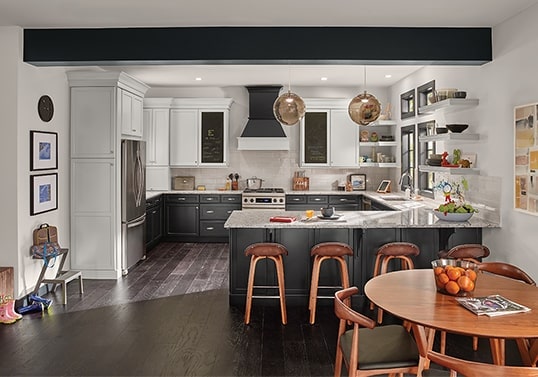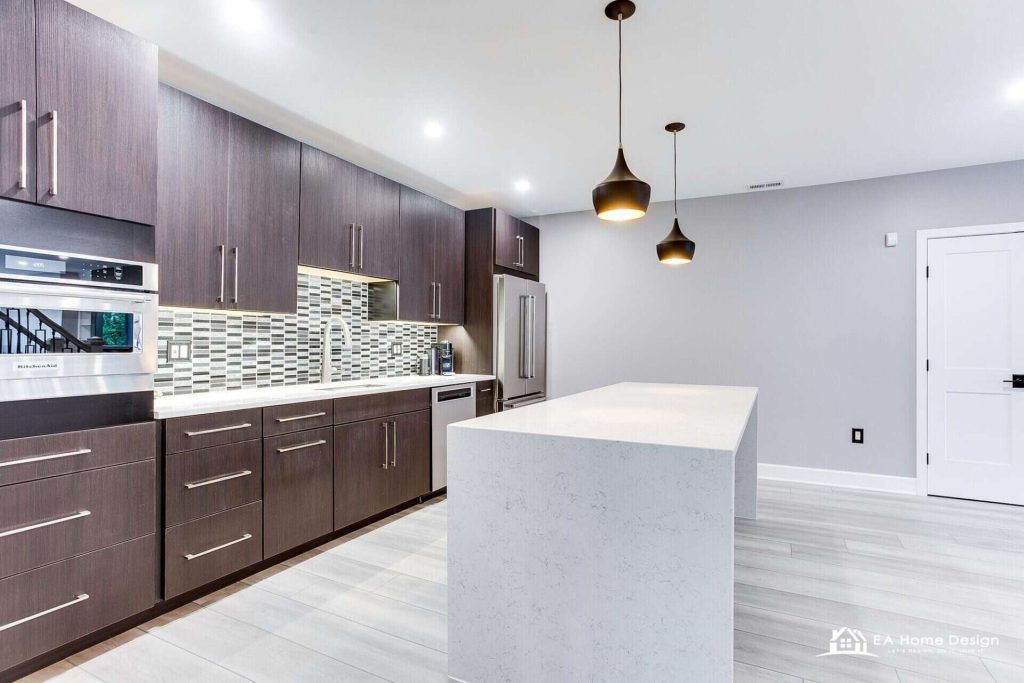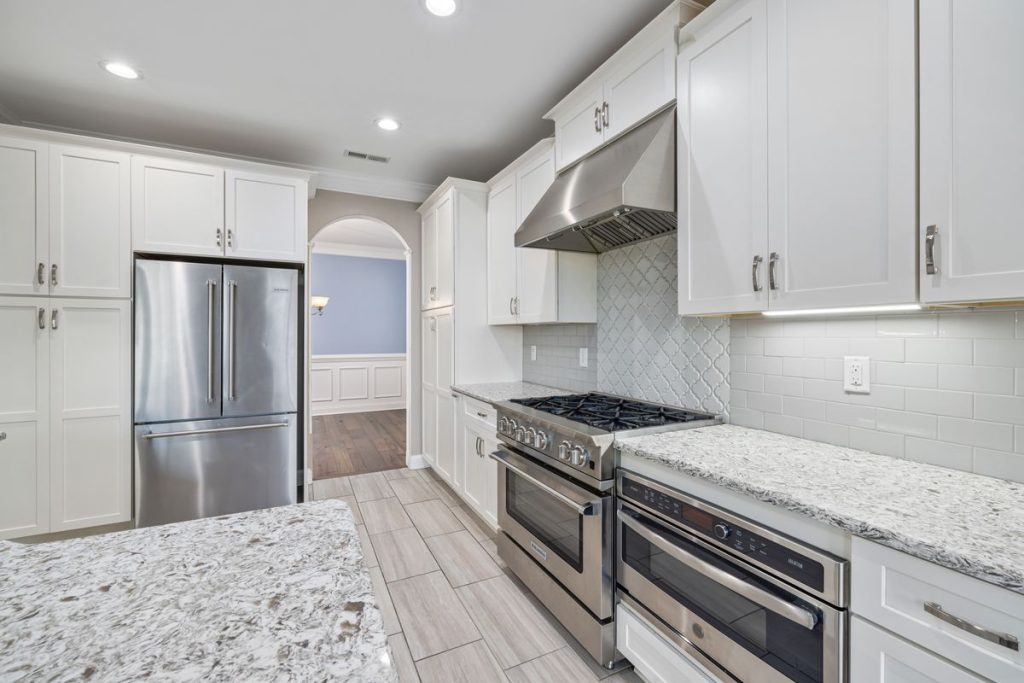
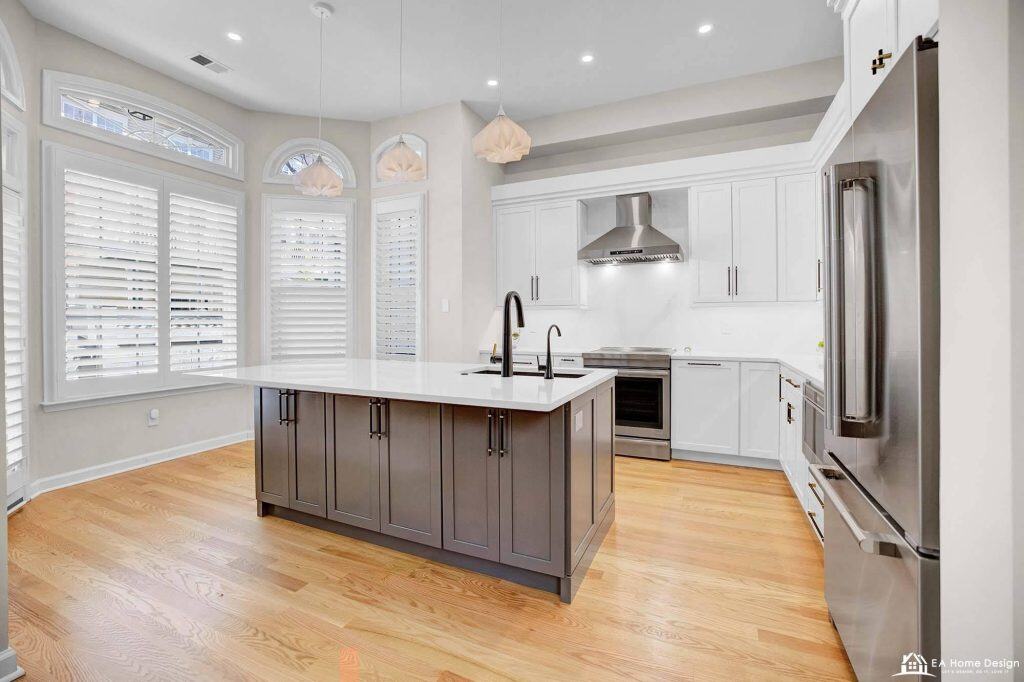
The short answer: a U-shaped kitchen puts cabinets and counters on three walls around one aisle, and it holds more storage and more counter than any other layout in the same room. It works in a room 10 to 14 feet wide: below 10 feet the aisle between the two legs drops under the 42 inches a cook needs, and only above 14 feet is there room for an island inside the U. A 10 by 11 foot U carries 26 to 28 linear feet of cabinets, against about 20 in an L of the same room. The sink goes in the base of the U under the window, the range on one leg with counter on both sides, the refrigerator at the open end of the other leg, and the two corners get the cabinets that open properly.
This guide covers the U-shaped kitchen as we build it in Northern Virginia: the dimensions, four floor plans from a 10 by 10 to a U with an island, the two corners, the G shape and the open ended U, twenty ideas, the mistakes we are asked to undo, and what a U-shaped kitchen costs in Fairfax and Loudoun County in 2026, held to our kitchen remodel cost guide. The small kitchen layout guide compares the U with the L, the galley and the one wall kitchen; this page is the U in depth.
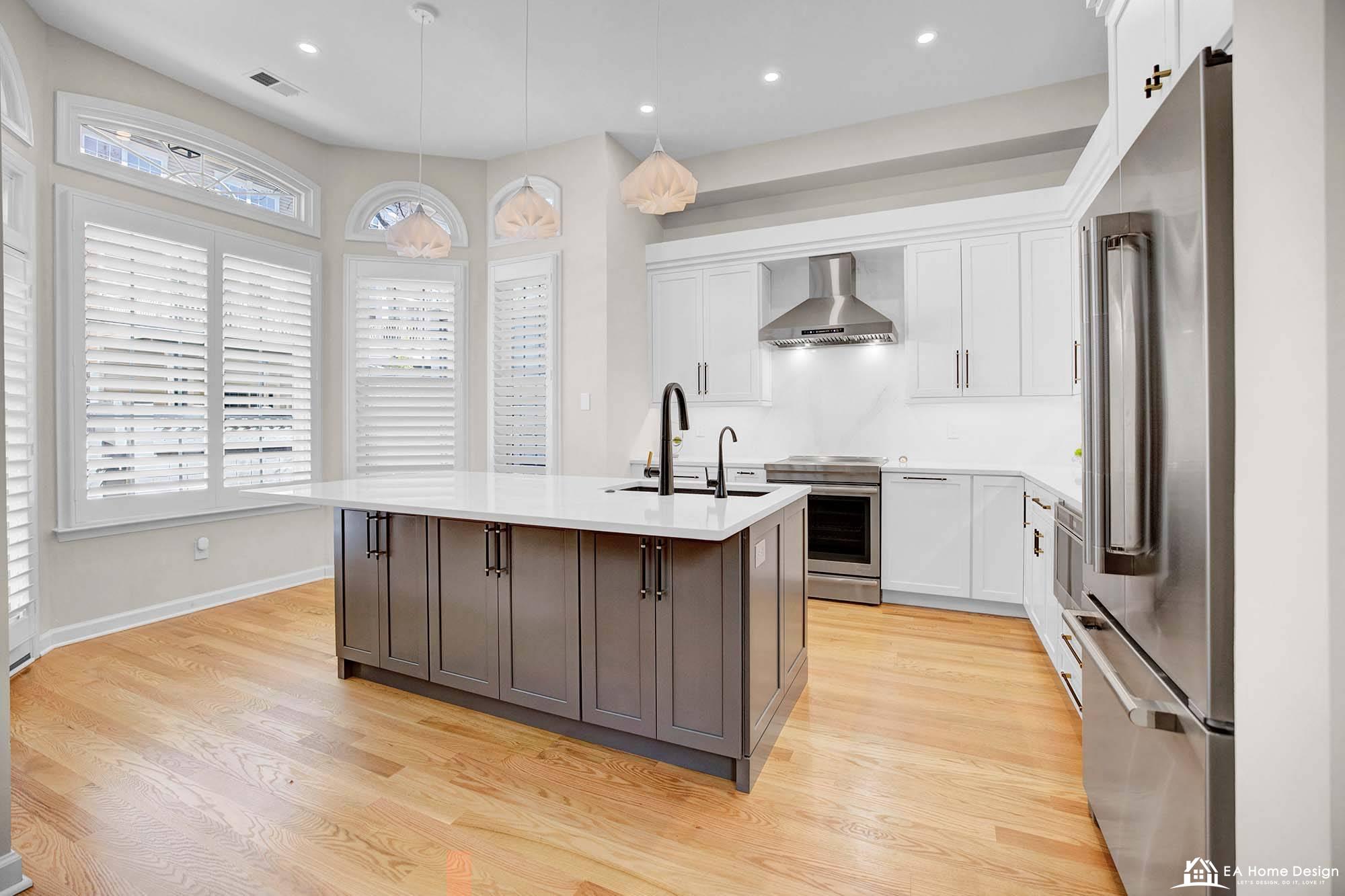
What a U-Shaped Kitchen Is, and Its Three Variations
Three runs of cabinets: a base run, usually under the window, and two legs that come toward you from each end of it. The cook stands inside, every surface is within a turn, and the layout keeps traffic out of the work zone because there is only one way in. Three variations cover nearly every U we draw.
| Variation | What changes | When it is the right choice |
|---|---|---|
| The closed U | Three full walls of cabinets with uppers; the open end faces the door or the dining room | A room of 10 to 12 feet across that is a kitchen and nothing else; the most storage per square foot of any layout |
| The open ended U | One leg is a peninsula into the next room instead of a wall, with stools on its far side | A kitchen opened to a family or dining room; the peninsula is the fourth wall and the seating |
| The G shape | A closed U with a short fourth run or peninsula partly across the open end | A large room where the cook wants a second counter near the entry; it narrows the way in, so the opening must stay at least 36 inches |
| The U with an island | A U at least 14 feet wide with a 36 inch island in the middle | A big kitchen; the island takes the prep and the seating and the three walls hold the storage |
U-Shaped Kitchen Dimensions
The U is the layout most sensitive to the width of the room, because two of its runs face each other. These are the figures a designer checks before the first cabinet is drawn; they follow the kitchen industry’s planning guidelines and they are the same in a townhouse and an estate.
| Dimension | Figure | What it decides |
|---|---|---|
| Minimum room width for a closed U | 10 feet | Two 24 inch counters and a 42 inch aisle need 7 feet 6 inches between finished walls; 10 feet leaves room for the drywall, the toe kicks and a comfortable aisle |
| Comfortable room width | 11 to 13 feet | A 48 to 60 inch aisle; two people work without passing sideways |
| Width for a U with an island | 14 feet with one cook, 15 with two | 24 inch counter, 42 inch aisle, 36 inch island, 42 inch aisle, 24 inch counter is 168 inches; 48 inch aisles make it 180 |
| Aisle between the legs | 42 inches minimum, 48 for two cooks | The number most small U kitchens fail; a 36 inch aisle is a corridor with a dishwasher door in it |
| Depth of the room | 9 feet and up | Each leg wants at least 6 feet of run beyond the corner cabinet, or the leg is a corner with nothing on it |
| Cabinet run in a 10 by 11 U | 26 to 28 linear feet | Against about 20 in an L of the same room; it is where the U’s storage comes from |
| Counter beside the range | 12 inches one side, 15 the other | A range in a corner has neither, and the hood cannot vent straight up |
| Counter beside the sink | 24 inches one side, 18 the other | The dishwasher goes on the 24 inch side; in a U the sink is usually in the base run under the window |
| Counter beside the refrigerator | 15 inches on the handle side | At the open end of a leg, the landing is the end of that leg’s counter |
| Work triangle | Each leg 4 to 9 feet, 13 to 26 feet in all | A U keeps the triangle short by nature; the risk is the range and the sink too close across a corner |
Where the Sink, the Range and the Refrigerator Go
A U fails or succeeds on three placements, and the order in which they are decided matters.
- The sink in the base of the U, under the window. It is the station you stand at longest, it wants daylight and no upper cabinet over it, and the base run is the one wall that usually has the window. The dishwasher goes beside it on the side nearest the dish cabinets, which are the upper on that leg.
- The range on a side leg, never in a corner and never in the base run if the window is there. On a leg it has counter on both sides and a wall behind it for the hood to vent through or up; in the base run it steals the window; in a corner it has no landing and the hood is a diagonal nobody is happy with.
- The refrigerator at the open end of the leg opposite the range. That puts it where people fetch from without entering the work zone, gives it the end of the leg as its landing, and completes a triangle of about 15 to 18 feet in most 10 to 12 foot rooms.
- The microwave in a drawer or a tall cabinet beside the refrigerator, so the hood over the range is a real hood and the uppers over the base run stay shallow.
- Tall cabinets at the open ends of the legs, a pantry on one side and the refrigerator surround on the other, so the U reads as a room with two bookends and the counters in between stay unbroken.
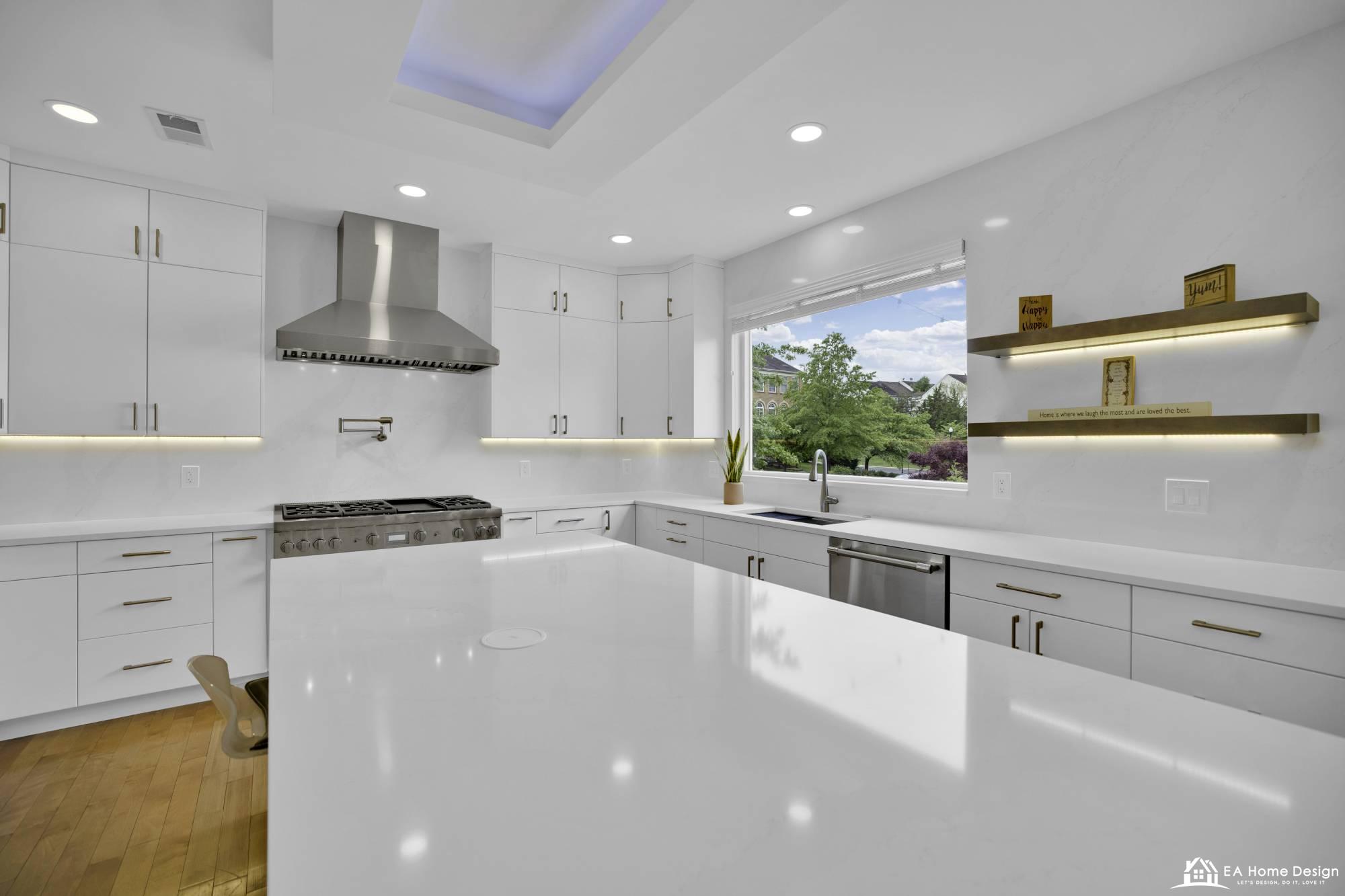
The Two Corners
Every U has two inside corners, and in a 10 by 11 room they are 6 square feet of the best storage in the kitchen. Left as blind cabinets, they are the two places nothing comes out of.
| Corner solution | What you reach | What it costs in the run | Best for |
|---|---|---|---|
| Lazy susan in a 36 inch corner base | Two full turning shelves; pots, small appliances | 36 inches of each wall | The standard answer; it works in both corners |
| Corner drawers | Two or three angled drawers that pull straight out | 36 inches of each wall; the most expensive corner | The corner nearest the range: pans and lids |
| Blind corner pull out | A swing out shelf unit that comes fully into the aisle | A 42 or 45 inch blind cabinet plus a 3 inch filler | One corner in a tight U where a 36 inch susan will not fit |
| Diagonal sink base | The sink itself in the corner on a 45 degree front | About 36 inches of each wall | A U with the window in the corner rather than the base |
| Open shelf or wine cabinet in the corner | A corner that does not need to be reached deep | 12 to 15 inches | The upper corners, instead of a diagonal upper that dominates the wall |
| Dead corner opened from the other side | A cabinet door in the next room or the hall | Nothing in the kitchen | A U whose corner backs onto a pantry closet or a hallway |
Upstairs, the choice is simpler: either a diagonal corner upper, which is the biggest cabinet on the wall and looks it, or two uppers that stop short of the corner with a 3 inch filler between them, which is lighter and loses almost nothing.
U-Shaped Against L-Shaped and Galley
| U-shaped | L-shaped | Galley | |
|---|---|---|---|
| Walls used | Three | Two | Two facing |
| Cabinets in a 10 by 11 room | 26 to 28 linear feet | About 20 | About 20 |
| Corners to solve | Two | One | None |
| Room width it needs | 10 feet and up | Any; it leaves a corner open | 7 feet 6 inches and up |
| Seating inside the kitchen | On an open ended leg or an island at 14 feet and up | A table in the open corner, or a peninsula | At the end of a run only |
| Traffic through the work zone | None; one way in | Some; the open corner is a path | Through, if there is a door at each end |
| Cost of the cabinet line, same grade | Highest: 6 to 8 more linear feet and two corner cabinets | Lowest | Low |
If the room is under 10 feet wide, the U becomes a galley or an L on paper before it is built. The galley kitchen guide covers the narrow room, and the small kitchen layout guide the L and the one wall kitchen.
Four U-Shaped Kitchen Floor Plans
1. The 10 by 10 U
The base run under the window: a 36 inch sink base in the middle, a 24 inch dishwasher to one side, 30 inch base to the other. Each leg: a 36 inch corner base with a lazy susan at the corner, then on the range leg a 30 inch range with a 15 inch base beyond it, and on the other leg a 24 inch base and a 36 inch refrigerator at the open end. About 26 linear feet, 35 to 40 square feet of counter, a 42 inch aisle between the legs and no island. This is the U that turns a 10 by 10 from a cramped L into a kitchen with counter on three sides.
2. The 10 by 12 U with a pantry leg
The same base run, with the extra 2 feet spent on the legs: a 24 inch tall pantry at the open end of the range leg and a 36 inch refrigerator with a 15 inch tall cabinet beside it at the open end of the other. The tall cabinets at the open ends frame the kitchen from the dining room and the counters between them run unbroken. About 28 linear feet.
3. The open ended U with a peninsula
One leg is a peninsula into the family room: 24 inches deep on the kitchen side, a 12 inch overhang with three stools on the room side, no uppers above it. The sink or the dishwasher often sits in the peninsula so the cook faces the room. It needs 42 inches of aisle on the kitchen side and 36 inches of walkway past the stools on the room side; the opening into the kitchen at the end of the peninsula stays at least 36 inches.
4. The U with an island, 14 feet and wider
Three walls of storage and a 36 inch deep island in the middle with 42 inch aisles on every side; at 15 feet, 48 inch aisles and seating on the island’s far side. The sink usually moves to the island so the base run under the window becomes the longest unbroken counter in the house. It is the layout of the large 1990s and 2000s kitchens in Loudoun County, and the one the kitchen island guide and the island cost guide are written for.
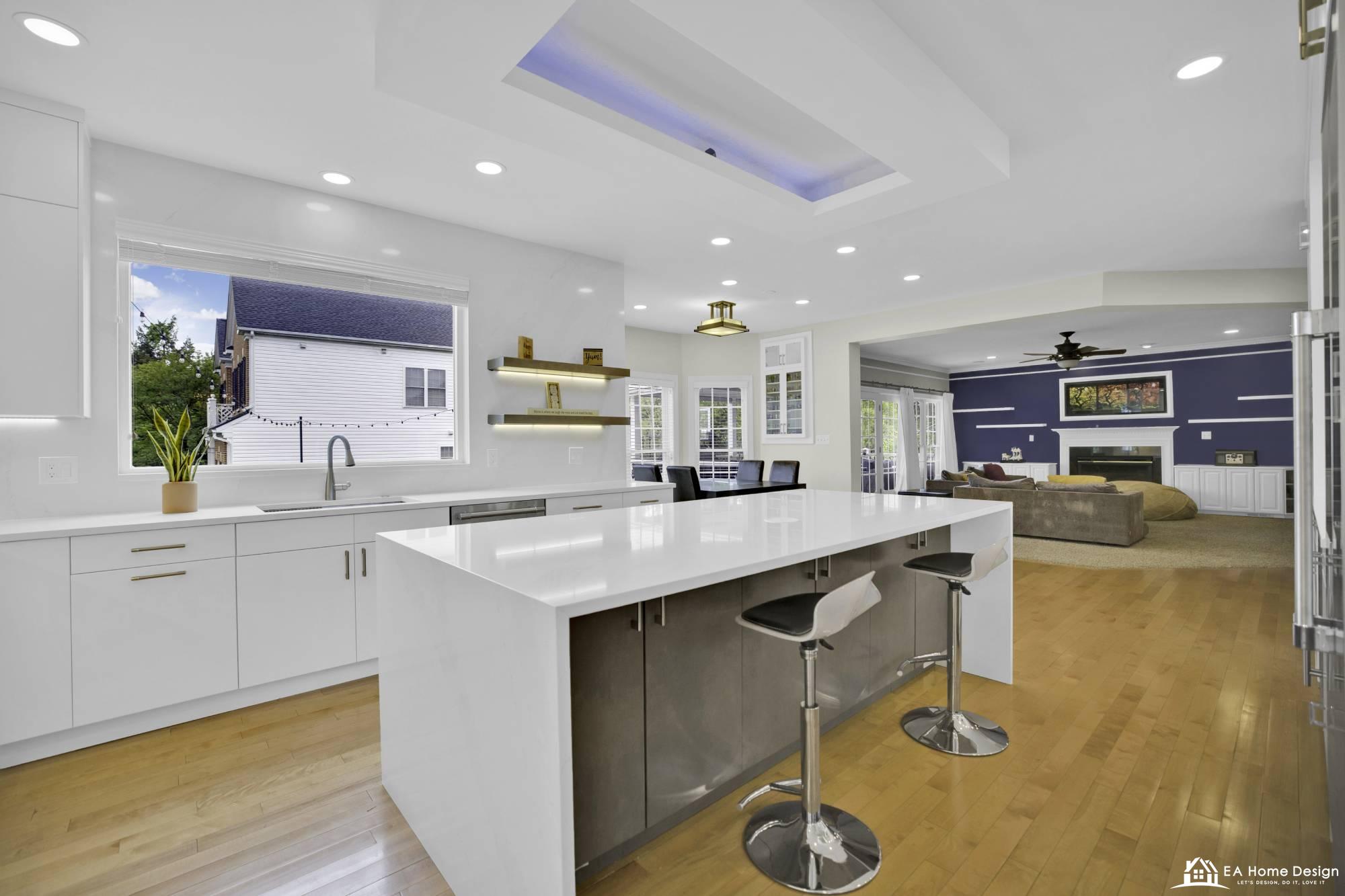
20 U-Shaped Kitchen Ideas
1. The sink under the window, with nothing above it
The base run is the one wall with daylight. A sink there, with the uppers stopping either side of the window, gives the cook the view and the room a focal point.
2. The range on a leg under a real hood
A wall behind the range means a ducted hood that vents straight out or up, counter on both sides, and a tile wall to the ceiling that becomes the kitchen’s one dramatic surface.
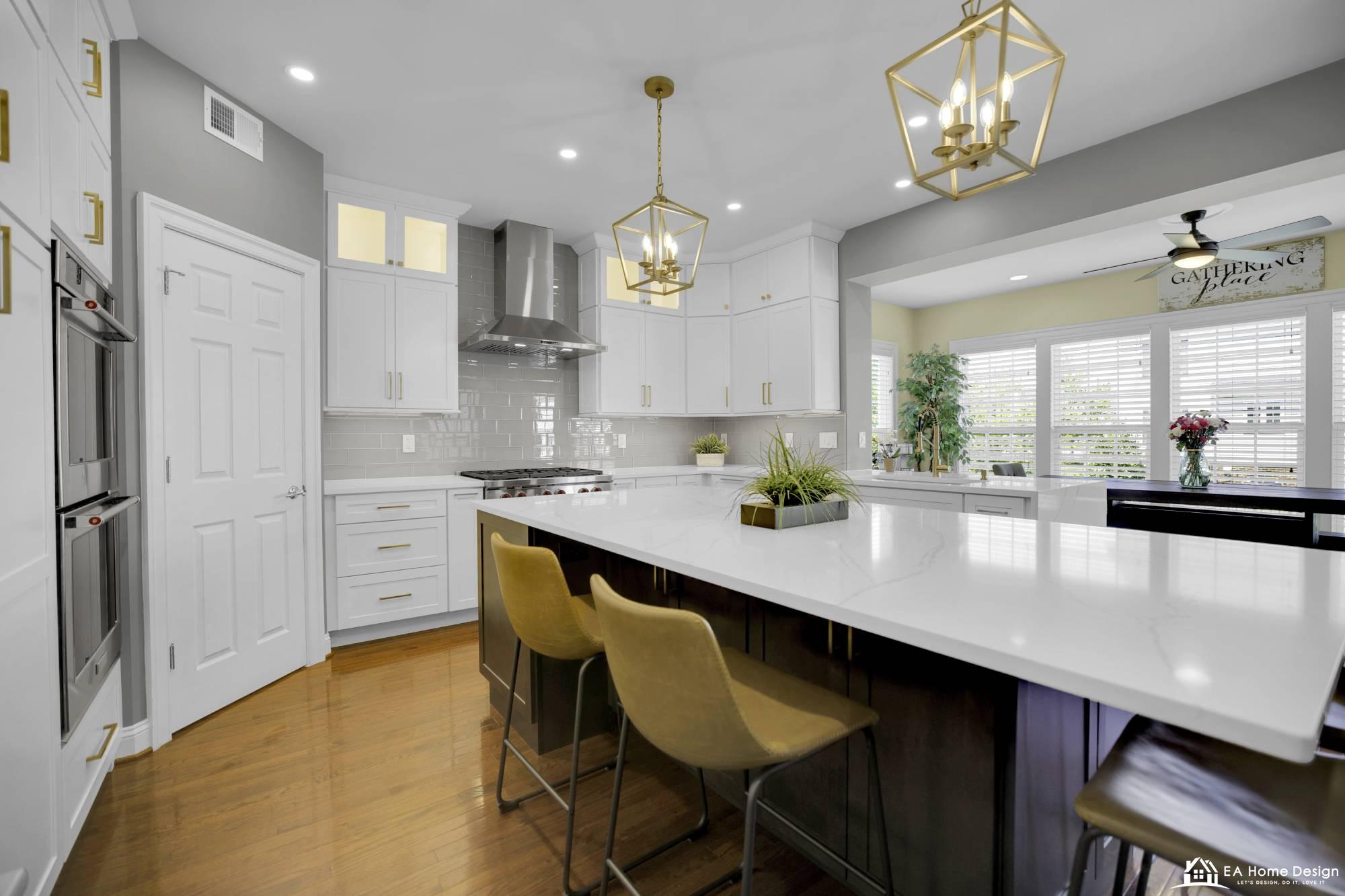
3. Tall cabinets as bookends
A pantry at the open end of one leg and the refrigerator surround at the other frame the U from the next room and keep the counters between them unbroken.
4. Drawers under every counter
Three deep drawers in each 30 inch base. In a U there are more bases than in any other layout, and drawers are the difference between storage you use and storage you lose.
5. Corner drawers at the range corner
The corner nearest the range takes pans and lids in angled drawers that pull straight into the aisle. The other corner takes the lazy susan.
6. No uppers on one leg
Leave the leg that faces the room without wall cabinets and the U stops feeling like a box. The storage moves to the tall cabinets and the drawers; the wall takes a window, open shelves or art.
7. Glass uppers at the open ends
Lit glass in the last upper on each leg lightens the two corners the eye reaches first from the doorway.
8. A pass through in the base wall
If the base run backs onto the dining room and has no window, a 4 to 6 foot opening above the counter brings light through and turns the base counter into a serving ledge, for $2,500 to $6,000.
9. One leg as a peninsula
The open ended U: the fourth side of the room becomes seating and the kitchen joins the family room without losing a run of cabinets.
10. The baking corner
A 30 inch lower counter on one leg, 34 inches instead of 36, with the mixer in an appliance garage beside it and the baking sheets in the corner drawers.
11. An appliance garage in the corner
The upper corner that would hold a diagonal cabinet holds a lift up door with the coffee machine and toaster inside, on the counter and out of sight.
12. A second sink in a long base run
In a U wider than 12 feet, a 15 inch prep sink at the range end of the base run keeps the main sink for dishes.
13. A banquette at the open end
Where the U faces a dining room, a built in bench against the end of one leg and a table makes the open end an eat in kitchen without an island.
14. Counter overhang on the open leg
Twelve inches of counter past the base cabinets on the leg nearest the room, with two stools, is the cheapest seating a U can have.
15. Under cabinet lighting on all three runs
Three runs of uppers mean three runs of shadow on the counters; a strip under every upper, on one dimmer, is the single biggest change in how a U feels to cook in.
16. One counter material, run through the corners
A quartz that turns both corners without a seam at the sink reads as one surface and makes the U feel larger; a different material on each run makes it three small kitchens.
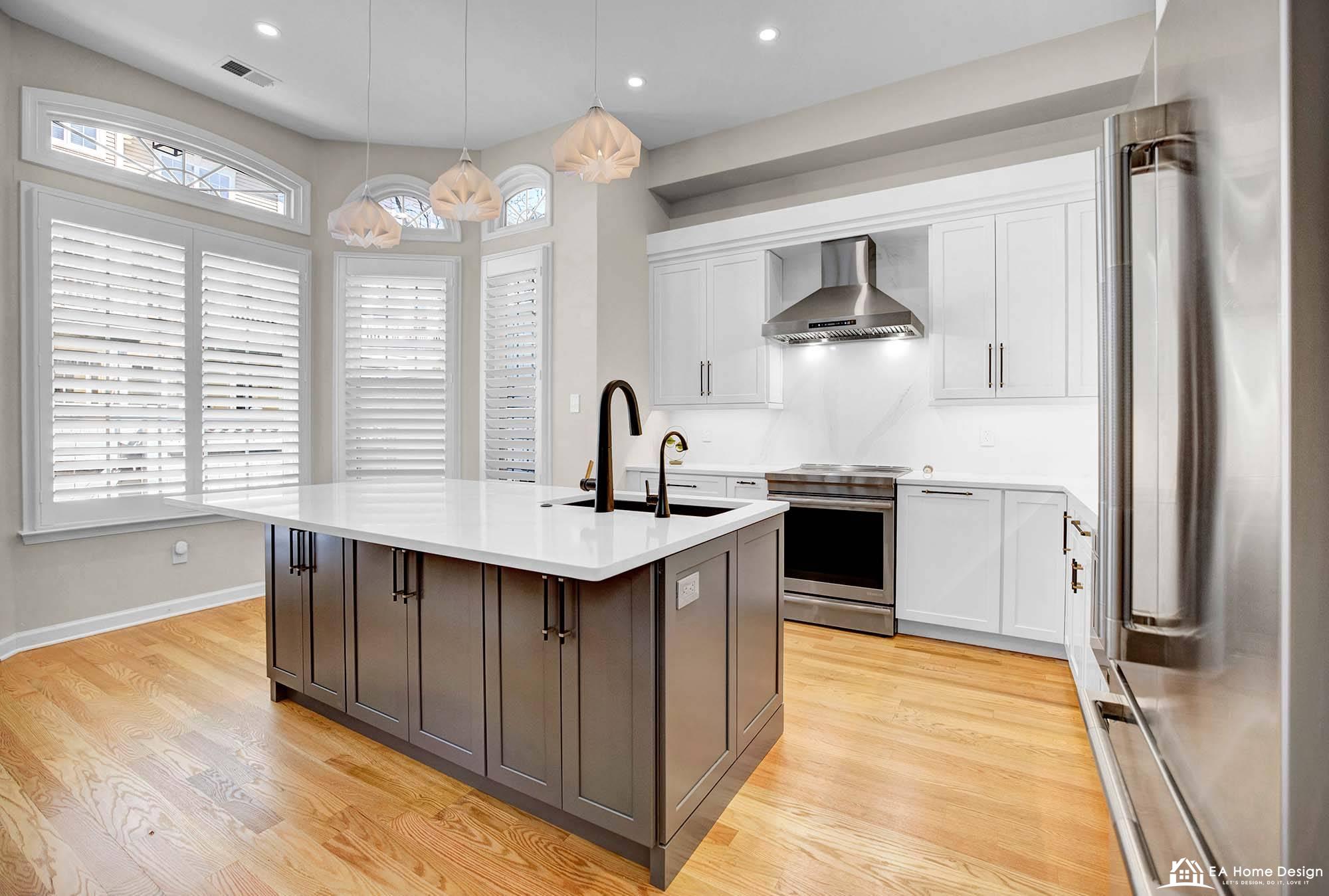
17. Two colors, legs and base
White uppers and a mid tone on the base cabinets, or the island in a color, keeps the top half open and gives the three runs some order.
18. The ceiling height uppers
A U has the most upper cabinet of any layout, so the 12 inches above a standard upper matters more here: stacked cabinets to the ceiling on the base run, and shorter uppers on the legs.
19. A window seat in the base
Where the window sits low, a 20 inch deep bench under it in place of the base cabinet turns the base of the U into a place to sit while the cook works.
20. Open the U when the room is too narrow
A U in a 9 foot room has a 30 inch aisle and no cure. Take one leg out, make it an L with a table, and the kitchen is wider than the U ever was.
Storage: Why the U Holds the Most
Three walls of base cabinets, three of uppers, two corners and two tall cabinets at the open ends: a 10 by 11 U holds 26 to 28 linear feet against an L’s 20, which is roughly a third more storage in the same room. Spend it well. Drawers under the counters, pull outs in the tall cabinets, a 12 or 15 inch pull out beside the refrigerator, toe kick drawers under the base run and the two corners opened properly. The kitchen organization guide covers the inserts, and the cabinet ideas guide what is behind the door at each cabinet tier.
What a U-Shaped Kitchen Costs in Northern Virginia
A U costs more than an L in the same room for one reason: 6 to 8 more linear feet of cabinets and two corner cabinets, which are the most expensive boxes in the line. Everything else, the counters, the appliances, the trades, the permit, costs what it costs in any kitchen of that size. These are the 2026 figures for Fairfax and Loudoun County, from our kitchen cost guide.
| Scope | What it includes | 2026 cost |
|---|---|---|
| Refresh of an existing U, cabinet boxes stay | Doors refaced or painted, new quartz through both corners, backsplash, sink and faucet, lighting | $20,000 to $35,000 in a small U; $35,000 to $60,000 in a medium one |
| Full remodel of a small U, under 100 square feet, same footprint | New cabinets, counters, backsplash, flooring, lighting and appliances | $45,000 to $70,000 |
| Full remodel of a medium U, 100 to 200 square feet, same footprint | The same, with 26 to 32 linear feet of cabinets | $60,000 to $100,000 |
| U with a layout change: a leg opened as a peninsula, a wall removed, the sink moved to an island | The above plus the structure, the engineer and the rerouted plumbing and electrical | $90,000 to $140,000 |
| Luxury U with an island, custom cabinetry, built in appliances | Three walls of custom cabinetry, stone, a professional suite | $120,000 to $200,000 |
The cabinet line itself: 26 to 28 linear feet of semi custom cabinets installed at $700 to $1,200 a foot is $18,000 to $34,000, with the two corner cabinets adding $800 to $2,500 over plain bases depending on the solution. The kitchen remodel cost guide has the full price list and ten kitchens we have built with what each cost; the 10×10 guide prices the small U line by line; the kitchen timeline and the permit guide cover the schedule and the county.
U-Shaped Kitchen Mistakes We Are Asked to Undo
- A U in a room under 10 feet wide. The aisle ends up at 30 to 36 inches, the dishwasher door closes it, and two people cannot pass. Make it an L.
- Two blind corners. Six square feet of storage that nothing comes out of. A lazy susan and corner drawers cost a little more and give the corners back.
- The refrigerator in the base run. It takes the window wall, breaks the longest counter and puts the most visited appliance in the deepest part of the work zone.
- The range in a corner. No landing on one side, a pan handle in the wall and a diagonal hood.
- An island in a 12 foot U. The aisles shrink to 30 inches on both sides. A peninsula or a table was the answer.
- Uppers on all three walls to the same height. A box. Drop the uppers on the leg facing the room, or open one leg as a peninsula.
- A G shape that closes the entry. The fourth run across the open end leaves a 30 inch gap to squeeze through; keep the opening at 36 inches or leave the G off.
- Three counter materials. One quartz through both corners; the U is three runs that should read as one.
Frequently Asked Questions About U-Shaped Kitchens
What is a U-shaped kitchen?
A kitchen with cabinets and counters on three walls around a single aisle: a base run, usually under the window, and two legs coming toward the cook from each end of it. It holds more storage and counter than any other layout in the same room, and traffic stays out of the work zone because there is only one way in.
How wide does a room need to be for a U-shaped kitchen?
At least 10 feet between finished walls for a closed U with a 42 inch aisle, 11 to 13 feet to be comfortable for two people, and 14 feet before an island fits inside it (24 inch counters, 42 inch aisles and a 36 inch island add up to 168 inches; 48 inch aisles make it 15 feet).
How much counter space does a U-shaped kitchen have?
A 10 by 11 U holds 26 to 28 linear feet of cabinets and 35 to 40 square feet of counter, against about 20 linear feet and 30 to 35 square feet in an L of the same room. The gain is the third wall and the two corners.
Can a U-shaped kitchen have an island?
Only when the room is at least 14 feet wide, 15 for two cooks: 42 inch aisles on every side of a 36 inch island. In a 12 or 13 foot U an island narrows the aisles to 30 inches; a peninsula on one leg or a table at the open end does the island’s job.
Where should the sink go in a U-shaped kitchen?
In the base of the U under the window, with the dishwasher beside it on the side nearest the dish cabinets. The range goes on one leg with counter on both sides, and the refrigerator at the open end of the other leg.
Where should the refrigerator go in a U-shaped kitchen?
At the open end of the leg opposite the range, so people fetch from it without entering the work zone and the end of that leg’s counter is its landing. Put it in the base run and it takes the window wall and breaks the longest counter.
What do you do with the corners of a U-shaped kitchen?
A lazy susan in a 36 inch corner base is the standard answer and works in both corners; corner drawers suit the corner nearest the range; a blind corner pull out suits a tight U; a diagonal sink base when the window is in the corner. Upstairs, two uppers stopping short of the corner with a filler is lighter than a diagonal corner cabinet.
Is a U-shaped kitchen good for a small kitchen?
Yes in a square room of 10 by 10 or more, where it turns a cramped L into counter on three sides. Below 10 feet wide the aisle fails and the small kitchen is better as an L or a galley. A 10 by 10 U runs $45,000 to $70,000 for a full remodel in Northern Virginia.
What is a G-shaped kitchen?
A U with a short fourth run or peninsula partly across the open end. It adds counter and seating near the entry, and it narrows the way in, so the opening must stay at least 36 inches; in rooms under 12 feet wide it usually closes the kitchen too much.
U-shaped or L-shaped kitchen, which is better?
The U when the room is 10 feet or wider and you want the most storage and counter; the L when the room is narrower, when you want an open corner for a table, or when the budget favors fewer cabinets. The U costs more for 6 to 8 extra linear feet and two corner cabinets.
How much does a U-shaped kitchen remodel cost?
In Fairfax and Loudoun County in 2026, $45,000 to $70,000 for a full remodel of a small U in the same footprint, $60,000 to $100,000 for a medium one, $90,000 to $140,000 when a leg opens or the sink moves to an island, and $120,000 to $200,000 for a luxury U with custom cabinetry. A refresh that keeps the cabinet boxes runs $20,000 to $60,000 by size.
Can you open up a U-shaped kitchen?
Yes, two ways: take the uppers off the leg that faces the room, or take that leg’s wall out and rebuild the leg as a peninsula with seating on the room side. Removing a non load bearing wall costs $2,500 to $8,000 and a load bearing one $15,000 to $40,000 with its beam and permit.
Plan the U Around the Aisle
Measure the width of the room first; if it is 10 feet or more, the U is on the table, and the aisle between the legs is the dimension everything else serves. Put the sink under the window, the range on a leg, the refrigerator at the open end, and give the two corners cabinets that open. We draw every U in a 3D model of your room before anything is ordered, which is how the free in home design consultation starts across Fairfax and Loudoun County; the kitchen visualizer shows your own kitchen remodeled from a photograph.
Related guides: small kitchen layout ideas, galley kitchen remodel ideas, what a 10×10 kitchen remodel costs, kitchen island cost, kitchen cabinet ideas, cabinet refacing versus replacing, countertops by material, quartz versus granite, the best appliance brands, open concept kitchen remodeling, transitional kitchen design, choosing a kitchen sink and the Northern Virginia kitchen cost guide. For the service and the showroom, see kitchen remodeling in Northern Virginia.