A galley kitchen remodel is the most cost effective kitchen project you can take on, because the layout is already efficient and you are improving it rather than fighting it. In Northern Virginia, a full galley kitchen remodel runs $35,000 to $75,000 for a quality mid range project and $75,000 to $120,000 or more for a luxury remodel that opens a wall, adds an island, and uses custom cabinetry. The best results come from four moves: widening the walkway to at least 48 inches, running cabinets to the ceiling, lighting the counters properly, and, where the structure allows, opening one wall so the galley borrows light and space from the next room.
This guide is built on galley kitchens we have remodeled across Fairfax and Loudoun County, including a Reston townhouse project photographed before and after below. You will find 20 galley kitchen remodel ideas organized by what they fix, the three layout paths (keep it, open it, or add an island) with the measurements that decide which one you can use, real costs, a planning checklist, and answers to the questions homeowners ask us most.
What Is a Galley Kitchen?
A galley kitchen is a long, narrow kitchen with two parallel runs of cabinets and counters separated by a single walkway. The name comes from ship galleys, where every inch has to work. The layout shows up constantly in Northern Virginia housing stock: 1960s and 1970s colonials in Fairfax, Annandale, and Springfield, townhouses in Reston, Herndon, and Ashburn, and condos and split levels throughout Loudoun County.
Galley kitchens have real strengths. The work triangle between sink, range, and refrigerator is naturally tight, so cooking involves fewer steps than in most open kitchens. Every wall holds storage. Plumbing and electrical are concentrated, which keeps remodel costs down. The weaknesses are just as real: a walkway under 42 inches feels cramped with two people, the room can be dark if one end is closed, and there is usually no place to sit. A good galley kitchen remodel keeps the strengths and fixes the weaknesses.
Galley Kitchen Remodel Before and After: A Reston Project
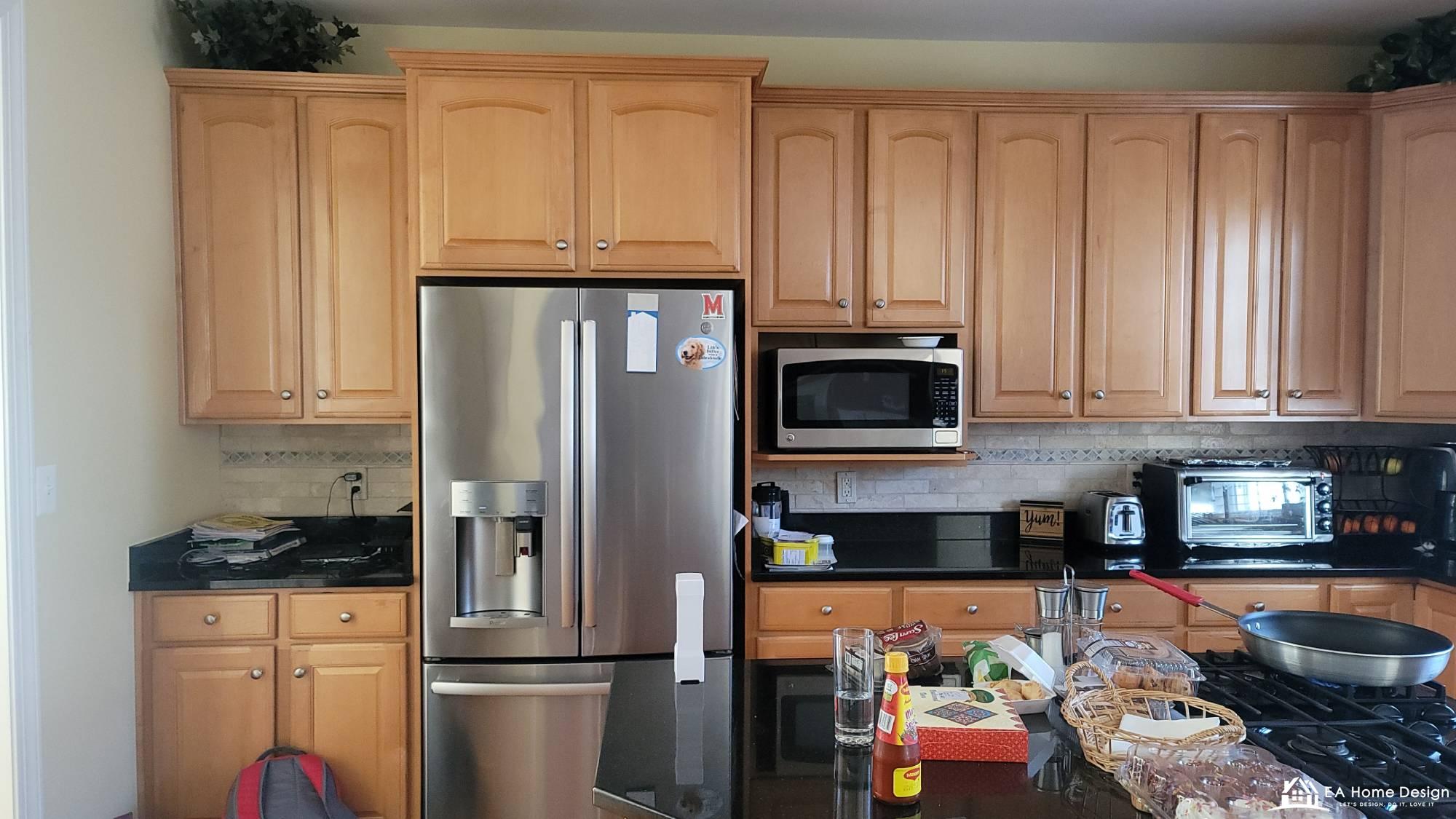
The clearest way to understand what a galley kitchen remodel can do is to look at one. This Reston home had a typical closed galley: teal painted cabinets, a black refrigerator crowding the walkway, a single window at the sink, and a dining room walled off on the other side.
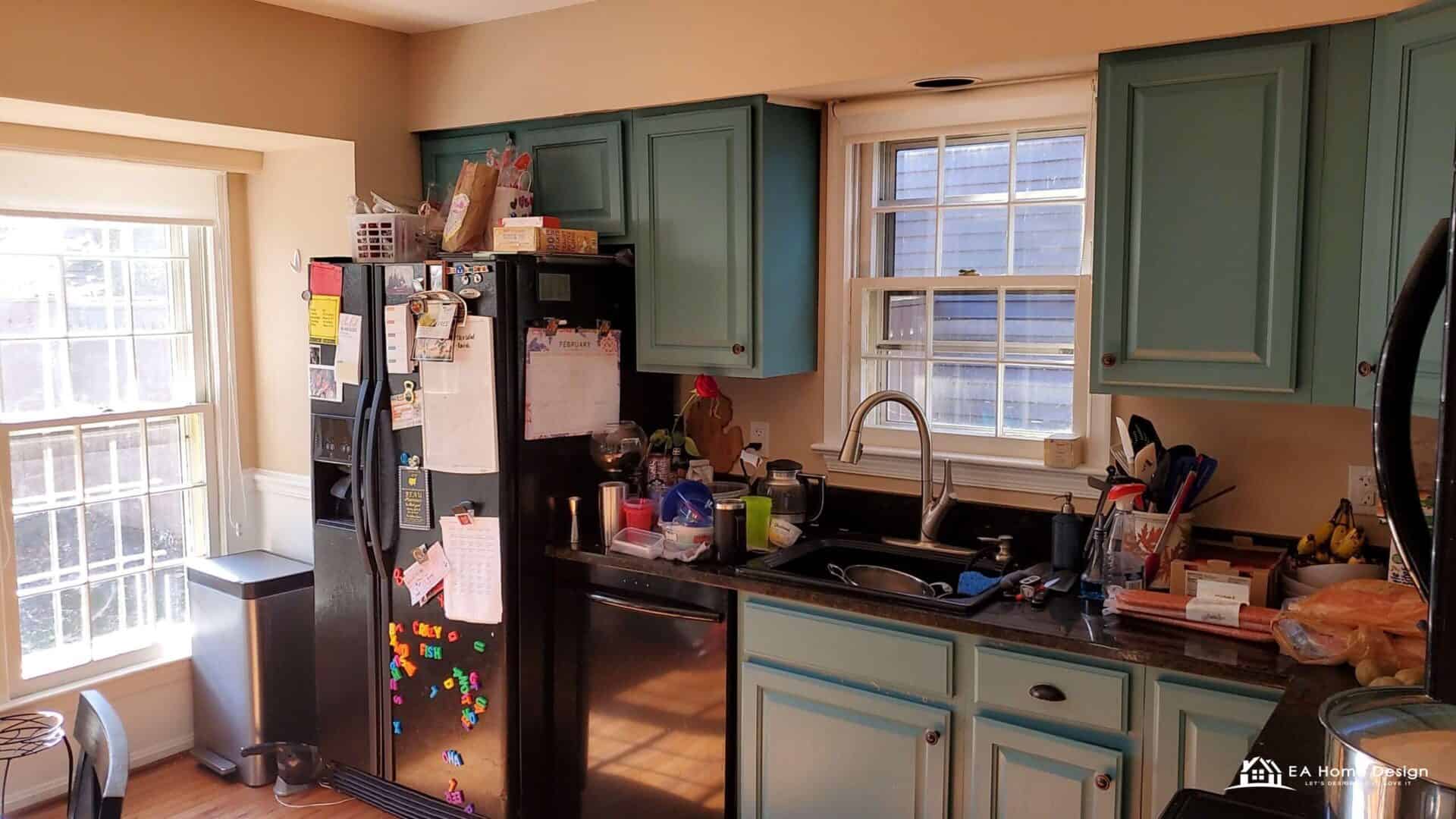
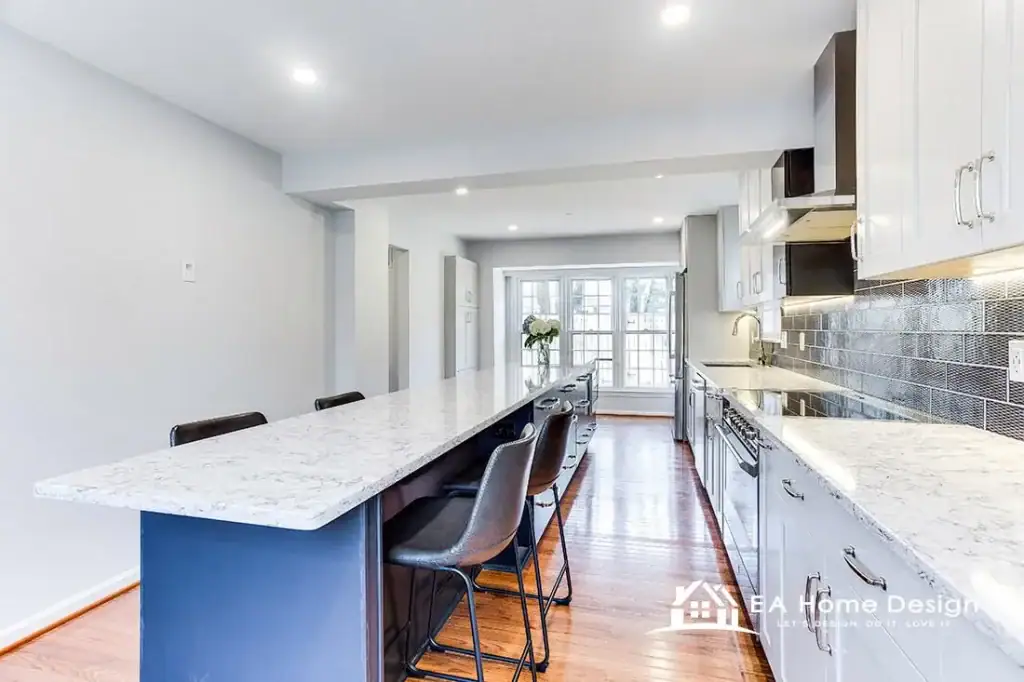
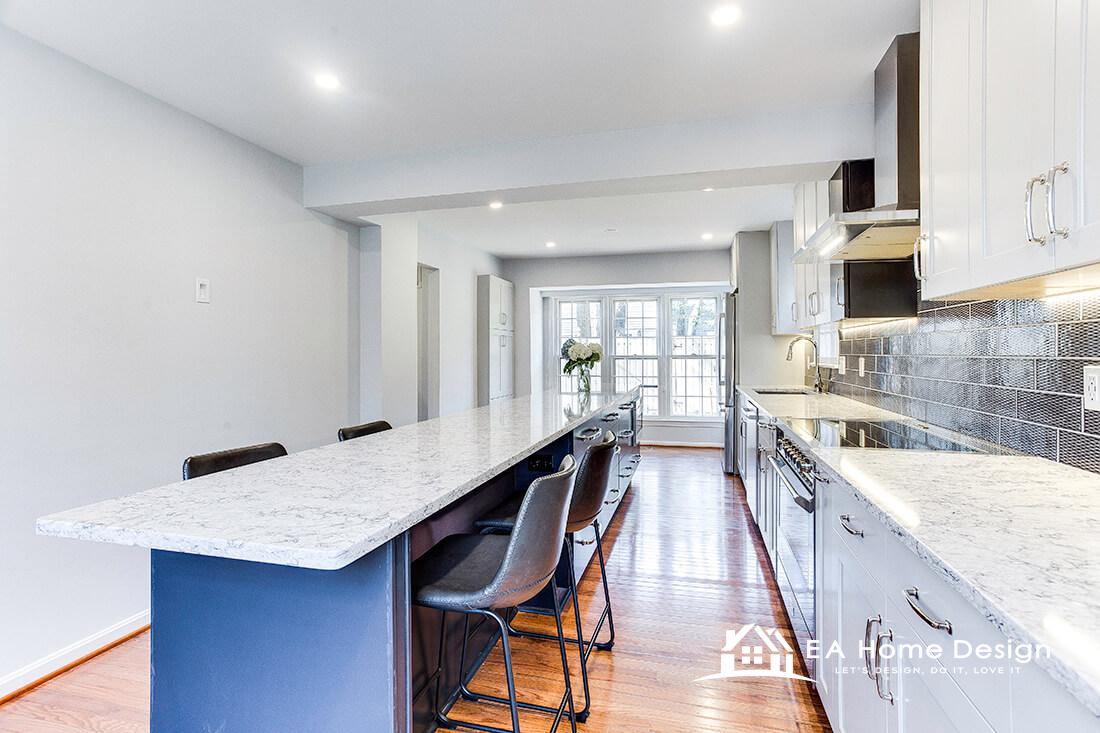
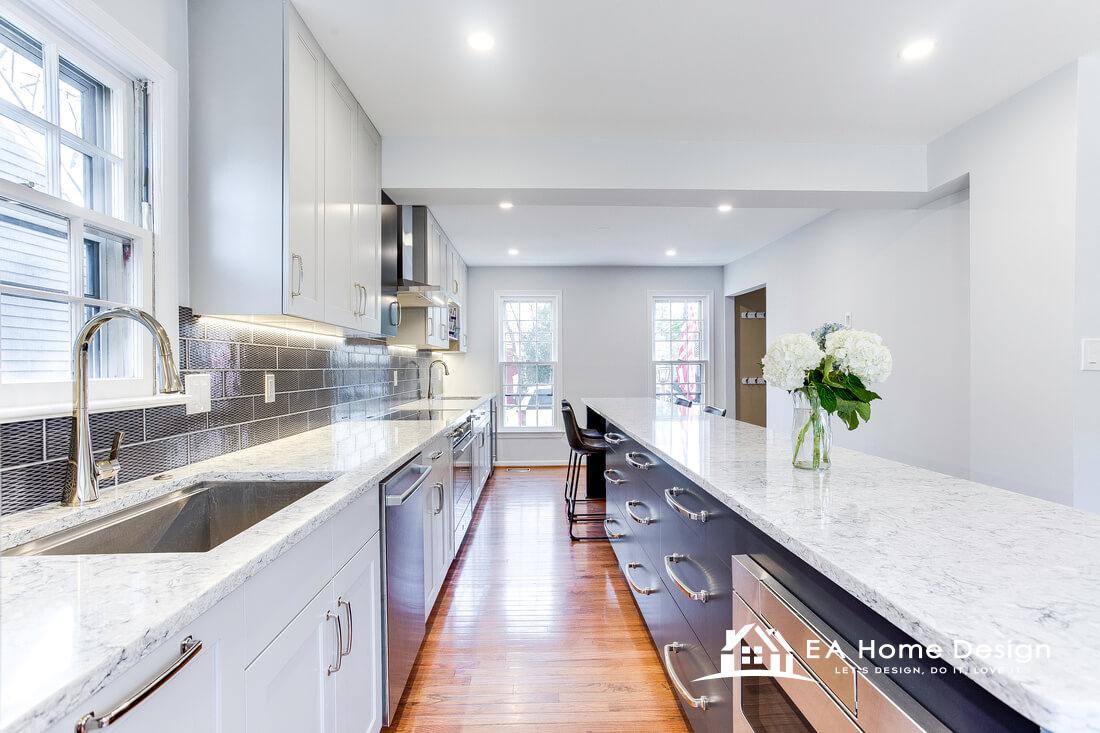
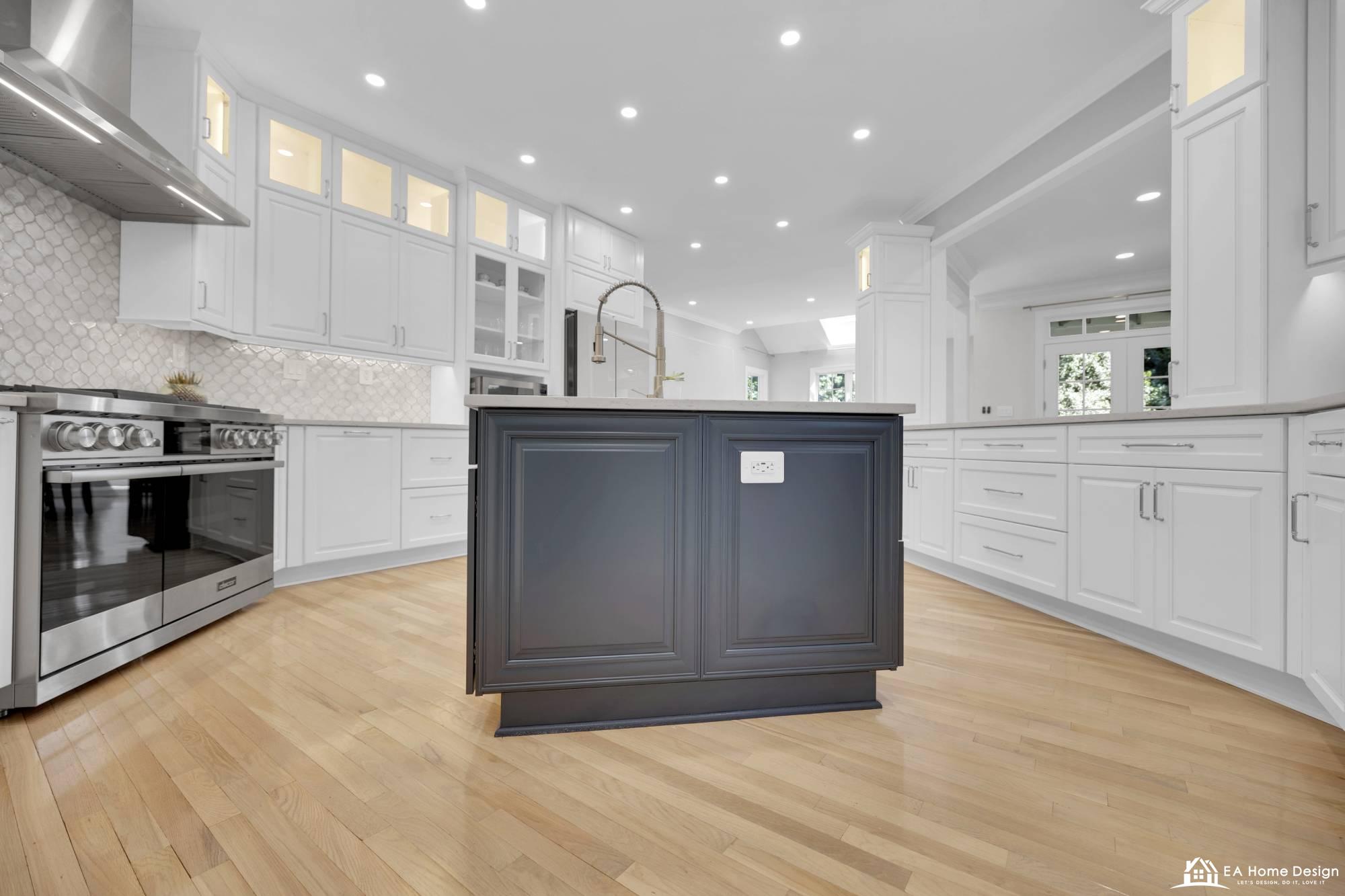
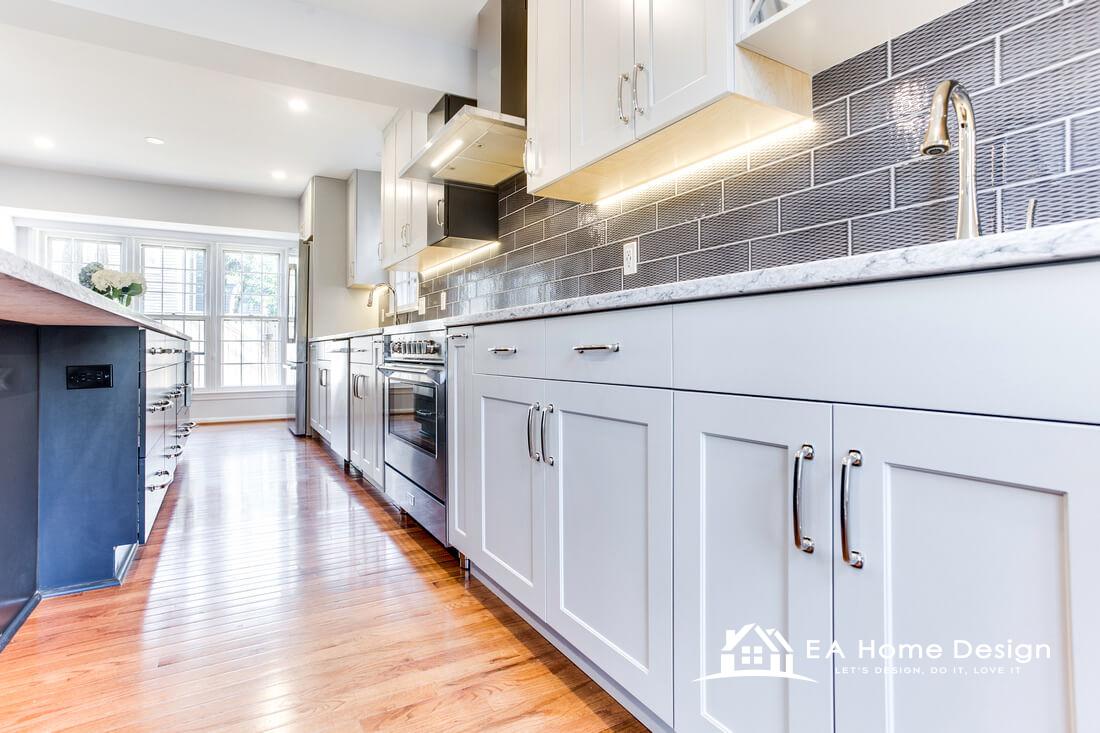
The remodel removed the wall between the kitchen and the dining room, which turned the second cabinet run into a long island with seating on the dining side. The cooking wall kept its galley efficiency: sink under the window, range with a wall hood, and the refrigerator moved to the end of the run so it no longer narrows the walkway. White shaker cabinets run to the ceiling, a grey subway backsplash adds depth without darkening the room, and under cabinet lighting makes the counters usable at night.
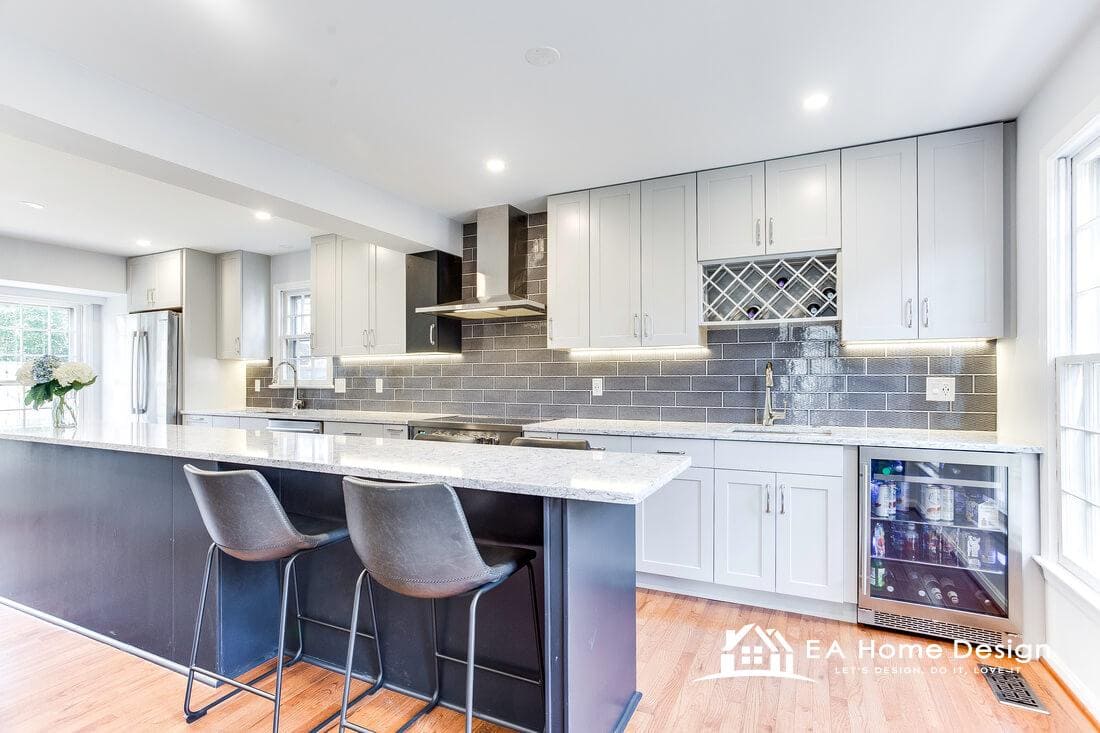
The lesson for any galley kitchen remodel is that the layout did not change as much as it looks like it did. Plumbing stayed put, the cooking wall kept its sequence, and the transformation came from opening one wall, lifting the cabinets to the ceiling, and lighting the space properly. That is also why the project cost a fraction of a full relocation remodel. You can see more of this project in our Reston kitchen remodel case study.
Three Galley Kitchen Layout Options (and Which One You Can Use)
Before choosing finishes, decide the layout. There are three paths, and your kitchen’s width and the wall construction decide which are available.
| Layout path | Requires | Best for | Typical NoVA cost range |
|---|---|---|---|
| Keep the closed galley, improve it | Any width; walkway ideally 42 to 48 inches | Condos, townhouses, homes where the adjacent wall is load bearing or holds a stair | $30,000 to $60,000 |
| Open one wall (galley to peninsula or half wall) | Non bearing wall, or bearing wall with a beam | Colonials and split levels with a dining room behind the kitchen | $50,000 to $90,000 |
| Galley kitchen remodel with island | At least 11 feet 6 inches total width for a 36 inch island with 42 inch aisles on both sides | Kitchens that open to a family room or a removed dining wall | $65,000 to $120,000 and up |
The number that matters most is the walkway. The National Kitchen and Bath Association recommends 42 inches of clear floor between facing counters for one cook and 48 inches for two. Below 36 inches, appliance doors collide and two people cannot pass. If your galley is under 8 feet wide wall to wall, you cannot fit a true island, and a peninsula or a half wall opening is the better play. Between 8 and 11 feet, open a wall and use the second run as a peninsula. Above 11 feet 6 inches, an island works. Measure before you fall in love with a photo.
Galley Kitchen Dimensions and Clearances
These are the numbers a galley layout is drawn to. They come from the National Kitchen and Bath Association planning guidelines and from what actually works in the 7 to 12 foot rooms we remodel across Fairfax and Loudoun County.
| Measurement | Minimum | Comfortable | Why it matters in a galley |
|---|---|---|---|
| Walkway between facing counters | 36 inches (one cook, doors collide) | 42 inches for one cook, 48 for two | The single number that decides whether the room works |
| Wall-to-wall width, two full-depth runs | 7 feet 6 inches | 8 to 10 feet | 24 inch counters on both sides plus the walkway |
| Wall-to-wall width with a 36 inch island | 11 feet 6 inches | 12 to 13 feet | Two 42 inch aisles plus the island; below this, use a peninsula |
| Length of each run | 8 feet | 10 to 14 feet | Shorter than 8 feet and one run cannot hold a sink, a dishwasher and a range together |
| Landing space beside the range | 12 inches one side, 15 the other | 18 inches both sides | Somewhere to put a hot pan without crossing the walkway |
| Landing space beside the sink | 18 inches one side, 24 the other | 24 inches both sides | Dish staging; also where the dishwasher goes |
| Landing space on the handle side of the refrigerator | 15 inches | 18 to 24 inches | Groceries land here; on a galley the fridge goes at the end of a run |
| Dishwasher position | 21 inches of standing room in front | Not directly across from the oven | Two open doors in a 42 inch aisle block the room |
| Upper cabinets above the counter | 15 inches | 18 inches | Lower and the counter is unusable; higher and the top shelf is out of reach |
| Range hood | 400 CFM, 30 inches above a gas cooktop | 600 CFM for a 36 inch range | A galley concentrates cooking fumes more than any other layout |
| Peninsula or island seating | 24 inches of width per stool, 12 inch overhang | 15 inch overhang, 30 inches per stool | Seating belongs on the side away from the walkway |
| Doorway into the galley | 32 inches clear | 36 inches, pocket or no door | A swinging door eats the first three feet of the walkway |
How to Remodel a Galley Kitchen: Step by Step
A galley remodel is won in the first four steps, which cost nothing but a tape measure and a structural opinion. Everything after them is the same kitchen project as any other, run in a room with one aisle and no place to hide.
- Measure the room. Wall to wall at three points, the length of each run, the ceiling height at both ends, every window and door with its swing, and the walkway with the current cabinets in place. Write down where the water, the gas and the range circuit enter the room.
- Get the structural answer. Before any drawing, find out whether the wall to the next room carries load. In the colonials and split levels where most galleys live it usually does, and the answer changes both the budget and the layout path. A remodeler or an engineer can tell you in one visit.
- Choose the layout path. Keep the galley and improve it, open one wall to a peninsula, or open it and add an island. The width table above decides which are available; the structural answer decides what the open ones cost.
- Lay out the runs. Sink and range on the same wall keeps the water and the gas together and leaves the other run for storage or a peninsula; sink and range across from each other with the walkway between them is the classic galley triangle and works when the aisle is 48 inches. The refrigerator goes at the end of a run in both cases, counter depth, so nothing narrows the aisle.
- Make every selection. Cabinets to the ceiling, the counter as one slab per run, the backsplash, the flooring run lengthwise, appliances with their spec sheets, lighting on the drawings. Nothing in a galley can be decided later, because there is nowhere for a late decision to go.
- Permit. A same-footprint galley with new circuits needs an electrical permit; an opened wall needs a building permit with an engineer’s letter and a beam calculation, one to three weeks of review in Fairfax and Loudoun County.
- Order and wait. Semi-custom cabinets take six to eight weeks, custom ten to fourteen. The demolition date is the day the cabinets are confirmed on a truck, not the day the contract is signed.
- Set up the temporary kitchen. A galley has no half measures: the whole room is gone for the duration. A microwave, a coffee maker, a toaster oven and the refrigerator in the dining room, and paper plates for a month.
- Build, in order. The sequence below, with the two inspections that hold the walls open until they pass.
- Punch list. Drawer alignment down the long run, the counter seam if there had to be one, the caulk line at the backsplash, and the walkway clear of every box before the first dinner.
| Stage | Working days | What is specific to a galley |
|---|---|---|
| Demolition | 1 to 2 | Both runs come out in a day; the floor is checked for level along the full length |
| Framing and beam, if a wall opens | 1 to 3 | Temporary walls on both sides of the opening, the beam set, the posts carried to the foundation |
| Plumbing and electrical rough-in | 2 to 4 | New circuits for the range, the dishwasher, the disposal and the under-cabinet lighting; a gas line moved only if the range changes walls |
| Rough inspection | 1 | Walls stay open until it passes |
| Drywall, prime, ceiling | 2 to 3 | The opened wall is finished flush so the beam disappears |
| Cabinet installation | 2 to 3 | Both runs set to one level line; tall pantry and refrigerator cabinets first, then uppers, then bases |
| Countertop template, then install | 7 to 14 between | One slab per run where the length allows; the seam, if any, at the sink |
| Backsplash and floor finish | 2 to 3 | Full-height tile behind the range at the end of the sight line |
| Appliances, plumbing and electrical trim | 2 | The refrigerator goes in last, at the end of the run |
| Final inspection and punch list | 1 to 2 | Every drawer and door checked along the aisle for swing |
Add it up and a same-footprint galley runs four to six weeks of construction, an opened wall adds one to two, which is what the timeline section below and our kitchen remodel timeline guide both say. What the steps above change is not the length of the schedule but whether the room at the end of it is the right one.

20 Galley Kitchen Remodel Ideas That Actually Work
These are grouped by the problem they solve: space and light, storage, and finish and style. Most successful galley remodels use six to ten of them rather than all twenty.
Ideas for Space and Light
1. Open one wall to the next room. The single highest impact move in a galley kitchen remodel. Even a 6 foot wide opening with a half wall changes how the room feels. A structural engineer’s letter and a beam add $3,000 to $8,000 if the wall is load bearing, which it often is in colonials where the kitchen wall runs parallel to the ridge.
2. Widen the walkway by using shallower cabinets on one side. Swapping one run from 24 inch deep to 15 or 18 inch deep base cabinets gains 6 to 9 inches of floor. Put the sink and range on the full depth side and pantry storage on the shallow side.
3. Add a skylight or solar tube. In a galley with a single window at one end, a skylight over the walkway can double daylight. Sun tunnels cost $1,500 to $3,000 installed in a one story roof and need no framing changes.

4. Replace a swing door with a pocket door. A door that swings into a galley steals 9 square feet of usable floor every time it opens. A pocket door returns it.
5. Enlarge the window at the sink. Raising a standard 36 inch window to a 48 or 60 inch picture window is a modest framing job if the header is already there, and the view makes the sink wall the focal point instead of the bottleneck.
6. Light in layers. Recessed cans down the center of the walkway, LED tape under every upper cabinet, and a pair of pendants over a peninsula or island. Under cabinet lighting is the cheapest upgrade on this list and the one homeowners tell us they notice every day.
7. Use one continuous flooring material. Running the same hardwood or large format tile from the kitchen into the adjacent room visually widens a galley. Stopping the floor at the doorway does the opposite.
Ideas for Storage
8. Run cabinets to the ceiling. Standard 30 inch uppers leave 12 to 18 inches of dead space under an 8 or 9 foot ceiling. Stacked or 42 inch uppers with crown molding add a full row of storage and make the room feel taller.
9. Use deep drawers instead of lower cabinet doors. Three drawer bases hold pots, pans, and dishes where you can see them, and they do not swing into the walkway. In a galley, that last point matters as much as the storage.
10. Build a tall pantry cabinet at one end. A 24 inch wide, 84 to 96 inch tall pantry with roll out trays holds more than 6 feet of uppers and keeps the counter clear.
11. Add a beverage center or wine storage to the peninsula. An undercounter beverage fridge on the seating side of a peninsula keeps guests out of the cook’s walkway. This is one of the most requested galley kitchen ideas in our Loudoun County projects.
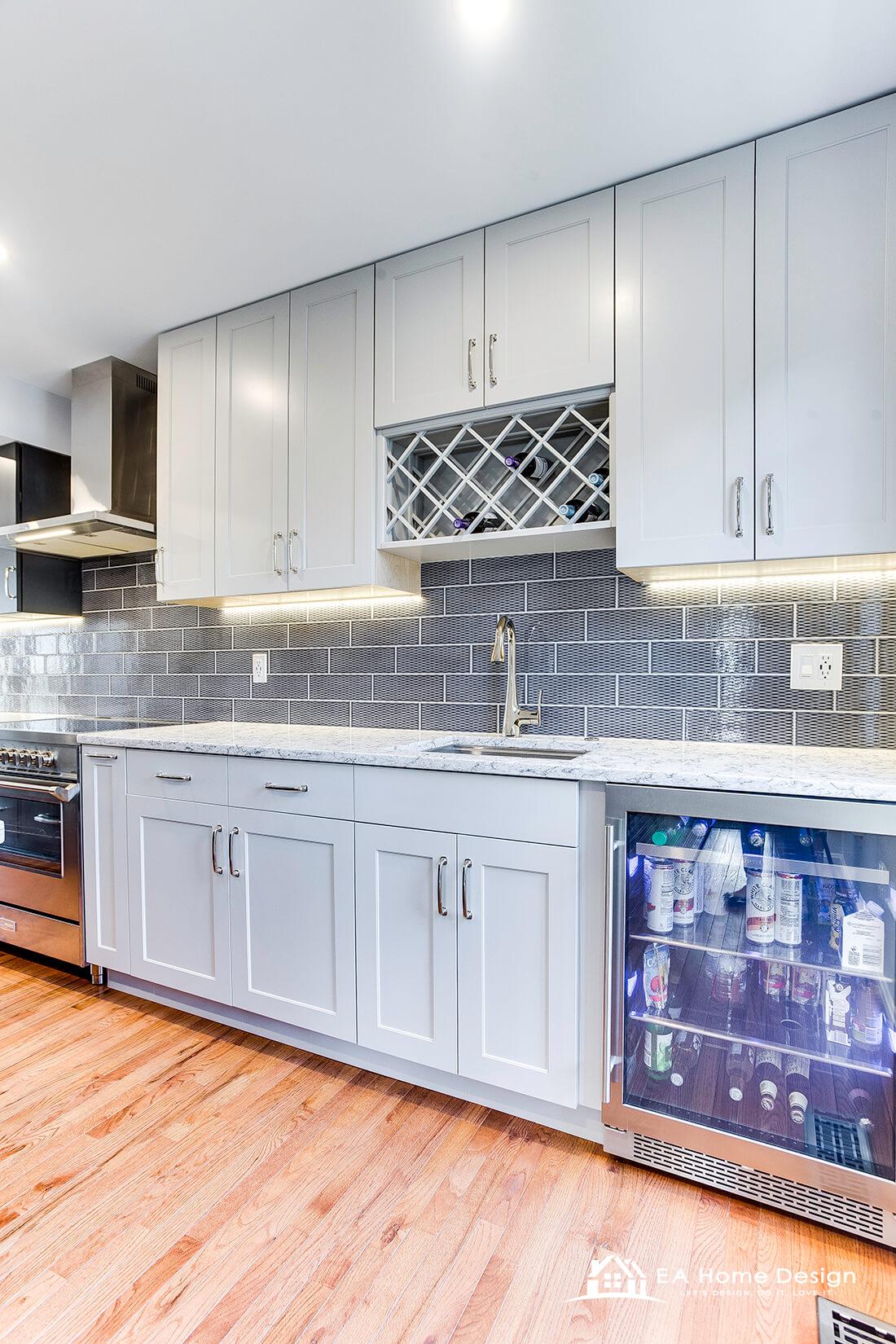
12. Switch to a counter depth refrigerator, or move it to the end of the run. A standard 36 inch deep refrigerator sticks 6 inches past the counter and is the number one walkway blocker in a galley. Counter depth models or a built in at the end of the run solve it.
13. Use a single bowl sink and an 18 inch dishwasher if width is tight. Both free up 6 to 12 inches of base cabinet for drawers without hurting function for most households.
14. Put open shelving only where uppers would crowd the window. Two or three open shelves flanking the sink window keep the wall light and give the eye a rest. Open shelving across the whole galley looks cluttered within a month.
Ideas for Finish and Style
15. Choose a two tone scheme: light uppers, darker base or island. White or light grey uppers keep the room bright while a navy, charcoal, or walnut lower run grounds it. The Reston project above uses a navy island against white shaker cabinets. The full playbook for that look, door styles, colors and costs, is in our transitional kitchen design guide.
16. Use a light, low pattern countertop. Quartz in a soft marble look or a solid light color runs the length of a galley as one calm line. Busy granite chops the room up. Quartz runs $70 to $120 per square foot installed in Northern Virginia; see our countertop guide for the full comparison.
17. Run the backsplash to the ceiling on the range wall. Full height tile behind the hood gives the galley a focal point at the end of the sight line instead of a strip of tile at eye level.
18. Pick integrated or panel ready appliances. A paneled dishwasher and refrigerator make the long cabinet run read as furniture, which matters more in a galley than any other layout because you see the whole run at once.
19. Use large format floor tile or wide plank wood laid lengthwise. Planks running the long direction of the galley stretch the room. Small tiles with many grout lines shrink it.
20. Keep hardware and fixtures in one finish. A galley has a lot of pulls in a small area. One finish (brushed nickel, matte black, or brass) keeps the run quiet. Mixing finishes here reads as indecision rather than style.
Opening Up a Galley Kitchen: Wall Removal, Beams and What It Costs
Most galley kitchen remodels in Northern Virginia end up opening a wall, because the dining room behind the kitchen is the space the galley needs and the wall between them is rarely doing anything a beam cannot do better. There are three ways to open it, and the right one depends on what the wall carries and what is inside it.
| How far it opens | What it involves | 2026 cost, Northern Virginia | What you get |
|---|---|---|---|
| A pass-through or a window in the wall | A framed opening of 4 to 6 feet with a header; the wall stays as a wall below counter height | $2,500 to $6,000 | Light and sight lines; the galley keeps both runs and gains a serving counter |
| A half wall with a peninsula | The wall cut to 36 or 42 inches, a header above if it is bearing, the second run turned into a peninsula with seating on the far side | $6,000 to $15,000 for the opening and the structure; the peninsula cabinetry on top | The layout most closed galleys should have; the cook’s aisle stays private |
| Full removal, non-bearing wall | Demolition, rerouting whatever runs inside it, patching the floor and ceiling where the wall stood | $3,000 to $8,000 | An open galley: two runs facing a dining space, or one run and an island |
| Full removal, load-bearing wall | An engineer’s letter and calculations ($500 to $1,500), a building permit, temporary shoring, an LVL or steel beam with posts to the foundation, dropped or flush | $8,000 to $20,000 for a typical 8 to 12 foot galley opening, a flush beam in the upper half; longer spans and two-story loads run $15,000 to $40,000, as the open concept guide details | The same open galley with nothing overhead; the flush beam is what makes the two rooms read as one |
How to tell if the wall is bearing. A wall that runs perpendicular to the floor joists above it, a wall that sits mid-house parallel to the ridge, and a wall that stacks over a wall or a beam in the basement are the usual carriers. A wall running parallel to the joists with nothing stacked above it usually is not. In a center-hall colonial the kitchen wall to the dining room is often bearing; in a split level it often is not; in a townhouse the party walls carry the load and the interior walls rarely do. The visit that answers it costs less than a redesign after the deposit.
What is inside the wall. The wall between a kitchen and a dining room commonly carries a return-air duct, the plumbing vent from the kitchen sink, two or three electrical circuits and, in older houses, the range circuit. All of it has to move before the wall comes down, and the rerouting is usually more of the cost than the beam. Our open concept kitchen remodeling guide covers the beam choices and the permit review in detail.
The open galley layouts that result. Below 11 feet 6 inches of total width, the second run becomes a peninsula: the cook’s aisle keeps its 42 to 48 inches and the seating faces the dining room. Above it, the second run becomes an island, 36 to 42 inches wide, with the sink or a cooktop in it and seating on the far side; the kitchen island guide has the sizing rules. In either case the cooking wall stays a galley, which is the whole point: the room gains light, seating and a view without giving up the tight triangle that makes a galley the fastest kitchen to cook in.
Modern Galley Kitchen Design: What Makes It Look Current
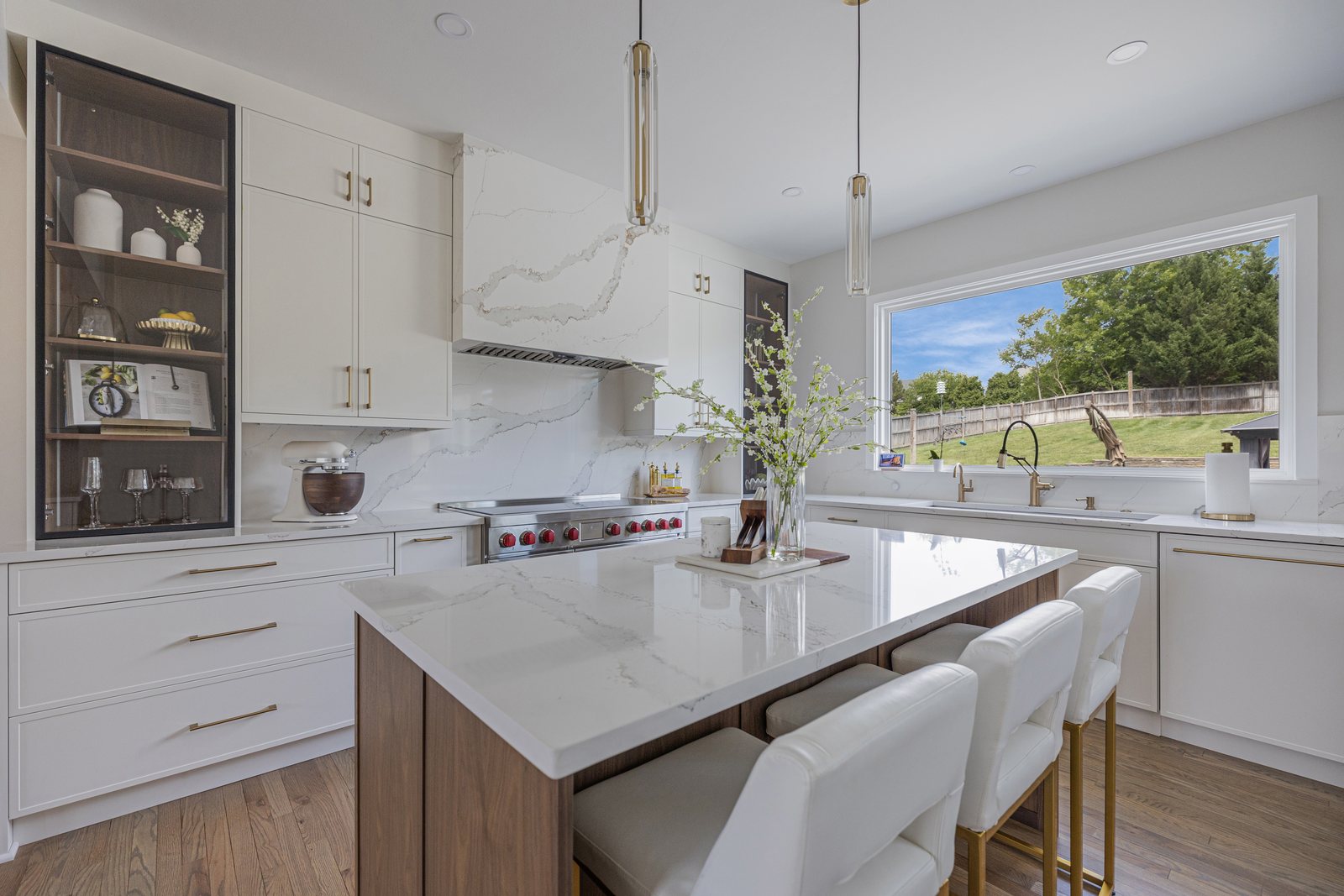
Homeowners searching for a modern galley kitchen usually mean three things: flat or simple shaker doors, handle free or slim hardware, and an uninterrupted counter line. To get that look in a galley, spend on the cabinet fronts and the counter, hide the appliances, and put the lighting in the architecture (recessed and under cabinet) rather than on display. A single statement element, such as a lit glass front upper cabinet, a pair of sculptural pendants over the peninsula, or a full height backsplash behind the range, is enough. In narrow rooms, restraint photographs better and lives better.
How Much Does a Galley Kitchen Remodel Cost in Northern Virginia?
Galley kitchens cost less to remodel than L shaped or U shaped kitchens of similar quality because there is less cabinetry, less counter, and the plumbing rarely moves. Here is what we see in Fairfax and Loudoun County in 2026.
| Scope | What it includes | Cost range |
|---|---|---|
| Refresh | Cabinet refacing or painting, new counters, backsplash, lighting, fixtures, same layout | $20,000 to $35,000 |
| Mid range full remodel | New semi custom cabinets, quartz, tile, appliances, lighting, flooring, same footprint | $35,000 to $75,000 |
| Open wall plus peninsula | Everything above plus structural opening, beam, electrical and drywall work | $60,000 to $95,000 |
| Luxury galley with island | Custom cabinetry, wall removal, island with seating, panel ready appliances, designer finishes | $90,000 to $150,000 and up |
Cabinets take 30 to 40 percent of the budget in any of these tiers, which is why cabinet refacing is worth considering if your boxes are sound; our guide to cabinet refacing vs replacing covers when it makes sense. For how these numbers compare with other layouts, see our Northern Virginia kitchen remodel cost guide, and for a small footprint benchmark, the 10×10 kitchen remodel cost breakdown.
How Long Does a Galley Kitchen Remodel Take?
A same footprint galley remodel takes 4 to 6 weeks of construction after cabinets arrive. Opening a wall adds 1 to 2 weeks for engineering, permit, framing, and drywall. Plan on 6 to 10 weeks of design and ordering before construction, since semi custom cabinets run 6 to 8 weeks lead time and custom runs 10 to 14. Because a galley has one walkway, you will lose the whole kitchen during construction rather than half of it, so set up a temporary kitchen elsewhere. Our kitchen remodel timeline guide walks through each phase.
Any wall removal, electrical circuit, or plumbing change requires a permit in Fairfax and Loudoun County. Cabinet, counter, and fixture swaps in place do not. Our Northern Virginia permit guide explains what triggers one.
Galley Kitchen Remodel Planning Checklist
- Measure wall to wall width and walkway width. This decides your layout path before anything else.
- Find out whether the adjacent wall is load bearing. A remodeler or engineer can tell you in one visit. It changes the budget by $3,000 to $8,000.
- Decide where the refrigerator goes. End of the run, counter depth, or built in. Solve this first and the rest of the layout follows.
- Keep the sink and range on the same side if possible. It keeps water and gas in one wall and lets the other side be pure storage or a peninsula.
- Plan lighting on the drawings, not after. Under cabinet, recessed, and pendants need wiring before drywall.
- Choose cabinet height to the ceiling. Confirm ceiling height at several points; older homes are rarely level.
- Pick counter material with one continuous run in mind. Confirm slab length so you avoid a seam in the middle of the galley.
- Order appliances before cabinets are finalized. Cabinet openings are cut to the appliance spec sheets.
- Plan the temporary kitchen. A galley has no half measures during construction.
- Hold 10 to 15 percent contingency. Opening walls in 1960s and 1970s Northern Virginia homes regularly reveals wiring or plumbing that needs updating.

Mistakes to Avoid in a Galley Kitchen Remodel
The mistakes we correct most often in galley kitchens are specific to the layout. Placing the dishwasher directly across from the oven means both doors cannot open at once. Putting the refrigerator in the middle of a run breaks the counter and blocks the aisle. Choosing a dark floor and dark lowers in a room with one window makes the galley feel like a corridor. Installing a too small range hood because of the narrow wall leaves the whole kitchen smelling like dinner; a galley concentrates cooking fumes and needs at least 400 CFM of ventilation. And skipping the structural check before designing around an open wall leads to a redesign after the deposit is paid. Our broader list of remodel planning mistakes applies too.
Frequently Asked Questions About Galley Kitchen Remodels
How do you remodel a galley kitchen step by step?
Measure the room and the walkway, find out whether the wall to the next room is load-bearing, choose the layout path the width allows, lay out the runs with the refrigerator at the end, make every selection before ordering, permit the electrical and any wall opening, order cabinets and set the demolition date for their arrival, set up a temporary kitchen, then build in order: demolition, framing and beam, rough-ins, inspection, drywall, cabinets, counters, backsplash, appliances and trim, final inspection. Four to six weeks of construction, plus one to two for an opened wall.
Can a galley kitchen have an island?
Yes, if the room is at least 11 feet 6 inches wide wall to wall, which allows a 36 inch island with 42 inch aisles on each side. Most closed galleys are 8 to 10 feet wide, which is why the common path is to open one wall and turn the second cabinet run into a peninsula or island that borrows space from the next room, as in the Reston project above.
How much does it cost to open up a galley kitchen?
In Northern Virginia in 2026, $2,500 to $6,000 for a pass-through, $6,000 to $15,000 for a half wall with a peninsula, $3,000 to $8,000 to remove a non-bearing wall and $8,000 to $20,000 to remove a load-bearing one across a typical galley span with an engineered beam, permit and shoring; longer spans and two-story loads run $15,000 to $40,000. Rerouting the ducts, vent and wiring inside the wall is usually more of the cost than the beam.
How do I know if my galley kitchen wall is load bearing?
A wall running perpendicular to the floor joists above, a wall sitting mid-house parallel to the ridge, or a wall stacked over a wall or beam below is usually bearing; a wall running parallel to the joists with nothing above it usually is not. In center-hall colonials the kitchen-to-dining wall is often bearing, in split levels often not, and in townhouses the interior walls rarely are. Have a remodeler or an engineer confirm it before designing around the opening.
How do you make a galley kitchen look bigger?
Light upper cabinets to the ceiling, under cabinet lighting, a continuous light counter, flooring that runs lengthwise and continues into the next room, a counter depth refrigerator at the end of the run, and, where possible, an opening in one wall. Mirrored or glass front uppers near the window also help. Avoid dark lowers with dark floors and avoid breaking the counter line with a protruding appliance.
What is the ideal width for a galley kitchen?
Ten to twelve feet wall to wall is ideal, which gives two 24 inch counter runs and a 48 to 72 inch walkway. The minimum comfortable walkway is 42 inches for one cook and 48 inches for two. Many older Northern Virginia galleys are 7 to 8 feet wide with a 36 inch aisle, which is where shallower cabinets on one side make a real difference.
Is it worth remodeling a galley kitchen or should I open it completely?
Remodel it, and open one wall if the structure allows. Fully open kitchens lose the galley’s efficiency and storage and cost far more. A galley with one wall opened to a peninsula or island gives you the light and seating of an open plan with the workflow of a galley.
What are the best colors for a galley kitchen?
White, soft white, light grey, and pale greige uppers with either matching lowers or a darker accent on the lowers or island (navy, charcoal, forest green, walnut). Keep the backsplash in the same light family or a mid tone like grey subway tile. Save saturated color for a single element at the end of the sight line, such as the range wall.
Can I remodel a galley kitchen on a budget?
Yes. A $20,000 to $35,000 refresh that keeps the layout and cabinet boxes, refaces or paints the doors, adds quartz counters, a new backsplash, under cabinet lighting, and a counter depth refrigerator delivers most of the visual change of a full remodel. Spend first on the counter line and lighting, since those are what you see down the length of a galley.
How do galley kitchens compare to other small kitchen layouts?
For pure cooking efficiency the galley wins; for socializing, an L shape with a small island does better if the room is square rather than long. If you are deciding between layouts for a compact room, our guide to small kitchen design layouts compares galley, L shaped, U shaped, and one wall options with dimensions.
See your own kitchen remodeled from a photo with our kitchen visualizer, then bring the result to a design consultation.
Planning a Galley Kitchen Remodel in Fairfax or Loudoun County?
Galley kitchens reward careful planning more than any other layout, because a few inches of walkway and one wall decide everything. EA Home Design has remodeled galley kitchens in Reston, Herndon, Vienna, Fairfax, Ashburn, and Leesburg, from same footprint refreshes to full wall removals with islands. Our design build process starts with measurements and a structural check so you know which layout path is open to you before you choose a single finish. See our kitchen remodeling services or contact us for a design consultation, and bring your measurements; we will tell you in the first meeting whether an island, a peninsula, or a better galley is the right answer for your home.
EA Home Design · Fairfax & Loudoun County
Ready to open up your own galley kitchen? We design and build kitchens across Northern Virginia, and you will see your layout in 3D before committing.
Book a Free In Home Design Consultation or call (703) 687-1818